

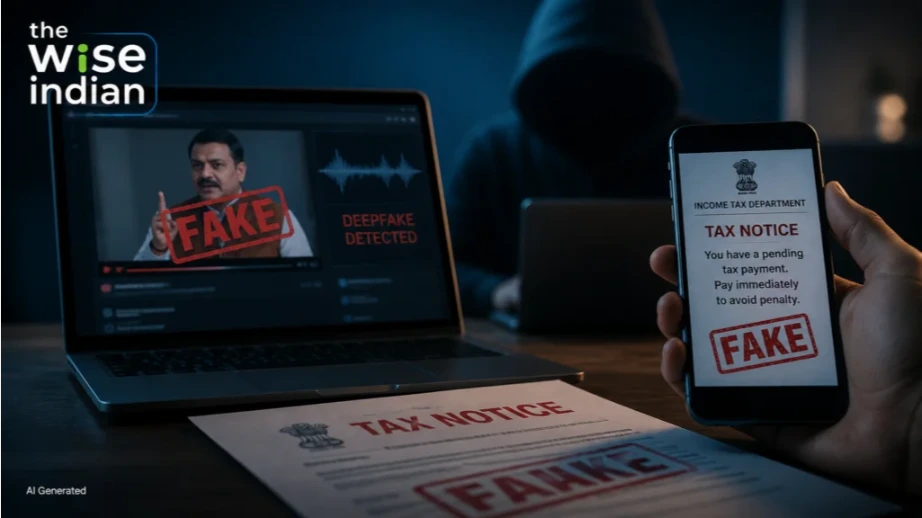
A run of government fact checks through July and August 2026 points to a clear pattern. Financial fraud online is now built on borrowed credibility.
The scam message has changed shape. It no longer arrives as a badly written email from a stranger. Increasingly, it arrives wearing the face of someone the recipient already trusts, whether that is a Union minister, a well-known philanthropist or the Income Tax Department itself.
Over recent weeks, the Press Information Bureau’s Fact Check Unit has publicly rejected a series of viral financial claims. Read together, they describe a single technique rather than four unrelated frauds.
An AI Video That Never Happened
The Fact Check Unit confirmed that a widely circulated video appearing to show Union Finance Minister Nirmala Sitharaman endorsing an investment scheme was fabricated using artificial intelligence. The clip claimed an investment of twenty-two thousand rupees could generate assured returns of seventy thousand rupees a day.
The unit stated the video does not represent any genuine communication from the minister or the Government of India, and cautioned citizens against schemes promoted through social media advertisements. The unit also urged citizens not to make investment decisions on the basis of viral videos, social media advertisements or celebrity endorsements that have not been independently verified.
A Scheme Attributed to People Who Never Backed It
Around the start of August 2026, the unit also addressed claims that an investment product was backed by Nirmala Sitharaman and Sudha Murty. It confirmed no such scheme exists or is endorsed by the government or by either individual.
Attaching respected names to a fictitious product is an old confidence trick. What is new is how convincingly it can now be packaged, and how fast it travels.
A Tax Notice That Was Really a Phishing Attempt
On 12 August 2026, the Fact Check Unit flagged a circulating notice claiming to be issued by the Income Tax Department and demanding a payment of six thousand rupees. It described the notice as fake and a phishing attempt.
Filing season is a predictable window for this kind of fraud, because taxpayers are already expecting official communication and are primed to act quickly on it.
How to Check Before You Click
The pattern across these cases is consistent. Urgency, an authority figure, and a payment or personal data request arriving through an unofficial channel. Any two of those together deserve suspicion. Financial regulators have repeatedly noted that assured, exceptionally high short-term returns are among the most reliable indicators of a fraudulent scheme rather than a genuine one.
Verify tax communication only through the Income Tax Department’s official portal, treat guaranteed high returns as a warning sign rather than an opportunity, and report suspicious content relating to central government departments to the PIB Fact Check Unit. A separate viral claim that Instagram would be banned in India from 25 August 2026 was also rejected as false, a reminder that panic itself is often the product being sold.
The Wise Take
There is a temptation to treat these scams as a technology story, and partly they are. But the technology only supplies the face. What supplies the loss is the assumption that seeing is confirming. That assumption served most of us reasonably well for a very long time, and it no longer does. The practical defence is unglamorous and effective. Slow down, go to the official source yourself rather than following the link provided, and accept that a genuine government communication will survive a delay of ten minutes. Scepticism here is not cynicism. It is simply the reading habit this particular moment asks of us.