
A draft notification issued on 27 July would declare 56,825 sq km across six states ecologically sensitive, reviving a proposal no state has yet accepted.
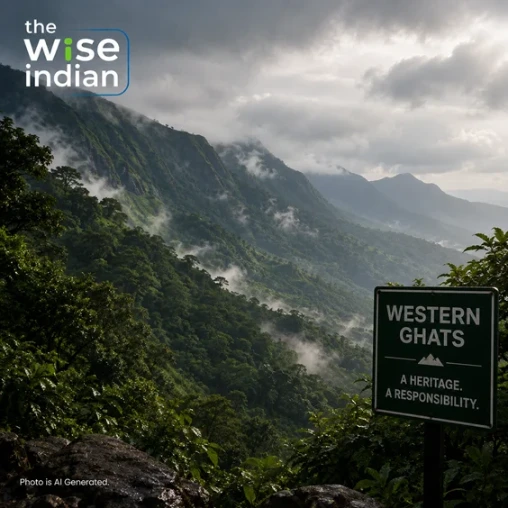
The Western Ghats run about 1,500 kilometres down India’s western edge, are older than the Himalayas, and hold species found nowhere else on earth. They are also a UNESCO World Heritage Site.
What they are not, after twelve years of attempts, is legally protected as an ecologically sensitive area.
What the Draft Proposes
On 27 July 2026, the Union Ministry of Environment, Forest and Climate Change reissued its draft notification proposing an Ecologically Sensitive Area, or ESA, across the range. It is the seventh such draft since 2014.
The proposal covers 56,825.7 sq km spread across Gujarat, Maharashtra, Goa, Karnataka, Kerala and Tamil Nadu, with Karnataka accounting for the largest share.
Within the ESA, mining, quarrying, sand mining, new thermal power plants, highly polluting industries and large construction projects would be prohibited. Activities such as hydropower development would be regulated rather than banned. Public objections have been invited over 60 days.
Why It Keeps Lapsing
The draft draws on the 2013 recommendations of the high-level working group chaired by K. Kasturirangan, which identified roughly 37 percent of the Western Ghats as requiring protection.
Each successive draft has lapsed without finalisation because the six states have not agreed to it. Their stated concerns centre on restrictions affecting agriculture and plantations, curbs on roads, housing and industry, and disputes over which villages should be included.
The extent has barely moved between versions. The earlier draft distributed the area as roughly 20,668 sq km in Karnataka, 17,340 in Maharashtra, 9,993 in Kerala, 6,914 in Tamil Nadu, 1,461 in Goa and 449 in Gujarat, and the current draft is reported to retain the same state-wise breakup and regulatory provisions.
The Argument on the Other Side
Ecologists and disaster researchers have linked repeated landslides in the Ghats, including in Wayanad, to deforestation, unplanned construction and changing rainfall patterns.
Their position is that the absence of a final notification has allowed environmentally hazardous activity to continue in fragile terrain. Each disaster has revived the debate without resolving it.
The Wise Take
Seven drafts in twelve years is not a story about missing science. The extent, the state-wise breakup and the list of restricted activities have barely changed across versions, which suggests the technical work was largely settled long ago. What has not been settled is the harder question of who absorbs the cost of protection, since the restrictions fall on districts where farming, quarrying and construction are what people live on. A conservation rule that six states will not sign is not enforcement, whatever it says on paper. Until the notification is paired with a credible answer on livelihoods, the eighth draft is a reasonable thing to expect.