
Skyroot Aerospace’s Vikram-1 completed its maiden orbital flight on 18 July, six years after India opened its space sector to private companies.
For most of India’s space history, the question of who could build a rocket had one answer. On 18 July 2026, it acquired a second.
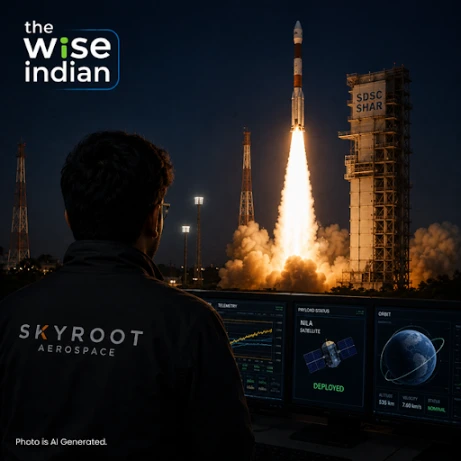
Skyroot Aerospace’s Vikram-1 lifted off and placed its payload in orbit, becoming the first launch vehicle built by an Indian private company to reach orbit successfully.
The Vehicle and the Flight
Vikram-1 stands roughly as tall as a seven-storey building and is designed to carry payloads weighing up to 350 kilograms.
The flight was designated as the vehicle’s first test flight, and the company confirmed that the mission had been completed. For a maiden orbital attempt, which fails more often than it succeeds anywhere in the world, reaching orbit on the first try is uncommon.
What Changed in 2020
ISRO Chairman V. Narayanan, speaking after the launch, linked the milestone to the space sector reforms introduced in 2020, which allowed private companies to undertake activities previously reserved for the national agency.
He noted that when the policy was first put into practice there was a single start-up in the field. India’s space economy is now valued at around 8.4 billion dollars and is home to more than 400 space start-ups.
Narayanan also drew attention to the Skyroot team’s average age, which he put at 28.
Where the Sector Goes Next
ISRO has said it is targeting at least seven launches during the current financial year, with two satellites already built and others in final integration.
Former ISRO chairman K. Sivan described the launch as the result of seeds sown when the sector was opened, and observed that a rocket is among the most demanding technologies in any space system.
The commercial segment Vikram-1 is built for is small satellite launch, where operators want specific orbits on specific dates rather than a slot on a larger shared mission. Demand there depends on frequency and price rather than on any single record.
The Wise Take
A single successful launch does not make a launch industry. What it does is remove an argument, because the question of whether an Indian private company could build an orbital rocket has now been settled by demonstration rather than projection. The harder test is repetition. Commercial viability in small satellite launch depends on flying often, at predictable cost, for customers who can plan around a manifest. That will take years and will involve failures, which are ordinary in this business and should be read as such. What is worth noticing today is that a policy decision made in 2020 has produced a physical result, and that the people who built it are largely in their twenties.