
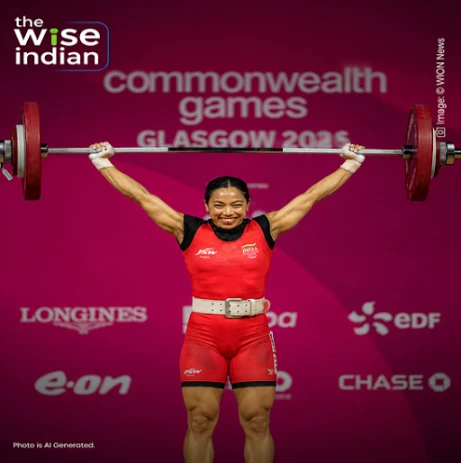
She won silver at Glasgow in 2014. She returned to the same city in 2026 and lifted a Games record.
Mirabai Chanu’s first Commonwealth Games medal was a silver, won in Glasgow in 2014. Her fourth was a gold, won in Glasgow twelve years later.
At 31, she lifted a Games record total of 190kg in the women’s 48kg category to take India’s first gold of these Games.
Records in Every Component
The 190kg total broke the Games record, and so did each half of it: 85kg in the snatch and 105kg in the clean and jerk.
Her snatch also set a new Commonwealth record, meaning the mark now stands across the Commonwealth rather than only at these Games.
A snatch and a clean and jerk are scored together, so a record total means the lifter was consistent across two very different movements on the same day rather than strong in one.
Three Titles, Four Games
The win made Chanu a three-time Commonwealth Games champion, adding to her golds at Gold Coast in 2018 and Birmingham in 2022, after that first silver on debut in 2014.
She is better known internationally for her silver at the Tokyo Olympics. Her qualification for Glasgow came through gold at the 2025 Commonwealth Weightlifting Championships in Ahmedabad, where she lifted 193kg and set championship records in the snatch, the clean and jerk and the total.
Chanu is from Manipur and has competed internationally for more than a decade, through a stretch in which her weight category was reshaped on the Olympic programme and Indian lifters had to rebuild careers around new classes.
The Squad Around Her
Chanu’s gold was one of eight Indian weightlifting medals at these Games, from a squad of eleven that included six women.
Gyaneshwari Yadav took silver in the women’s 53kg, Harjinder Kaur silver in the 69kg, and Bindyarani Devi bronze in the 58kg. Three of India’s four women’s medals in the discipline came from lifters competing in their first or second Commonwealth Games.
The Wise Take
Twelve years is a long time to remain at the top of a weight category, and in a sport where a career often ends at 27 it is close to remarkable. What makes Chanu’s longevity useful rather than merely admirable is the squad that travelled with her: six women in an eleven-member contingent, most of them lifters who entered the sport during the years she was winning. India’s women’s weightlifting programme did not exist at this depth in 2014. Her medals are the visible part of it, and the less visible part is that she is no longer the only one expected to deliver.