

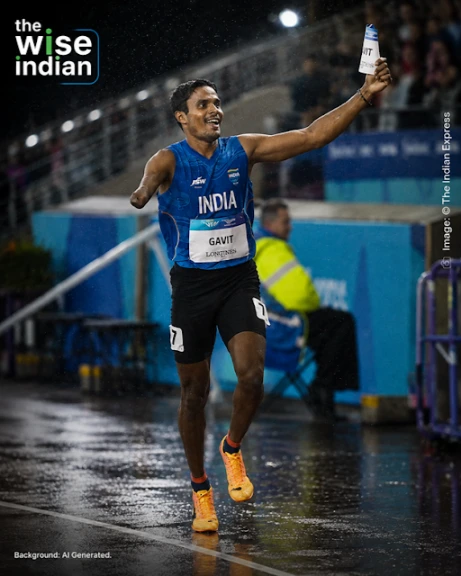
He is a 400m runner whose event was not on the programme. Two months later he won the sprint, with a Games record, in his first serious race over the distance.
At the 60-metre mark of the men’s 100m T47 final in Glasgow, Dilip Gavit was nowhere near the medals. He had 40 metres left and no history at the distance to draw on.
He crossed the line first in 10.71 seconds, a Games record and a season’s best.
The Event He Was Not Meant to Run
Two months before the Games, Gavit was not certain he would compete in Glasgow at all. He is a 400m T47 specialist and a Paris Paralympic finalist over that distance, but the 400m T47 was not on the Commonwealth Games programme.
At the insistence of a Paralympic Committee of India official, he switched his focus to the 100m, an event he had previously run mainly as training. He qualified comfortably and travelled intending to add a Commonwealth medal to the Asian Para Games gold he already held.
What the Result Means
Gavit became the first Indian para track athlete to win a Commonwealth Games gold medal. The race was run on a rain-soaked track.
India took the top two places. Mohammed Basil, the national 100m T47 champion, won silver on his international debut. Basil is from Veliyancode in Kerala’s Malappuram district, lost his arm at birth, and like Gavit competed in open competitions before being introduced to para sport only last year.
The Route Here
Gavit, 22, is from Toran Dongari, a tribal hamlet near Nashik in Maharashtra. He lost his right arm below the elbow as a young child after a fall from a tree became septic. He trains under national coach Vaijnath Kale, who became his legal guardian, and is supported by the sports NGO Olympic Gold Quest.
His 400m T47 gold at the 2022 Asian Para Games was India’s 100th medal at that competition. At the Paris Paralympics in 2024 he reached the final and finished eighth.
The Wise Take
The detail that ought to travel further than the medal is that this was a quarter-miler’s first serious 100 metres, and he set a Games record in it. That is partly raw ability and partly a system functioning correctly for once, an official noticing that an athlete’s event was missing and redirecting him in time. India has plenty of athletes whose events do not appear on a given programme, and no reliable mechanism for redeploying them. Glasgow is one case where somebody made that call, eight weeks out, and it produced a first.