
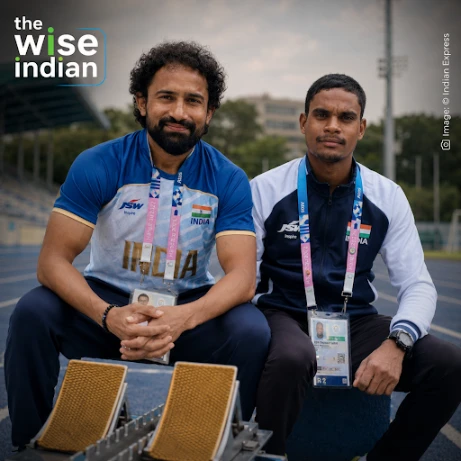
Vaijnath Kale took in a boy from a Nashik tribal hamlet who had lost an arm. Twenty years later that boy is a Commonwealth Games champion.
Dilip Mahadu Gavit was about five when he fell from a tree in Toran Dongari, a tribal hamlet in the Surgana area of Maharashtra’s Nashik district. His parents, from a farming family, took him to a local ayurveda practitioner who bandaged the arm.
An infection set in and turned septic. By the time the family reached professional care, the arm had to be amputated below the elbow.
A Coach Who Became a Guardian
Dilip went to school at the Shahid Bhagat Singh School in Surgana taluka and trained on the dusty roads of his village. He was spotted by Vaijnath Kale, a national coach.
What began as giving an interested boy a fair chance did not stay there. Kale legally adopted Dilip. Dilip has described living with him as being one of his own children, and has said that his coach looks after his health and his education, and that he is where he is because of him.
Building Around the Athlete
Sprint events require a crouch start, which is designed for two arms. Rather than treating that as a limit, Kale had a starting stand made within the rule book so that Dilip could take the start comfortably.
Kale also entered him in open competitions against able-bodied athletes. His reasoning, stated years ago, was that competing there would make Dilip mentally strong enough to perform when it mattered in para events. As a teenager Dilip ran 49.89 seconds in a 400m heat at a national open championship in the under-20 category, against able-bodied runners.
Twenty Years Later
Dilip won 400m T47 gold at the 2022 Asian Para Games, which happened to be India’s 100th medal at those Games, and reached the 400m final at the Paris Paralympics in 2024, where he finished last. On 30 July 2026 in Glasgow he won the 100m T47 title at the Commonwealth Games, and dedicated the medal to his coach on Guru Purnima.
The Wise Take
Much of Indian sport runs on small-town coaches who are not paid to do most of what they actually do. Kale’s contribution to Dilip’s career was not primarily technical. It was a legal guardianship, a school fee, a piece of equipment built to a rule book, and a decision to enter a one-armed teenager against able-bodied sprinters because losing there would be useful later. None of that appears in a results sheet. It is worth noticing that the amputation itself was avoidable, and came from a family with no access to competent care in time. Both halves of the story are ordinary in rural India.