

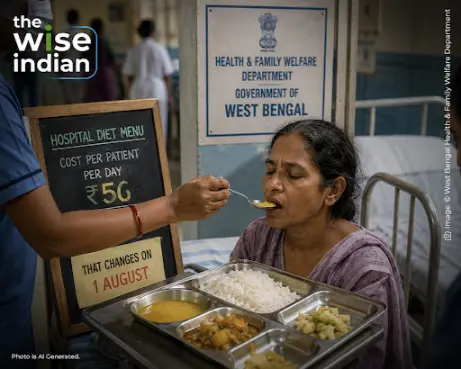
For Nine Years, West Bengal Fed Hospital Patients on 56 Rupees a Day. That Changes on 1 August
The daily diet allocation for patients in government health centres nearly doubles to 110 rupees, after a committee formed on a Calcutta High Court order reviewed the rate.
The daily food allocation for a patient admitted to a West Bengal government health centre has been 56.64 rupees. From 1 August 2026 it becomes 110 rupees.
The revised rate applies to indoor patients receiving the standard full rice diet across government health facilities in the state.
A Rate Last Set in 2017
The previous figure had stood since 2017. Over those nine years the cost of rice, pulses, vegetables, milk and cooking fuel moved considerably, while the amount available to feed a patient did not.
According to a notification from the Health and Family Welfare Department, the increase follows a review by a committee constituted in compliance with a Calcutta High Court order, which reassessed meal costs against current market prices.
Nearly doubling the figure brings it closer to what a balanced meal costs at current prices, though it still amounts to a little over 36 rupees per meal across three meals a day.
School Meals Revised at the Same Time
The same announcement raised the daily cooking cost under the PM POSHAN scheme for pre-primary and primary school students from 6.78 rupees to 10 rupees per child.
The state government will bear the additional expenditure in both cases.
Chief Minister Suvendu Adhikari described the decision as a landmark and people-centric step and said patients would receive improved, balanced meals from August.
Why Hospital Food Is a Clinical Question
Nutrition in hospital is not incidental to treatment. Adequate protein and calorie intake affects wound healing, recovery from surgery and length of stay, and undernutrition among admitted patients is a documented problem in Indian public hospitals.
For patients from low-income households, the hospital meal is often the only food available during admission, since families frequently cannot afford to bring supplements from outside.
Recovery diets also differ by condition. A patient after surgery, a patient with tuberculosis and a patient with kidney disease need materially different meals, and a single flat rate has to accommodate all of them.
The Wise Take
Diet budgets are among the least visible line items in a health system, which is exactly why they go unrevised for nine years. The rate now roughly matches food inflation over that period rather than exceeding it, so this is a correction more than an expansion. What determines whether patients notice is procurement and kitchen practice at individual facilities, and that will only be visible through inspection records rather than announcements. A rate revision creates the possibility of a better meal. It does not by itself serve one.