
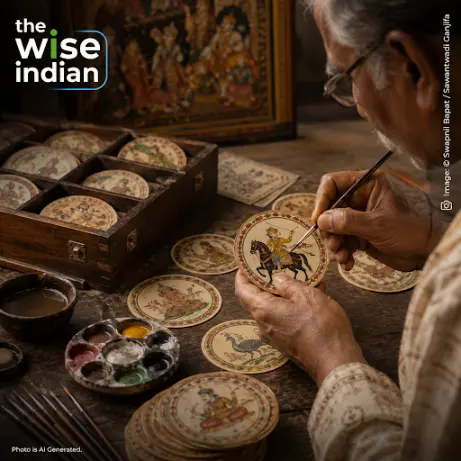
Ganjifa flourished in Mughal courts and nearly disappeared by Independence. In Sawantwadi, a royal family learned to paint it themselves.
The word comes from the Persian ganj, meaning treasure. Ganjifa arrived in India from Persia and became a fixture of Mughal court life, played with circular cards painted by hand.
The classic Mughal deck ran to 96 cards across eight suits. Sets made for the wealthy used ivory, tortoiseshell and sandalwood, inlaid with gold, silver and precious stones.
How a Court Game Became a Village One
Over time the game moved outward from the court and took on local form. The Dashavatara Ganjifa reorganised the deck into ten suits drawn from Hindu mythology, built around the ten avatars of Vishnu.
Distinct regional styles developed under different patrons, notably in Sawantwadi in Maharashtra, in Odisha where the form is known as Ganjapa, and in Mysore.
How the Craft Nearly Ended
Mass-produced European playing cards reached Indian markets through the twentieth century at prices no hand-painted deck could match. Royal patronage, which had sustained the artisans, receded at the same time.
Workshops closed one after another. By Independence, most Ganjifa families had moved to steadier work, and the craft survived in only a handful of places.
A Royal Family Learns to Paint
In Sawantwadi, in Maharashtra’s Sindhudurg district, Lt Col Raja Bahadur Shivaram Sawant Bhonsle and Rani Satvashiladevi decided the only reliable way to preserve the craft was to learn it. They trained under Pundalik Chitari, a master artisan then in his eighties, and set up Sawantwadi Lacquerwares in 1971.
The cards are now made from handmade paper coated with tamarind paste, mud and gum arabic, then layered, painted in watercolour, finished with gold leaf and varnished. Sawantwadi Ganjifa carries a Geographical Indication tag, and during National Postal Week 2025 the artisans worked with India Post to release the country’s first circular postcards.
The painting follows conventions of its own. Kings are set against white, court women against red, soldiers against gold and landscapes against green, while the reverse of every card is kept dark.
The Wise Take
Most craft revivals fail at the same point, which is demand. Training artisans is achievable; finding people willing to pay for slow handwork in a market full of cheap substitutes is not. The Sawantwadi response has been to keep changing the object rather than the technique, moving the same brushwork onto postcards, boxes and decorative pieces. It is an uncomfortable answer for anyone who wants heritage preserved unchanged. It is also, on the evidence of the last fifty years, the version that keeps the artisans working.