
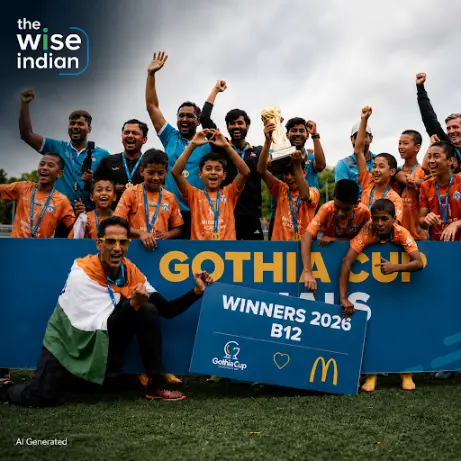
The Chandigarh academy won all eight matches in Gothenburg, days after lifting the Helsinki Cup in Finland.
In the 49th minute of the Gothia Cup Under-12 final in Gothenburg, a Minerva Academy move ended with Nongrem putting the ball past Brazil’s RS Sports Yellow. It proved to be the winning goal in a 2-1 result.
The Chandigarh-based academy had taken the lead in the tenth minute through T Kipgen before Brazil equalised before the interval.
Eight Matches, Eighty-Six Goals
Minerva won every one of its eight matches at the tournament, scoring 86 goals and conceding seven.
Along the way the side beat an English team 12-0, one of the largest margins recorded at the tournament, and defeated opponents from France and Bolivia. The semi-final against Ukraine’s FC Lokomotyv Kyiv finished 3-2.
The Gothia Cup is among the largest youth football tournaments in the world, drawing hundreds of clubs to Gothenburg each July. Facing a different style of opponent in each round is part of what the competition tests.
A Second European Trophy in a Week
The Gothia Cup title came days after Minerva won the Helsinki Cup in Finland, completing an unbeaten run across two European youth tournaments.
It is the second consecutive year the academy has taken the Gothia Cup Under-12 title. Both competitions draw youth sides from traditional footballing nations, which makes back-to-back wins unusual for an Indian academy.
What Youth Results Do and Do Not Prove
Minerva Academy was founded in 2015 by Ranjit Bajaj, who has argued that India’s route to a FIFA World Cup runs through children rather than short-term fixes at senior level. The academy also guided Minerva Punjab FC to the 2017-18 I-League title.
Youth success does not automatically convert into senior international performance. What it does provide is competitive exposure that domestic age-group football alone cannot replicate, against opponents raised in stronger footballing systems.
The harder problem sits after the trophy. India’s football structure has repeatedly lost promising age-group players at the transition into professional football, where clear pathways remain thin.
The Wise Take
Eighty-six goals in eight matches is an eye-catching number, and it is also the least interesting part of the story. What Gothenburg demonstrates is that a structured Indian academy can now travel to Europe and win against sides from countries where football infrastructure is decades