
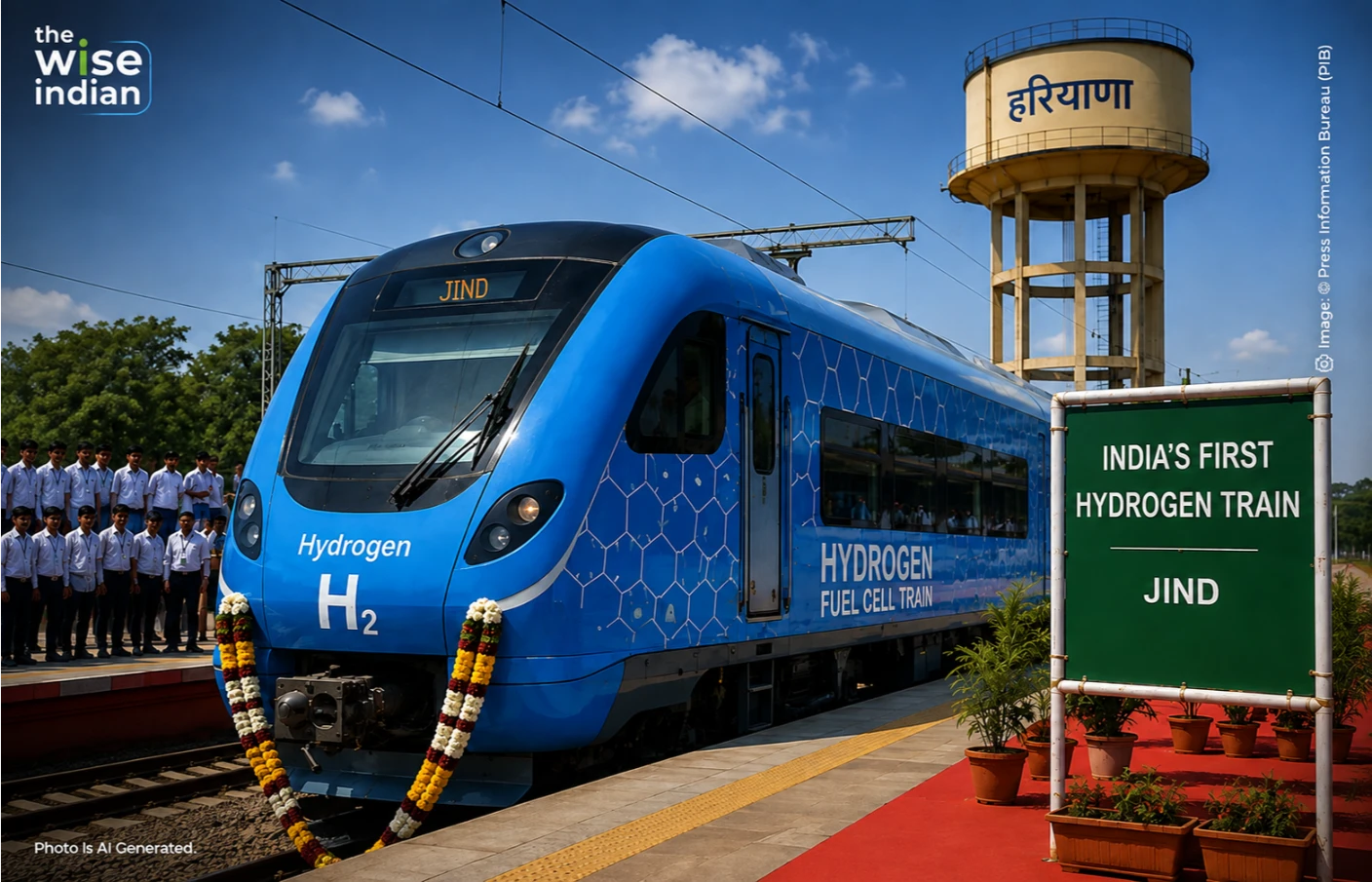
The ten-coach service between Jind and Sonipat emits only water vapour and heat. Whether hydrogen has a role in an almost fully electrified network is the open question.
India’s first hydrogen-powered train was flagged off on 17 July 2026 and now runs on the Jind to Sonipat route in Haryana, a corridor of roughly 90 kilometres, making two return trips a day.
The train has been named NaMo Green Rail. It emits only heat and water vapour in operation.
What Was Flagged Off
The set has ten coaches, two hydrogen-fuelled power cars at either end and eight passenger cars, with a capacity of about 2,600 passengers and a maximum speed of 75 kmph.
It was designed, engineered and integrated in India, with the coaches built at the Integral Coach Factory in Chennai. Its engine is rated at 1,200 horsepower, higher than the 500 to 800 horsepower typical of hydrogen trains elsewhere.
A hydrogen plant at Jind produces the fuel through electrolysis and has a storage capacity of 3,000 kg.
Where It Fits in an Electrified Network
India has already electrified almost all of its roughly 70,000 kilometre rail network, one of the largest in the world. Hydrogen is therefore unlikely to displace direct electric traction across the system.
Its likely role is narrower: routes where overhead electrification is impractical, and where diesel is currently the only alternative. Indian Railways has set a net-zero target for 2030.
Germany launched the world’s first hydrogen fleet in 2022. Japan, China and the United States also operate hydrogen trains.
The train is not air-conditioned, and the route was chosen partly because it is short enough for a single refuelling cycle to be tested end to end.
The Cost Question
Business Standard has reported that 111.83 crore rupees was sanctioned for the Jind-Sonipat pilot, covering conversion of a DEMU train along with hydrogen production, storage and refuelling infrastructure. That figure comes from secondary reporting and does not appear in the government’s July launch release.
The Ministry of Railways has separately allocated around 2,800 crore rupees towards 35 hydrogen fuel cell trains.
The Wise Take
A hydrogen train is not simply a cleaner engine. It requires electricity to make the hydrogen, infrastructure to store and deliver it, and fuel cells to convert it back into electricity on board, which is a longer chain than drawing current from a wire. That is why the interesting number here is not the speed or the seating capacity but the cost per kilometre once the pilot has run a full year. India is testing a technology it may need on a small share of its network, and finding that out early is a reasonable thing for a pilot to do.