
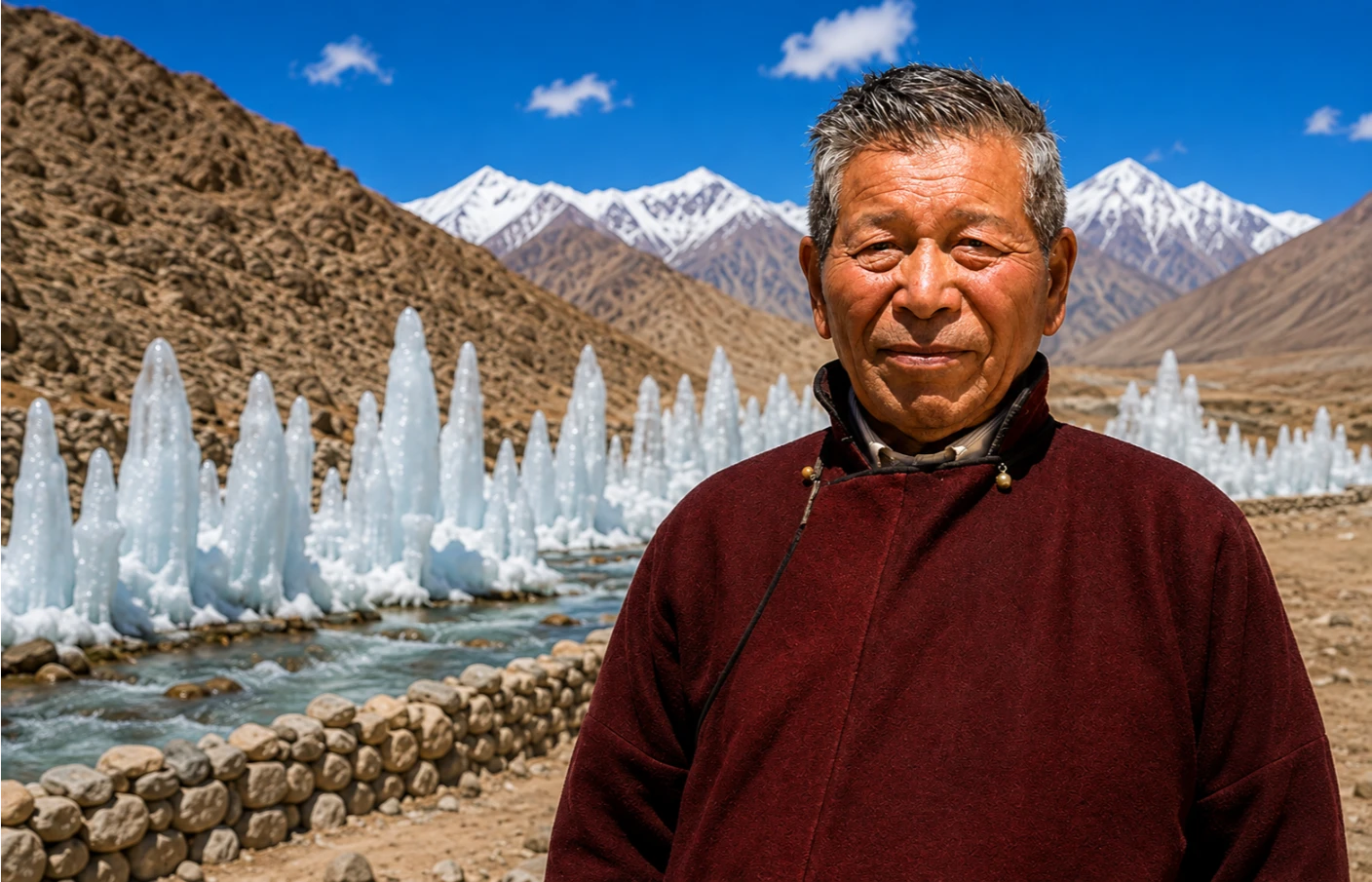
Chewang Norphel’s artificial glaciers exist to fill a two-month gap between when farmers need water and when the mountains supply it.
In Ladakh, sowing begins in April and May. The natural glaciers that supply almost all the region’s water usually begin melting around mid-June.
That gap is the problem Chewang Norphel spent his career on. Roughly 80 percent of Ladakh’s population depends on agriculture, and agriculture depends on meltwater arriving when the seed is already in the ground.
An Engineer Posted to a Water Problem
Norphel, from Leh, completed a diploma in civil engineering and joined the rural development department of Jammu and Kashmir in 1960. He worked in some of the region’s remotest subdivisions until his retirement in 1996.
Across those decades he built roads, bridges and irrigation systems. Nearly every problem he was sent to solve, he has said, turned out to be a water problem.
How an Artificial Glacier Works
The method is deliberately simple. A stream is diverted into a shaded side valley and slowed by a series of check walls until the shallow water freezes through the winter.
The critical design choice is altitude. Because these ice bodies sit lower than the natural glaciers, they melt earlier, releasing water into fields precisely during the sowing weeks when it is scarcest.
Norphel built the first at Phuktse Phu village in 1987 and has constructed around 15 since. The largest, at Phuktsey, measures roughly 1,000 feet by 150 feet at about four feet deep, serves a village of some 700 people, and cost in the region of 90,000 rupees.
After Retirement, More Glaciers
Retirement did not end the work. In 1996 he joined the Leh Nutrition Project as a project manager for watershed development, and it was from there that most of his glacier building followed.
He has spoken about how much has changed since his childhood, when heavy snowfall covered the ground for two or three months each winter and had to be swept off the roads daily.
The Wise Take
The cost figure is the detail worth sitting with. A structure serving an entire village for well under a lakh of rupees is not a story about frugality alone, but about designing for a specific local failure rather than importing a general solution. Norphel was reportedly dismissed as unrealistic when he first proposed freezing a stream on purpose. He received the Padma Shri in 2015, and the ice stupa designs now widely associated with Ladakh build on the same principle. Climate adaptation in the Himalaya will need engineering at that scale as much as at any other.