
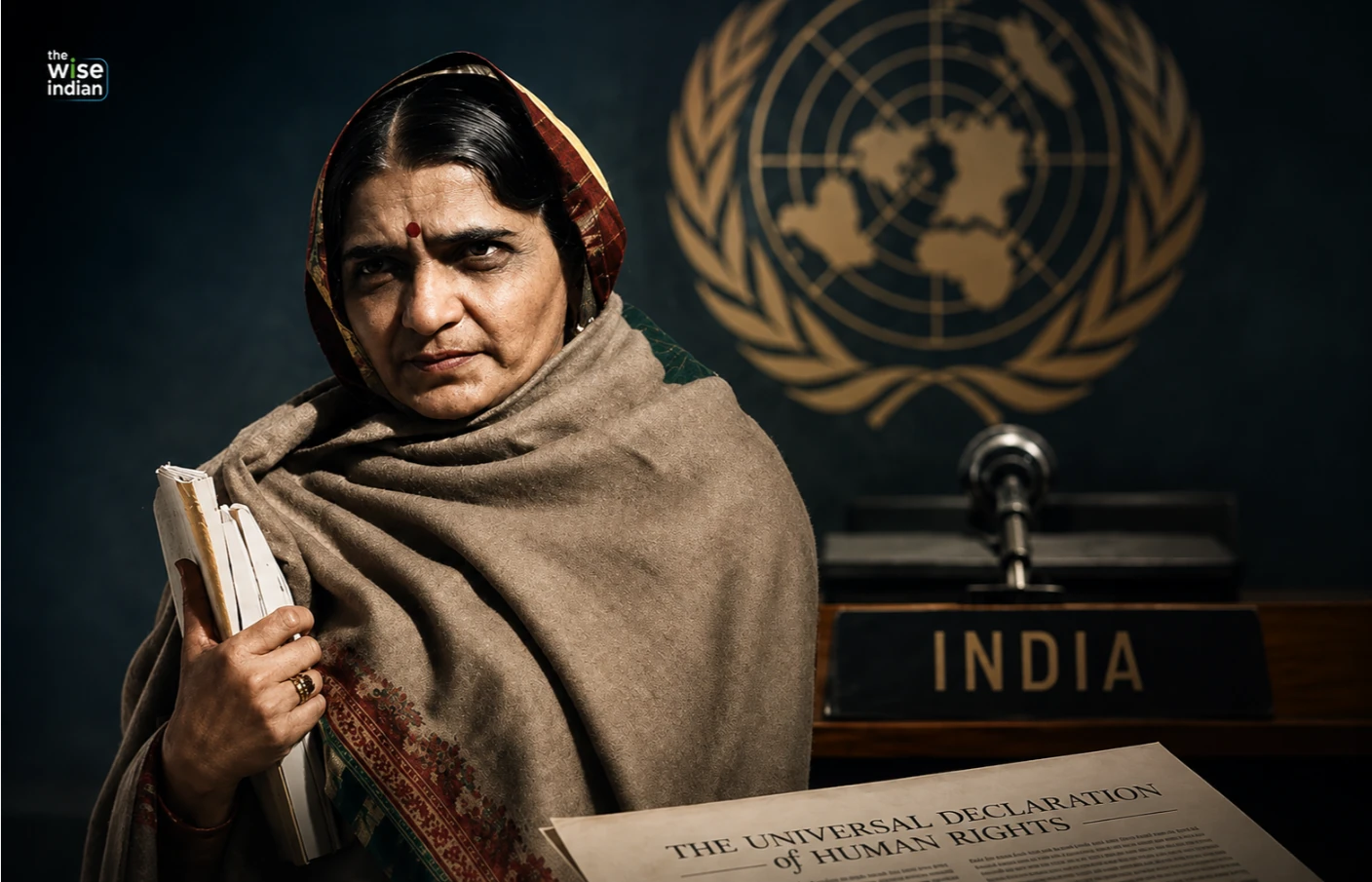
Hansa Mehta argued that ‘all men are born free and equal’ would not do. The final text reads ‘all human beings’.
The drafting committee of the Universal Declaration of Human Rights had a working text for Article 1 that began with the phrase all men are born free and equal.
Hansa Mehta, India’s delegate to the United Nations Commission on Human Rights, objected. The declaration adopted in Paris in December 1948 begins with the words all human beings.
Two Women in the Room
Mehta and Eleanor Roosevelt were the only two women delegates on the Commission during 1947 and 1948. Roosevelt chaired the drafting committee.
The two did not initially agree on this point. Roosevelt held that the word men was generally understood to include all human beings. Mehta maintained that the language had to be changed, and it was.
She also pressed for Article 16, on equal rights in marriage, which she regarded as a means of addressing child marriage and forced marriage. In 1950 she became vice-chairman of the Commission.
A Life Outside the Declaration
Mehta was born in 1897 in what is now Gujarat and studied philosophy, later training in journalism and sociology in England. She met Sarojini Naidu in 1918 and Mahatma Gandhi in 1922.
Where She Came From
She was the daughter of Manubhai Mehta, who served as Dewan of Baroda State, and the granddaughter of Nandshankar Mehta, author of the first novel written in Gujarati. She married Jivraj Narayan Mehta, a physician and administrator who became the first chief minister of Gujarat.
When provincial elections were introduced under the Government of India Act 1935, she contested a general seat in the Bombay legislative council rather than a seat reserved for women, and won.
She was among the women members of the Constituent Assembly that framed India’s Constitution, later served as vice-chancellor of the Maharaja Sayajirao University of Baroda, and received the Padma Bhushan in 1959. She died in 1995.
The Wise Take
Marking the declaration’s seventieth anniversary, the United Nations Secretary-General observed that without Mehta the world would be discussing the rights of man rather than human rights. The phrase is not merely symbolic. Article 1 is the sentence every subsequent human rights instrument builds upon, quoted in constitutions and judgments in more than 500 languages. That a delegate from a country then eighteen months into independence shaped its opening words is a piece of Indian history that sits outside the usual telling, and it turned on refusing to accept that a generic word covered everyone.