

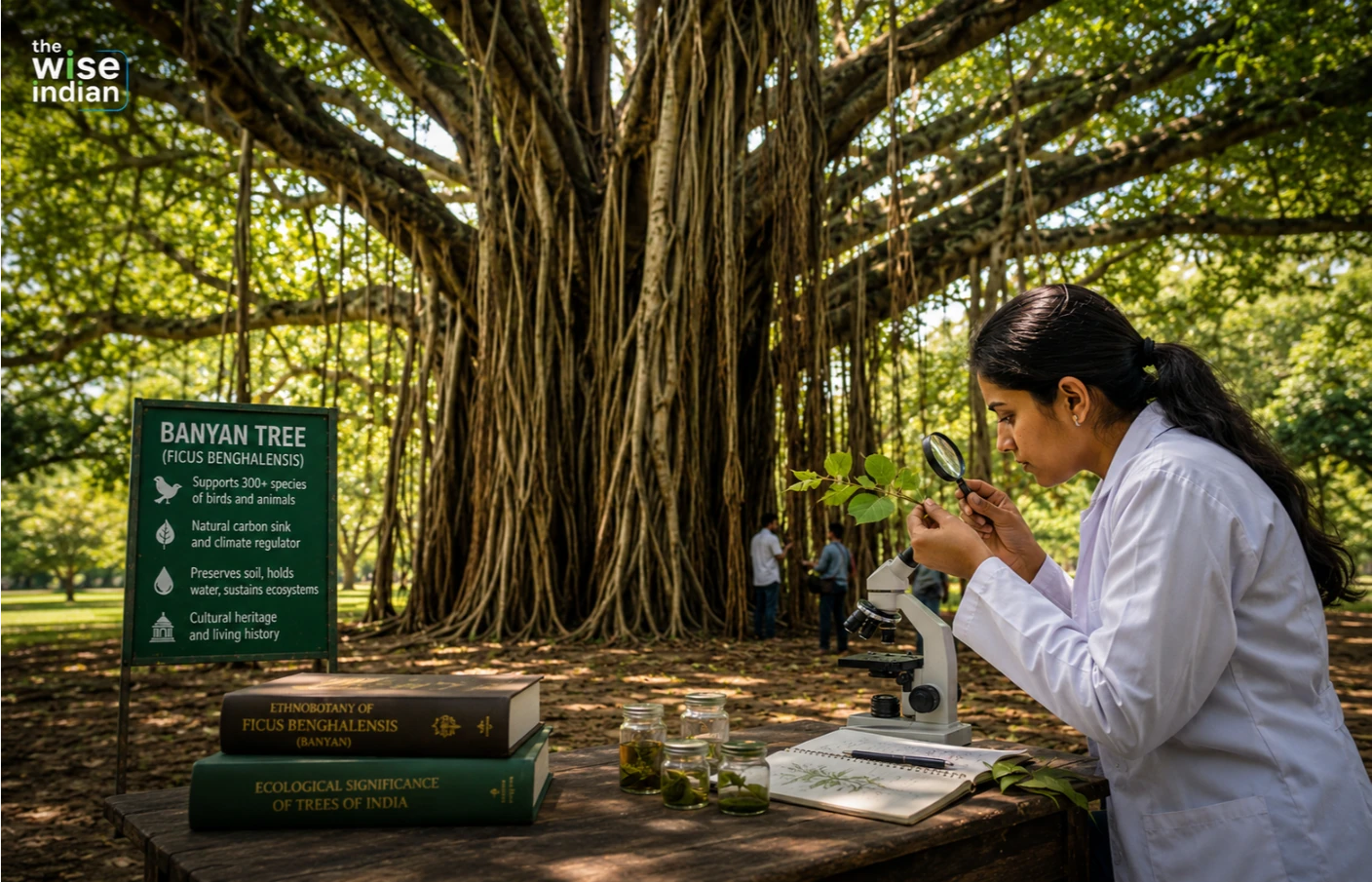
It is the national tree and a familiar one. Its ecological job is less familiar: feeding forest wildlife in the weeks when nothing else is fruiting.
Most Indians can identify a banyan. Fewer would describe it as load-bearing infrastructure for a forest, which is roughly how ecologists treat it.
Ficus benghalensis is India’s national tree, a fig that sends aerial roots down from its branches until they root and thicken into new trunks. A single old specimen can look like a small wood.
What a Keystone Species Means
A keystone species is one whose removal changes an ecosystem out of proportion to its numbers. Banyans qualify on a specific mechanism: timing.
Figs fruit irregularly through the year rather than in one synchronised season. That means a banyan is often carrying food during the lean weeks when the rest of the forest is not fruiting. Birds, bats, insects and small mammals that would otherwise go hungry are carried through that gap, and they in turn disperse seeds across the landscape.
This is why a handful of large banyans can matter more than their count suggests, and why a single mature tree in a fragmented landscape can act as a refuge, reconnecting interactions broken by roads, farmland and settlement.
What It Does Beyond Feeding Animals
The root system holds soil and limits erosion. The canopy creates a cooler microclimate beneath it, which in an Indian summer is a measurable difference rather than a poetic one. The tree also stores carbon in a large body of living tissue and holds it there for decades, sometimes centuries.
That last quality comes with a caveat worth stating. Banyans grow slowly, which makes them poorly suited to short-term tree-planting targets or offset arithmetic. Their value is durability, not speed.
How They Are Protected
Protection is patchy and mostly indirect. Notable trees are covered through habitat and sacred-grove provisions rather than being listed individually. Maharashtra’s heritage tree rules require geo-tagging and protection for trees over 50 years old. The Archaeological Survey of India protects banyans on or beside centrally protected monuments. Several famous specimens, including the Great Banyan near Kolkata and Thimmamma Marrimanu in Andhra Pradesh, are managed as heritage sites.
The Wise Take
India plants a great many trees and counts them carefully, which is why the banyan is an awkward case. It cannot be planted at scale on a deadline, it takes decades before it does the ecological work described here, and its contribution shows up as a bird population that did not crash rather than as a number in a report. The practical implication is unglamorous. Protecting the mature banyans that already exist, particularly the ones standing alone in farmland and along roads, is worth more than most new plantations, and costs almost nothing.