

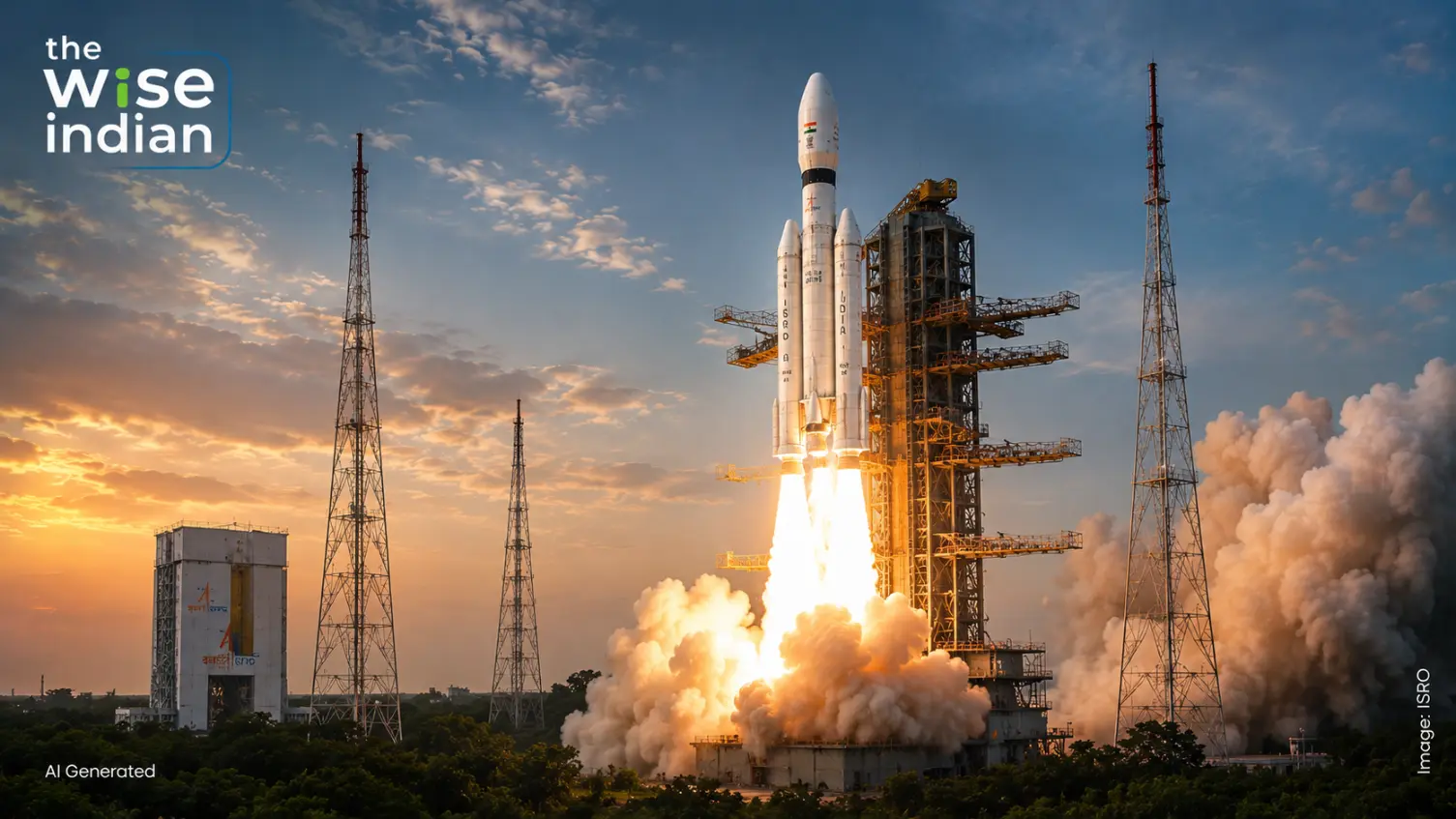
The agency has outlined its busiest calendar yet, while the government has told Parliament that the first crewed Gaganyaan flight is targeted for early 2027.
Space agencies are judged on the spectacular missions and sustained by the ordinary ones. India has proved it can do the first. The second is now the stated ambition.
ISRO Chairman V. Narayanan said in July that the agency is targeting at least seven launches during the current financial year, with the next mission expected within two months.
What Is on the Manifest
Two satellites are already fully built, with five to six others in the final phase of integration, according to the chairman.
The mix is deliberate. It includes earth observation satellites that monitor monsoons, coastlines and farmland, communication spacecraft, technology demonstrators and the first uncrewed mission under the Gaganyaan human spaceflight programme.
The financial year opened with PSLV-C62 carrying the Anvesha satellite from Sriharikota.
Earlier milestones in the human spaceflight programme include the TV-D1 flight, which tested the crew escape system designed to pull astronauts clear of a failing rocket.
Where Gaganyaan Stands
On 30 July, the government told Parliament that most critical technologies for Gaganyaan have been developed and tested. Union Minister of State for Space Jitendra Singh said development and ground testing of the human-rated launch vehicle are complete, as are the propulsion systems for the crew and service modules.
ISRO reported completing three major qualification tests for the crew module in July, covering systems including water recovery. The programme has been expanded to eight missions spanning uncrewed flights, crewed flights and work connected to the planned Bharatiya Antariksha Station.
The first crewed mission is currently targeted for the first quarter of 2027, subject to the completion of all required tests.
Why Cadence Matters More Than Any One Flight
A predictable launch calendar is what separates a national research programme from a working launch industry.
Satellite builders, commercial customers and downstream firms can only plan around a schedule they believe will hold, which makes regularity a commercial asset rather than a bureaucratic one.
The Wise Take
Seven launches in a year would be the busiest stretch in ISRO’s history, and slippage against that target is likely rather than shameful. A mission delayed because a test bay found a problem is a mission that did its job, and the alternative habit, of flying to meet a date, is how programmes lose vehicles. The useful measure over the next twelve months is not whether all seven fly, but whether the reasons for any that do not are stated plainly and early. India has already shown it can do the extraordinary thing occasionally. Doing the ordinary thing reliably, several times a year, is the harder and more valuable ambition