

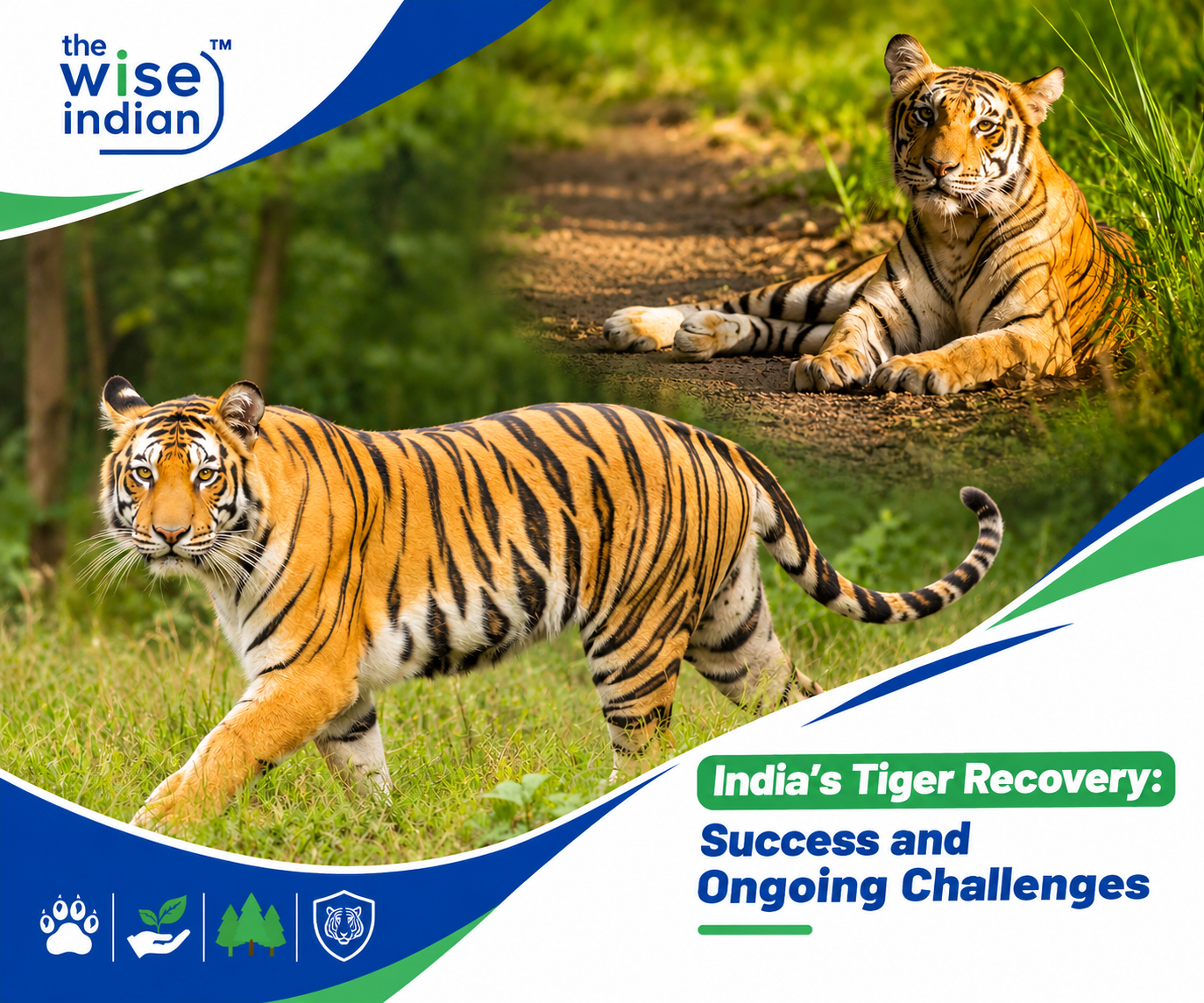
India has achieved a remarkable milestone in wildlife conservation. Its estimated wild tiger population increased from 1,411 in 2006 to 3,682 in 2022. This growth reflects decades of protection, scientific monitoring and habitat management. Moreover, India now supports approximately 70–75% of the world’s wild tiger population. However, these impressive numbers do not tell the complete story.
Several reserves still struggle to maintain healthy populations. Furthermore, many tigers live beyond protected forests, where development and human activities create additional risks. Wildlife biologist Ravi Chellam highlighted these concerns in his Down To Earth article published on 4 June 2026. His analysis raises an important question: can India protect its growing tiger population while safeguarding habitats and supporting forest communities?
India’s Remarkable Tiger Population Recovery
India’s tiger recovery represents one of the country’s major wildlife conservation achievements. Project Tiger began in 1973 to protect the country’s declining tiger population. Later, the National Tiger Conservation Authority (NTCA) strengthened the programme through monitoring and coordinated conservation efforts. The first modern nationwide tiger estimation in 2006 recorded 1,411 animals. Subsequent assessments showed steady growth. The population reached 1,706 in 2010, 2,226 in 2014 and 2,967 in 2018. The 2022 assessment estimated 3,682 tigers, with a statistical range of 3,167–3,925.
Importantly, researchers use camera traps, field surveys and statistical methods to estimate populations. The assessment also examines prey species and habitat conditions. Consequently, India has demonstrated that sustained protection can support wildlife recovery. This progress makes conservation a significant national achievement. Nevertheless, increasing numbers also bring greater responsibility to protect the landscapes that sustain these animals.
The Uneven Distribution of Tigers Across Reserves
A closer look at the 2022 assessment reveals a less encouraging picture. India had 53 notified tiger reserves during that assessment. However, tiger populations varied considerably between them. According to Ravi Chellam, 10 reserves had fewer than 10 tigers each. Five reserves had no tigers at all. A separate 2023 report by The Indian Express identified 18 reserves with fewer than 10 tigers. These figures come from different analyses and should not be treated as interchangeable.
Moreover, a 2024 Down To Earth analysis found that 22 reserves had fewer than 10 tigers or none. It also reported that nearly 40% of India’s reserve-based tiger population lived in just 11% of reserves. This concentration creates concerns about distribution and ecological balance. A strong national population cannot hide weaknesses in individual habitats. Therefore, conservation authorities must strengthen struggling reserves and examine the reasons behind their low populations.
Why Tigers Outside Protected Areas Matter
Tiger protection cannot stop at the boundaries of national parks and reserves. Ravi Chellam estimates that 35–40% of India’s tigers live outside officially protected areas. These landscapes include territorial forest divisions and human-dominated regions. Tigers often move between forests to find food, establish territories and reach other populations. Wildlife corridors help maintain these connections. However, roads, railway lines, mining and expanding settlements can fragment natural habitats. Such barriers restrict animal movement and increase encounters with people.
Tigers entering agricultural areas may threaten livestock and create safety concerns for nearby communities. At the same time, these animals need connected habitats to maintain healthy populations. Protecting corridors is therefore essential to long-term tiger conservation. Authorities must consider wildlife movement during infrastructure planning. They must also improve habitat management beyond reserve boundaries. Without connected landscapes, isolated tiger populations may face greater ecological risks.
The Human Cost of Wildlife Conservation
Wildlife protection also affects people who live near forests and depend on natural resources. Forest-dwelling communities, including Adivasi populations, often face difficult conservation-related decisions. Restrictions on forest access can affect traditional livelihoods. Crop damage, livestock losses and encounters with large predators create further challenges. In some areas, development projects and conservation measures also raise concerns about displacement and land rights. Ravi Chellam argues that conservation policies should recognise local communities as important partners.
His perspective challenges the idea that protected forests must remain separate from all human activity. Instead, effective policies should balance ecological needs with community welfare. Participation can improve trust between residents and conservation authorities. Timely compensation, livestock protection and community involvement can also reduce conflict. Furthermore, authorities should respect the rights and knowledge of forest-dependent people. Successful tiger conservation needs public support, not just stronger enforcement.
The Wise Take
India’s tiger recovery deserves recognition, but population growth alone cannot guarantee long-term survival. The country must now focus on habitat quality, ecological connectivity and balanced population distribution. Stronger protection for struggling reserves remains essential. Equally, wildlife corridors need careful planning and long-term monitoring. Development projects should consider their effects on forests before construction begins. Meanwhile, communities living alongside wildlife deserve fair treatment and practical support.
Conservation authorities must address poaching, habitat degradation and declining prey populations. They should also improve monitoring beyond protected boundaries. Most importantly, policymakers must recognise that forests support both wildlife and human livelihoods. India’s next challenge is not simply to count more tigers. It is to create landscapes where these animals can survive safely alongside people. That will determine whether today’s achievement becomes a lasting conservation success.