
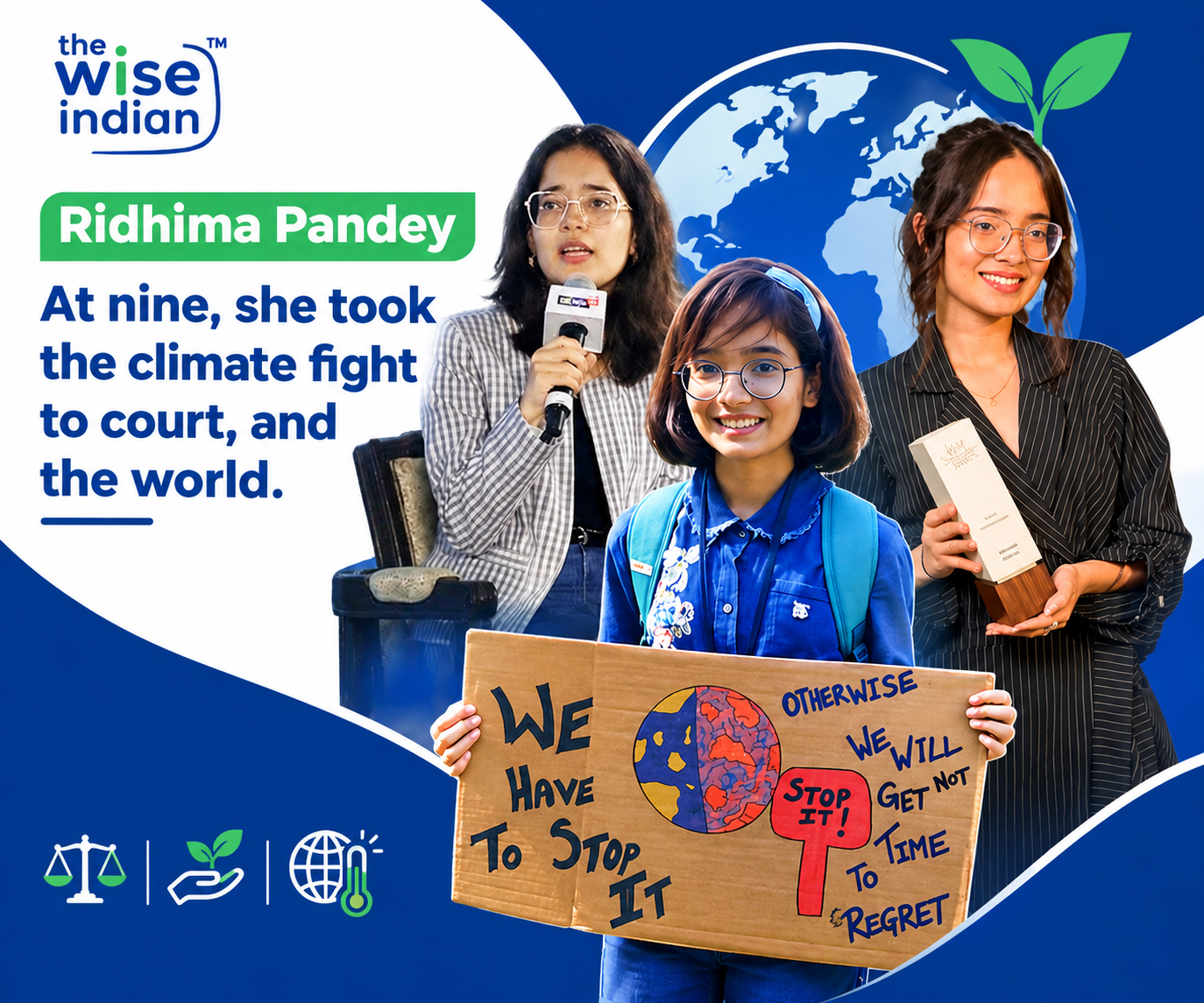
Ridhima Pandey was only nine years old when she decided to take action against climate change. While most children her age focused on school and everyday activities, she approached India’s National Green Tribunal (NGT) with a petition challenging the government’s response to the climate crisis. Her decision attracted international attention and introduced her to a wider movement for climate justice.
However, her journey did not end with one legal petition. She later joined an international climate complaint at the United Nations, participated in environmental campaigns and received recognition for her conservation efforts. Today, her story highlights how young people can use their voices to demand environmental responsibility and protect the planet for future generations.
The Uttarakhand Floods That Inspired a Young Environmental Activist
Growing up in Uttarakhand, Ridhima witnessed the devastating effects of environmental disasters from an early age. The 2013 Kedarnath floods left a particularly strong impression on her. She was around five or six when television images showed stranded people, damaged homes and suffering animals. Naturally, she began asking questions about why such destruction occurred. Her parents also influenced her interest in environmental protection. Her father, who worked with the Wildlife Trust of India, introduced her to wildlife conservation, while her mother worked with the state Forest Department.
Consequently, environmental discussions became part of her childhood. As she grew older, she learned about global warming, deforestation, pollution and the relationship between human activities and environmental damage. These experiences gradually shaped her understanding of climate change. Rather than treating environmental protection as an issue for scientists and government officials alone, she began believing that ordinary citizens, including children, could contribute to meaningful change. Eventually, these early experiences encouraged her to take an unusual step that would bring her international recognition.
The Nine-Year-Old Who Took the Government to Court
In March 2017, Ridhima Pandey filed a 52-page petition against the Indian government before the National Green Tribunal. At just nine years old, she challenged what she considered insufficient government action on climate change. Her petition, registered as Original Application No. 187 of 2017, was filed through her father and legal guardian, Dinesh Chandra Pandey. She argued that authorities needed to implement existing environmental laws more effectively and take stronger measures to reduce greenhouse gas emissions. Furthermore, she requested a national climate recovery plan, a carbon budget to limit carbon dioxide emissions and climate-related assessments of industrial projects.
Her petition also raised concerns about the rights of children and future generations, who would experience the long-term consequences of environmental degradation. The case attracted attention because it showed how a child could approach a legal institution to raise questions about national environmental policy. However, the tribunal dismissed the petition on January 15, 2019. It stated that climate change was already covered under the environmental impact assessment process governed by the Environment (Protection) Act, 1986. Although she did not receive the directions she requested, her legal action brought wider attention to climate litigation in India.
Taking India’s Climate Concerns to the United Nations
After her national legal campaign attracted attention, Ridhima joined a larger international effort in 2019. In September that year, she became one of 16 children from 12 countries who submitted a climate complaint to the United Nations Committee on the Rights of the Child. Swedish climate activist Greta Thunberg was also among the young petitioners. The complaint targeted Argentina, Brazil, France, Germany and Turkey, arguing that their inadequate climate action threatened children’s rights. The young activists used the Third Optional Protocol to the Convention on the Rights of the Child, which allows complaints about violations of children’s rights to reach the UN committee.
For Ridhima, this initiative offered an opportunity to connect India’s climate concerns with a global movement. Moreover, the complaint highlighted an important issue: children contribute very little to many activities responsible for climate change, yet they will face its long-term consequences. The initiative also demonstrated how young campaigners could work together across national boundaries. Her participation brought further international attention to India’s growing youth climate movement and strengthened discussions about environmental responsibility, human rights and the protection of future generations.
Awards and Recognition for Her Environmental Work
Over the years, Ridhima has received recognition for her commitment to environmental protection and public awareness. In 2020, she received the Sanctuary Asia Young Naturalist Award, which recognised her contribution to conservation and environmental communication. The same year, BBC included her in its 100 Women list, highlighting women making an impact across different fields. In 2021, she received the Mother Teresa Memorial Award for Social Justice from the Harmony Foundation. Her official website also lists the Nickelodeon Kids’ Choice Award 2023 in the Favourite Environmentalist category. Additionally, she has appeared in ELLE’s 100 Women Change Makers feature.
These recognitions reflect the attention her work has received beyond environmental organisations and legal institutions. Meanwhile, she has participated in TEDx talks, international conferences and youth-focused environmental initiatives. She also served on the Civil Society and Youth Advisory Council for COP26, bringing young people’s perspectives into discussions surrounding climate action. Her public appearances have provided opportunities to discuss pollution, wildlife conservation, plastic waste and sustainable development. Importantly, these achievements show that environmental advocacy can extend beyond courtrooms and reach schools, communities, international organisations and public discussions.
The Wise Take
Ridhima’s journey reminds us that age does not have to determine someone’s ability to contribute to society. Her decision to challenge the government at nine demonstrated how young citizens can participate in environmental discussions and use legal institutions to raise important concerns. Although her first petition did not succeed, she continued working on issues involving forests, pollution and climate protection. In 2022, she approached the National Green Tribunal again, raising concerns about alleged illegal mining in reserved forest areas of Uttarakhand’s Haldwani Forest Division.
The tribunal registered her complaint and directed authorities to investigate the matter. Her continued involvement shows that environmental protection requires consistent effort, public participation and accountability. Ridhima Pandey represents a generation that wants a meaningful role in shaping its environmental future. Her story leaves us with an important reminder: protecting the planet is not solely the responsibility of governments or environmental organisations. Every generation has a role to play, and even one determined voice can bring an important issue into the public conversation.
Also read our other article on 230 FIRs and 1,100 Raids: Inside Maharashtra’s Crackdown on Adulterated Milk
Follow The Wise Indian for exclusive stories celebrating everyday heroes who are quietly shaping the culture, sustainability, and future of a better India.