
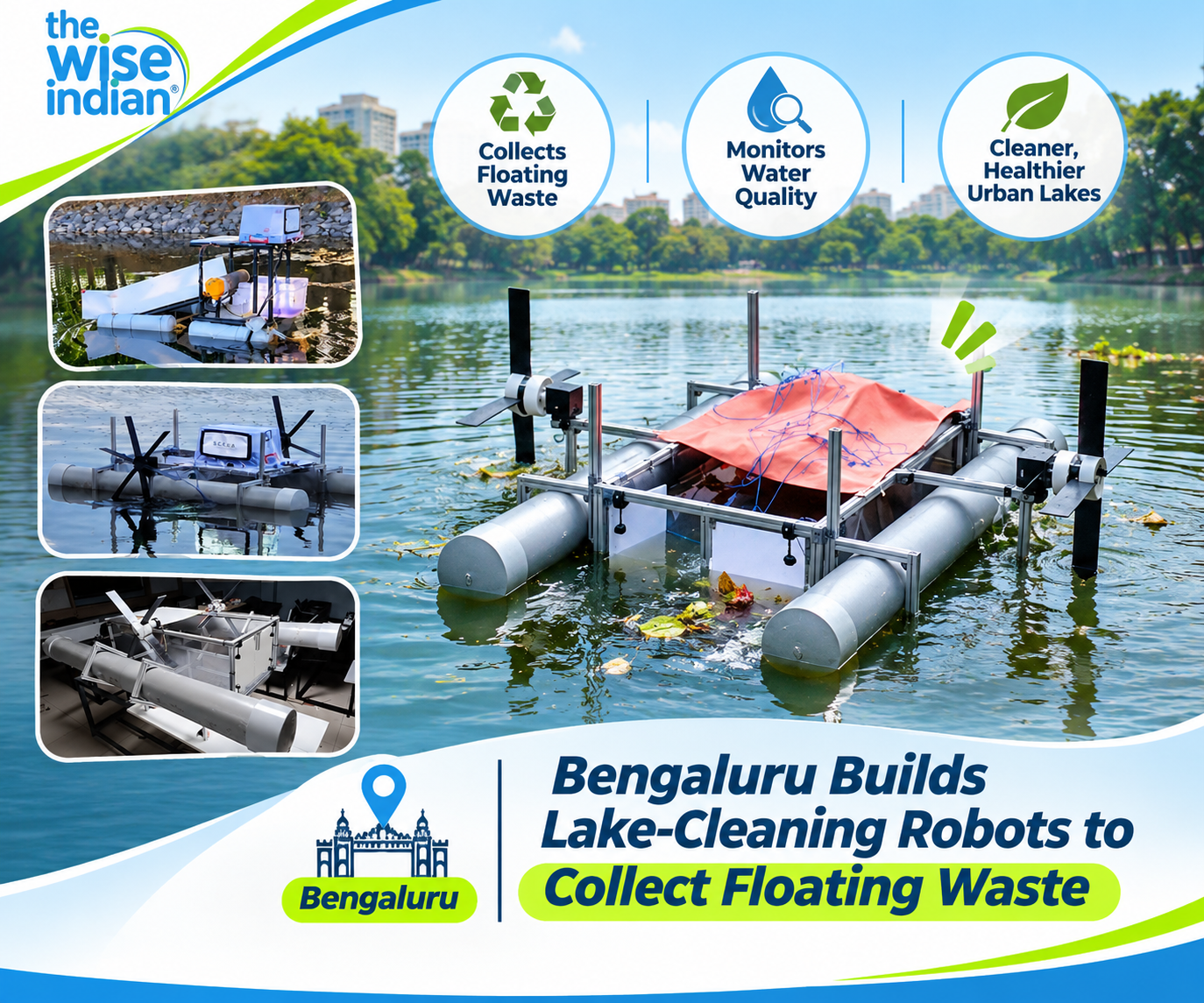
Bengaluru’s lakes face a persistent challenge: floating plastic, discarded packaging, weeds and polluted water. Removing this material often requires repeated manual work, sometimes in difficult and unsafe conditions. A team of young engineers in the city is exploring another approach. The RV College of Engineering (RVCE) incubated team, SCRUB Robotics, is developing autonomous floating platforms.
They collect surface waste and gather information about water quality. Its prototypes have moved beyond laboratory demonstrations, with trials reported at Kengeri and Madiwala lakes. The project brings robotics into a practical environmental setting. Its importance lies not in promising an instant cure. Instead, it tests whether technology can support regular maintenance and better monitoring.
An Engineering Response to Bengaluru’s Lake Pollution
SCRUB Robotics began with a familiar problem across urban India. Lakes receive plastic, packaging, aquatic weeds and other floating material. Cleaning often depends on people working from boats. Such work may be tiring, repetitive and hazardous, particularly where water is contaminated. The RVCE team set out to develop a robotic alternative. It would collect debris and reduce continuous manual intervention. Its aim is not simply to build a remote-controlled boat. Instead, the project brings together navigation, collection mechanisms, sensors and data tools.
This combination could help lake managers see both the waste on the surface and selected indicators of water quality. The team describes its wider mission as collecting, measuring and supporting the restoration of urban water bodies. That ambition will require dependable machines, careful field testing and cooperation with lake authorities. It will also need clear operating plans, trained supervisors and safe ways to handle collected waste. Without these basics, even a promising prototype may struggle to become a dependable public service.
How the Different SCRUB Robots Collect Waste
SCRUB Robotics has developed several platforms. Different water bodies need different equipment. The first model, SCRUB V1, uses a conveyor-based collection system. A mesh conveyor moves through floating debris and aquatic vegetation, lifts the material and transfers it into an onboard basket. The platform was field-tested at Kengeri Lake in coordination with the Bruhat Bengaluru Mahanagara Palike (BBMP). The James Dyson Award entry reports a collection of up to five kilograms per cycle.
This was during proof-of-concept testing. The later SCRUB V2 takes a simpler route. It removes the conveyor and uses a passive intake. Floating material enters as the robot moves forward. A closing mechanism helps retain it when the robot reverses. The team lists up to 25 kilograms per run. It also reports a 500-metre range and a runtime of five hours. These are reported design specifications, not independently verified results across different lakes. The two models therefore represent separate engineering approaches, rather than successive versions of one identical cleaning mechanism. Each design must match the size and waste load of its intended water body.
Trials at Kengeri and Madiwala Lakes
For SCRUB Robotics, field trials are essential. A lake is far less predictable than a laboratory tank. Wind, shallow patches, aquatic growth, floating branches and changing water conditions can all affect a small robot. Early V1 testing at Kengeri Lake let the team assess movement, collection and communication systems in an urban water body. The team has also reported later deployments involving its newer platforms at Madiwala Lake. Its website records a trial there on 8 September 2026.
The monitoring platform mapped GPS-tagged readings through its software. A separate technology report describes the Madiwala trials as a step towards testing the machines under real operating conditions. These deployments were prototype field trials. They do not prove that the robots have solved lake pollution at scale. Nevertheless, testing outside the workshop can reveal practical problems early. It also gives engineers information they can use to improve navigation, collection, durability and maintenance before wider deployment. Repeated trials across seasons would be especially useful, since water levels and vegetation can change throughout the year.
Monitoring Water Quality, Not Just Floating Rubbish
Visible waste tells only part of a lake’s story. Water can contain pollutants even when its surface looks relatively clear. For this reason, the team has developed SCRUB V4 as a separate water-intelligence platform. It is designed to record indicators such as pH, total dissolved solids (TDS) and turbidity. The system attaches GPS coordinates to readings. This helps map variations across different points in a lake. The information is displayed through a digital platform called SCRUB Observatory.
During its Madiwala work, the team reported collecting spatial water-quality readings and conducting water-sampling activities for further analysis. These tools could help authorities identify locations that need closer investigation. However, pH, TDS and turbidity alone cannot provide a complete assessment of water safety or ecological health. Laboratory testing and broader monitoring remain necessary. Authorities must also compare readings over time and investigate possible pollution sources before choosing corrective measures. This distinction matters. A robot can gather useful information, but experts must interpret readings before decisions are made.
The Wise Take
SCRUB Robotics offers an example of engineering students applying robotics to an environmental problem close to home. Its prototypes show how floating machines could combine surface cleaning with the collection of water-quality information. The Kengeri and Madiwala trials are meaningful steps because they take the designs into real water bodies. Still, prototypes and field demonstrations are only an early stage.
Wider use would depend on reliability, maintenance, operating costs, waste disposal arrangements and approval from lake-management authorities. Moreover, collecting floating rubbish cannot replace sewage treatment, pollution prevention or the restoration of damaged lake ecosystems. Those problems require action at their sources. If further trials establish that the machines can work safely and consistently, they could become one useful part of a larger lake-management system. The larger lesson is that cleaner lakes need both practical technology and sustained public responsibility.
Also read our other article on Aanchal Jain: How Regenerix Turns Farm Stubble Into Biomass Fuel for a Cleaner and More Sustainable Energy Future
Follow The Wise Indian for exclusive stories celebrating everyday heroes who are quietly shaping the culture, sustainability, and future of a better India.