
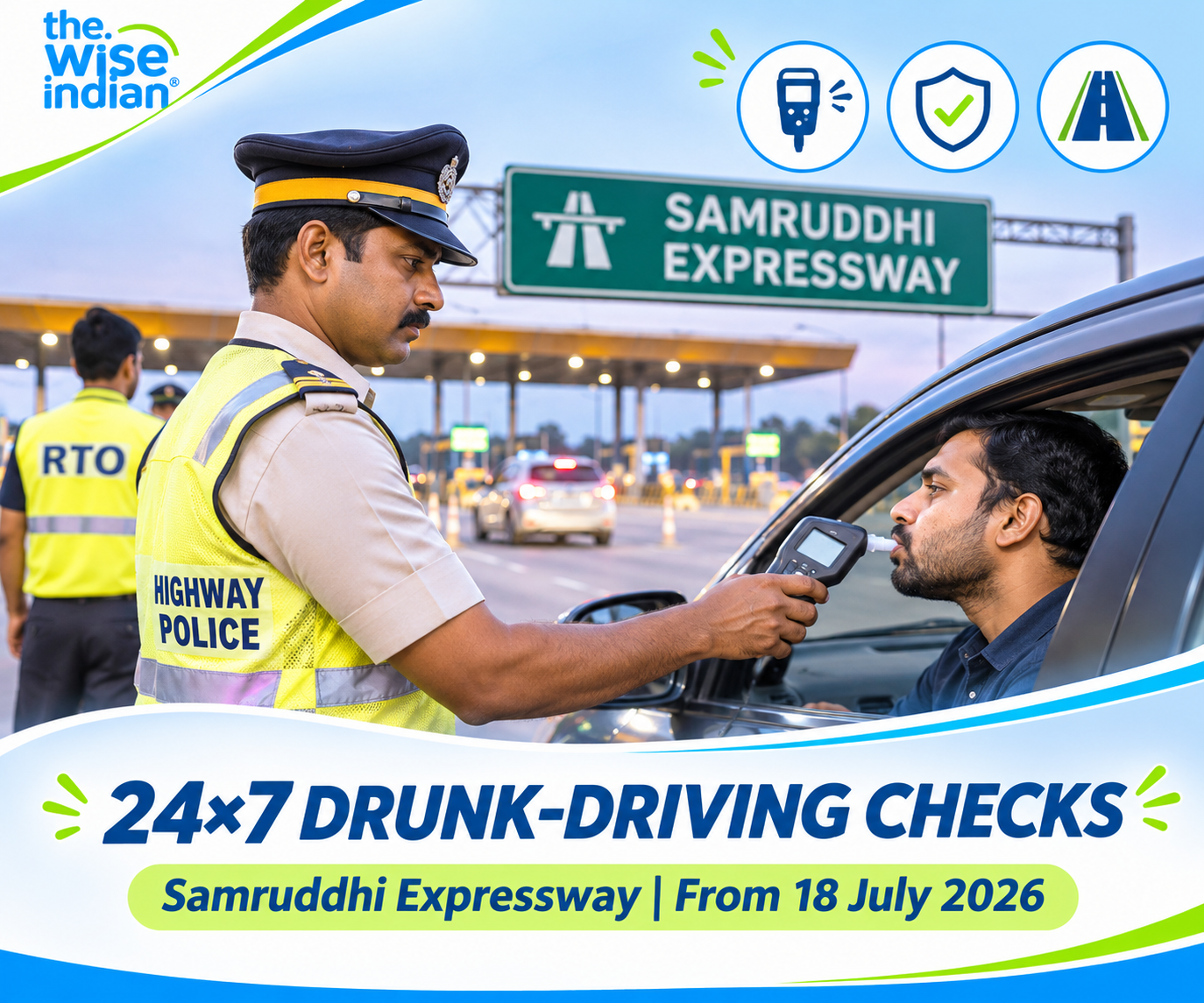
Maharashtra’s Highway Police and Regional Transport Office (RTO) began a round-the-clock campaign against drunk driving on the Samruddhi Expressway on 18 July 2026. The joint teams use breath analysers at toll plazas, interchanges, rest areas and other strategic points. Officials have placed particular attention on night travel and long-distance journeys, when fatigue and impaired judgement can increase danger.
However, the operation runs throughout the day, not only after dark. The Samruddhi crackdown aims to deter motorists from driving after consuming alcohol and to prevent avoidable crashes on the high-speed corridor between Nagpur and Mumbai. Police have urged every driver to follow traffic rules and cooperate with the teams.
Highway Police and RTO Launch a Joint Enforcement Drive
The Highway Police launched the campaign with the Regional Transport Office to strengthen checks along the expressway. The Times of India reported on 18 July that Highway Police Superintendent Lohit Matani oversees the operation in the Nagpur region. In addition, the agencies have combined their personnel for a continuous enforcement schedule. Officers carry breath analysers and screen motorists for alcohol when they reach designated checking points. Drivers who break the law face action under the Motor Vehicles Act and other applicable provisions. The agencies want motorists to expect checks whenever they use the expressway, regardless of departure time.
The drive targets drunk driving, which police identify as a major cause of serious highway crashes. Moreover, officers have asked motorists not to consume alcohol before taking the wheel. The Samruddhi crackdown also seeks to make enforcement visible, consistent and difficult to avoid. Rather than depending on occasional roadside checks, the teams maintain a presence at selected locations across different travel periods. This joint approach places responsibility on drivers while giving enforcement agencies a coordinated way to identify violations.
Fifteen Teams Cover Three Shifts Around the Clock
The operation uses 15 dedicated teams, with five teams covering each of three eight-hour shifts. As a result, the deployment allows officers to continue checks during daytime, evening and overnight hours. Consequently, drivers should follow officers’ instructions and cooperate with screening at designated points. Each team carries breath analysers to test drivers who may have consumed alcohol. The Hitavada reported that Highway Police and RTO personnel conduct checks at toll plazas, interchanges, rest areas and accident-prone stretches.
Furthermore, the shift system helps the agencies maintain coverage without limiting the campaign to a short special drive. The arrangement matters because motorists enter the expressway at different times, including late at night and early in the morning. However, a round-the-clock schedule does not mean every vehicle receives a test at every point. Officers conduct screening at designated locations and follow the applicable enforcement process when they detect an offence. The Samruddhi crackdown therefore combines staffing, equipment and coordination to support sustained monitoring. Its effectiveness will depend on consistent deployment, proper use of breath analysers and appropriate legal action against offenders.
Checks Target Entry Points and Night-Time Journeys
Police teams operate at strategic points along the Nagpur–Mumbai route, including toll plazas, interchanges, rest areas and accident-prone stretches. Reports also identify major access points such as Nagpur, Chhatrapati Sambhajinagar, Sinnar and Shirdi. In addition, enforcement has begun at other important entry points along the corridor. Meanwhile, the named entry points show that the campaign reaches several parts of the long corridor. The Live Nagpur reported that the campaign started at 7 pm on 17 July, while the Times of India reported its launch on 18 July. These reports describe the same round-the-clock operation and its rollout across the expressway.
Officials have highlighted night travel and long-distance journeys because drivers may face fatigue as well as the risks of alcohol impairment. Nevertheless, motorists should not assume that daytime travel falls outside the campaign. The teams operate in shifts and can screen drivers at designated points throughout the day. The Samruddhi crackdown sends a clear warning: a driver should never treat a quiet road, a short journey or a late departure as a reason to drive after drinking. Police have also urged commuters to control speed and take adequate rest before long trips.
Rising Fatalities Strengthen the Case for Road Safety
The campaign followed a rise in deaths on the expressway during the first half of 2026. The Times of India reported that 84 people died in crashes between January and June, compared with 64 during the same months in 2025. That increase represents 31.25%, while the average reached 14 deaths each month in the first six months of 2026. April recorded 25 deaths, and June recorded 19, according to the report. However, these figures do not mean drunk driving caused every fatal crash. The report also discussed fatigue, loss of control and rear-end collisions as road-safety concerns.
Therefore, enforcement against alcohol-impaired driving forms one part of a broader effort to reduce deaths. These numbers also show why authorities must examine crash patterns and respond to several road-safety risks. Section 185 of the Motor Vehicles Act, 1988, makes it an offence to drive with alcohol exceeding 30 milligrams per 100 millilitres of blood. A first offence can bring up to six months in prison, a ₹10,000 fine, or both. A second or subsequent offence can bring up to two years in prison, a ₹15,000 fine, or both. The figures underline the need for responsible driving and sustained attention to several causes of crashes.
The Wise Take
The round-the-clock campaign gives motorists a clear reason to plan safer journeys before they start. Drivers should never drink before taking the wheel, even when they expect a short trip or believe the road will remain quiet. Instead, they can arrange a sober driver, use a taxi or choose another safe way to travel. Passengers can also speak up when someone who has consumed alcohol tries to drive. In addition, every road user should follow speed limits, avoid distractions and take breaks when fatigue sets in.
Families and passengers can support safer decisions by refusing to travel with an impaired driver. Breathalyser checks can help police identify violations, but enforcement alone cannot prevent every crash. Ultimately, safer travel depends on both consistent policing and everyday decisions by motorists. The Samruddhi crackdown reinforces a simple message for everyone using the expressway: do not drink and drive.
Also read our other article on Chennai Road Safety in 2026: Fewer Crashes, Rising Helmet Deaths and a Late-Year Decline in Fatalities Across the City
Follow The Wise Indian for regular updates on stories that shape India’s strategic future and global standing. Stay connected with us for sharp analysis, untold perspectives, and a closer look at the shifting legal landscapes, civic rights, and institutional frameworks defining our democratic fabric