

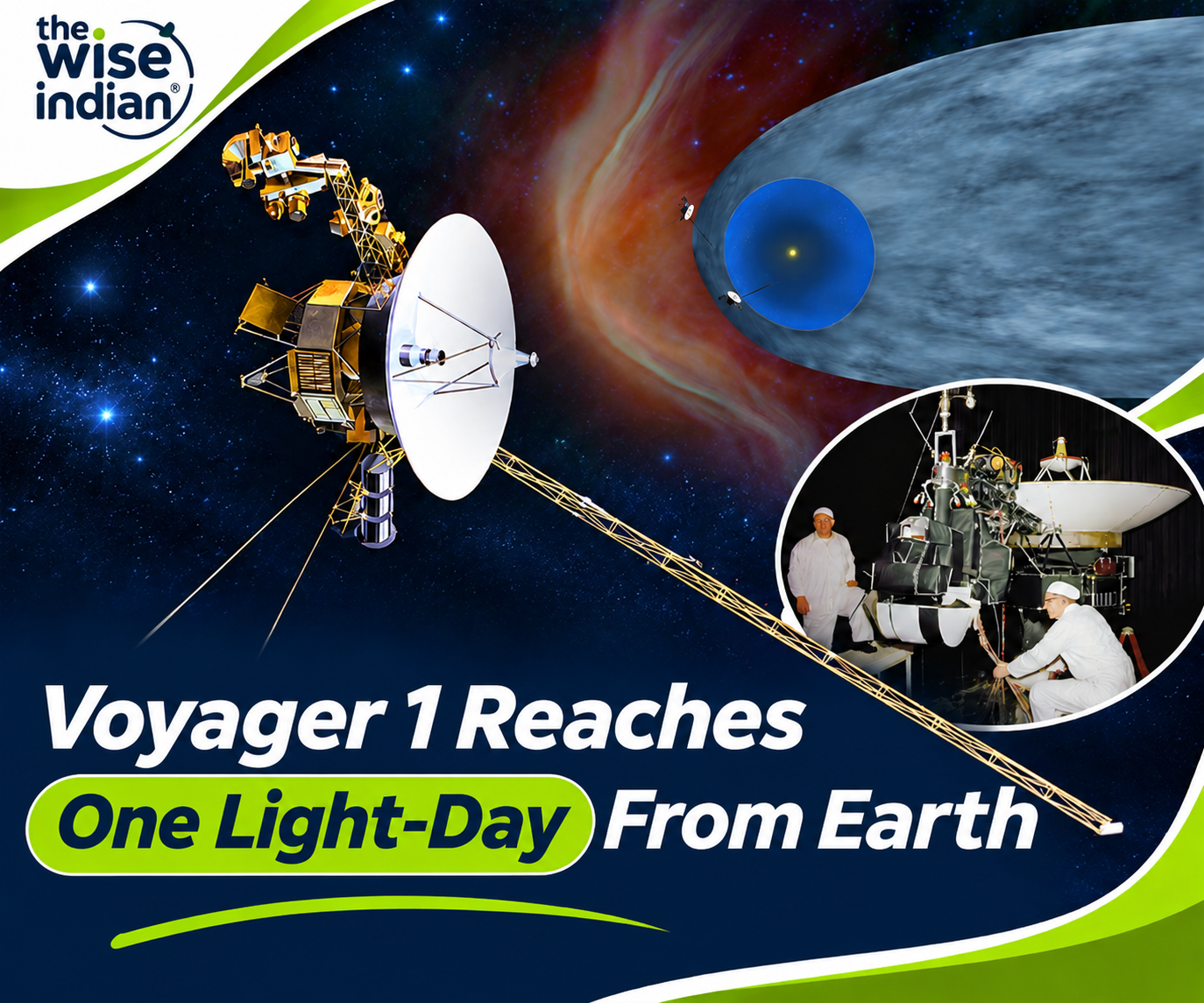
NASA’s Voyager 1 spacecraft has reached a remarkable milestone in human space exploration. On November 18, 2026, NASA calculated that it had travelled one light-day from Earth. It is the first human-made object to reach that distance. The achievement comes nearly 50 years after its launch. The spacecraft is now about 25.9 billion kilometres from our planet. A light-day measures distance, not time. It describes how far light travels in 24 hours. Even radio signals need about a full day to reach the distant probe.
A reply then takes another day to return. This delay makes every exchange a carefully planned operation. The milestone also offers a striking measure of humanity’s reach into space. NASA’s calculation placed the crossing at 5:16 a.m. Eastern Time. However, engineers still had to wait for the signal to arrive. That confirmation takes roughly another day. For Voyager 1, this delay makes routine communication a major engineering challenge. The distinction matters because the spacecraft cannot send an instant update across such an enormous gap.
A Record-Breaking Distance After Nearly Five Decades
NASA calculated that Voyager 1 reached one light-day from Earth on November 18. The distance is about 16.094 billion miles, or 25.902 billion kilometres. Light travels nearly 300,000 kilometres every second. Yet it still needs 24 hours to cover this gap. The milestone changes the practical rhythm of mission operations. Engineers cannot hold a quick conversation with the spacecraft. They also cannot respond immediately to an unexpected problem. Every command and reply must account for the long communication delay.
Reuters reported that NASA’s calculation placed the crossing at 5:16 a.m. Eastern Time. Mission teams still needed about another day for the returning signal. NASA’s Jet Propulsion Laboratory planned an event to discuss the achievement. The record therefore combines a precise distance calculation with a reminder. Operating a spacecraft at this range requires patience, planning and reliable communication systems.
The 1977 Mission That Changed Planetary Science
NASA launched Voyager 1 from Cape Canaveral, Florida, on September 5, 1977. Its original mission focused on the outer planets. The spacecraft was sent to study Jupiter and Saturn during a rare planetary alignment. This route helped it travel efficiently between worlds. It flew past Jupiter in 1979 and returned detailed observations. Its instruments studied the planet, its atmosphere and its moons. The mission also revealed active volcanoes on Io. The spacecraft identified two previously unknown Jovian moons, Thebe and Metis.
It then reached Saturn in 1980. There, it examined the planet’s rings, atmosphere and moons. These encounters transformed scientists’ understanding of the outer solar system. After completing its main planetary tour, the probe continued outward. Voyager 1 continued its journey after the final planetary encounter. Its mission did not end with that encounter. Instead, it became a long-running journey towards the edge of the Sun’s influence. The spacecraft’s discoveries helped establish the foundation for later studies of interstellar space.
Crossing Into Interstellar Space
A major turning point came on August 25, 2012. On that date, the spacecraft crossed the heliopause and entered interstellar space. The heliopause marks the outer boundary of the heliosphere. This vast region is shaped by the solar wind and the Sun’s magnetic field. Beyond it lies the interstellar environment between stars. The probe became the first spacecraft to provide direct measurements from this region. Its twin, Voyager 2, followed a different route. It crossed the heliopause in November 2018.
The two probes remain the only spacecraft operating beyond the heliosphere. Their instruments measure particles, magnetic fields and plasma waves. These observations help scientists study the boundary between the solar environment and interstellar space. NASA says Voyager 2 is expected to reach the one-light-day distance in November 2035. Its journey is slower and follows a different direction. Together, the probes continue to provide rare measurements from beyond the Sun’s protective bubble.
Keeping the Spacecraft Working Across the Cosmic Distance
The milestone is also an engineering achievement. The spacecraft has continued operating for almost five decades. It does not rely on solar panels. Instead, it uses radioisotope thermoelectric generators. These devices produce electricity from heat released by radioactive decay. Their power output gradually declines over time. Engineers have therefore switched off selected heaters and instruments. These measures conserve electricity for communication and essential science. The spacecraft sends data through NASA’s Deep Space Network.
This global system uses large radio antennas to contact distant missions. Reuters reported that recent power-saving steps may support communication for another three to four years. NASA has also discussed the possibility of keeping current instruments operating through the mission’s 50th launch anniversary in 2027. However, the spacecraft’s lifetime beyond that remains uncertain. Engineers must balance available power, instrument performance and scientific value. Each decision helps extend a mission that was originally designed for a much shorter planetary tour.
The Wise Take
Reaching one light-day from Earth is more than a distance record. It shows what sustained scientific ambition and careful engineering can achieve. Yet the milestone also puts the scale of space into perspective. Even travelling at nearly 61,000 kilometres per hour, the probe needed more than 49 years to cover this distance. Nearby star systems remain vastly farther away. The spacecraft is not expected to pass near another star for tens of thousands of years. Its measurements still help scientists understand the Sun’s influence and the wider galaxy.
NASA invited the public to mark the milestone through its Shine Bright for Voyager’s Light-Day activity. The agency also scheduled a mission discussion for November 19, 2026. Scientists and engineers are expected to discuss the spacecraft’s condition and discoveries. As the probe continues through interstellar space, its journey remains a reminder. Exploration does not always end when an original mission is complete. Sometimes, the most important discoveries begin long after launch.
Also read our other article on MS Dhoni Retires from IPL and Becomes CSK Mentor, Marking the End of an Extraordinary Playing Career
Follow The Wise Indian for regular updates on stories that shape India’s strategic future and global standing. Stay connected with us for sharp analysis, untold perspectives, and a closer look at the shifting legal landscapes, civic rights, and institutional frameworks defining our democratic fabric.