

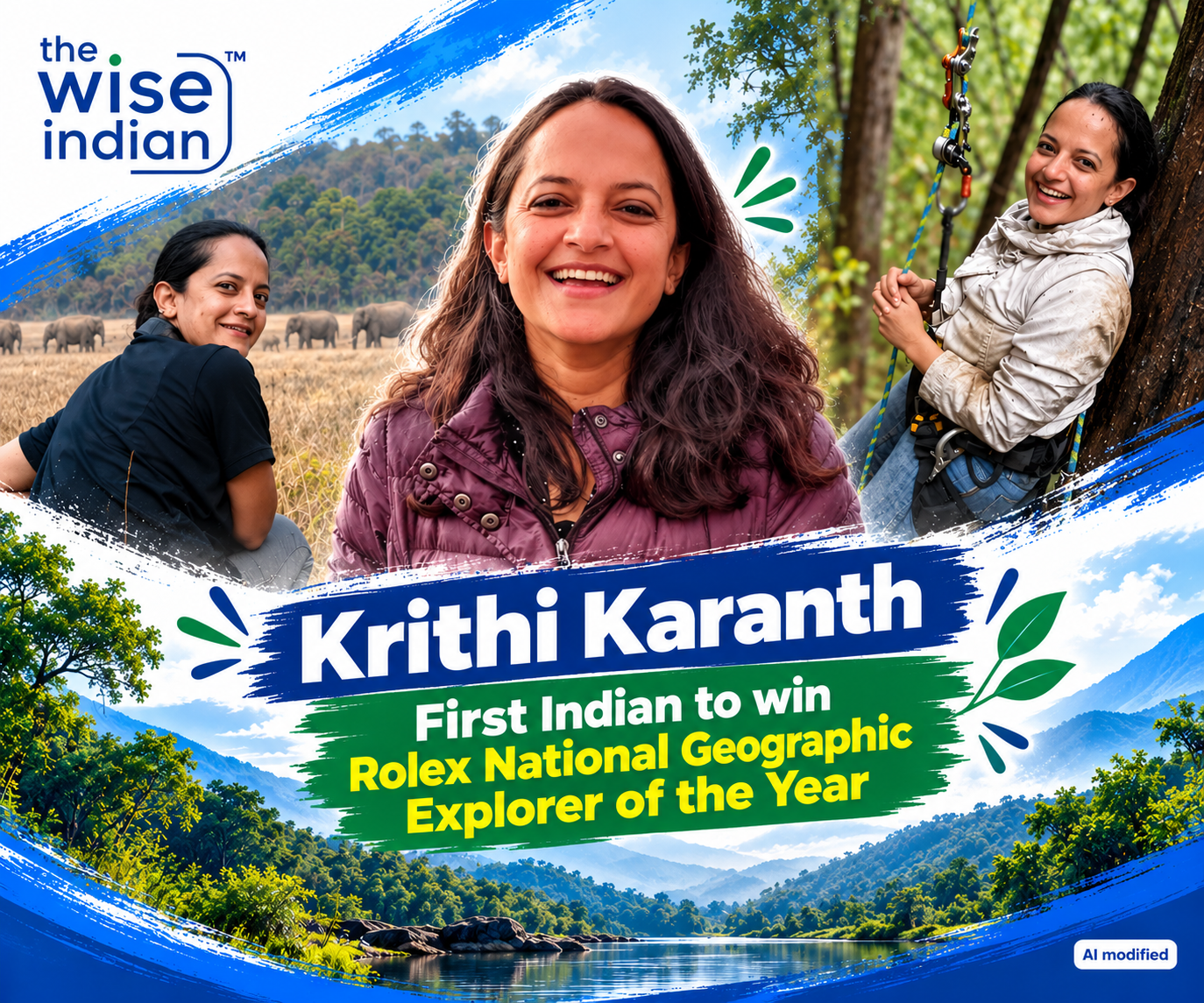
Krithi Karanth is the first Indian named Rolex National Geographic Explorer of the Year 2026. She is a scientist, educator and CEO of the Centre for Wildlife Studies in Bengaluru. Her work helps villagers and wild animals share land safely. This is the story behind the honour.
Who Is Krithi Karanth, India’s First Rolex Explorer?
Wildlife was part of her life from the very beginning. She was born in Mangaluru into a family of wildlife lovers. She spotted her first leopard at the age of two. By eight, she was tracking tigers with her father. He is a renowned tiger biologist and conservationist. At first, she did not plan to follow his path. Science and fieldwork soon pulled her in. Today she leads the Centre for Wildlife Studies as its chief executive. She has won more than 50 awards and recognitions. These include a Rolex Award for Enterprise in 2019. In 2011, she received the National Geographic Society’s 10,000th grant. She won the McNulty Prize in 2025. This year, the Royal Geographical Society gave her the Esmond B. Martin Prize.
Her research across India and Asia spans 28 years. She has mentored more than 300 young scientists. About 1,000 citizen science volunteers have joined her efforts. Three award-winning BBC series have featured her projects. The Explorer of the Year title honours leaders who spotlight planetary challenges. Rolex and the National Geographic Society have partnered for more than 70 years. The award itself has existed since 2011.
Why Human-Wildlife Conflict Is a Serious Problem in India
India is the world’s most populous nation. Yet only five per cent of its land is reserved for nature. Still, the country is home to 70 per cent of the world’s tigers. It also has about 60 per cent of Asian elephants. So people and wild animals often live side by side. For many villagers, animals are simply a threat to crops and livestock. Her research estimates about 100,000 conflict incidents reach the government every year. Between 2000 and 2010, Karnataka alone received over 100,000 compensation claims.
About 15 per cent of households reported livestock losses. Tigers, leopards, foxes and wild dogs caused most of them. Early studies revealed a worrying gap. Fewer than 30 per cent of affected households filed for and received payments. Many farmers found the process slow and costly. Families near forests often earn very little. She has noted that some live on about $1,200 a year. Compensation does not solve everything, she says. But it does help these families. Without support, anger can build against conservation. Sometimes communities harm animals in return. In a country where millions live near forests, protection cannot rely on exclusion alone.
How Wild Seve Supports Farmers and Wildlife
Krithi Karanth launched Wild Seve in 2015 to close this gap. In Kannada, seve means “to serve”. The programme runs a toll-free number for reporting incidents. A response team then helps families file government compensation claims. In its early years, teams reached families within a few hours. A smartphone app helps staff record claim details quickly.
It began in just two wildlife reserves. Today it operates in over 30 reserves across India. By November 2022, it had assisted with 21,442 incidents. These involved about 9,698 individuals and families. Families received roughly ₹6.86 crore through the programme. That equals about US $974,000. Wild Seve also helped build 89 predator-proof livestock sheds.
Trust has grown over time. Families now often insist that the team attend official damage assessments. The idea is simple. Help people quickly, and they tolerate wildlife better. This builds trust between villagers and forest staff. Wild Seve grew out of seven years of her own research. That work showed fair compensation can build tolerance toward wildlife. Oracle funded the early effort.
Wild Shaale, Wild Surakshe and Wild Carbon
Compensation solves only part of the problem. In 2018, she tackled the root cause: education. Wild Shaale teaches children who often meet wildlife near their homes. It started in 38 classrooms. Now it runs in 1,626 rural schools. More than 72,000 children have joined. The programme has reached 39 wildlife reserves. Every lesson is fun and hands-on, so children stay curious. She calls the approach experiential, and she believes every child should learn to champion wildlife. She also says the model could be replicated for jaguars, bears, wolves and lions elsewhere.
In 2020, she began Wild Surakshe. It works with community leaders, forest workers and health workers. It aims to protect lives and livelihoods. The programme has held more than 1,300 workshops. About 50,000 people have taken part. Another project, Wild Carbon, partners with 10,000 farmers. These farmers adopt wildlife-friendly practices on their land. Together, these programmes show how Krithi Karanth approaches conservation.
The Wise Take
Krithi Karanth proves that conservation works best when people are included. Protecting tigers and elephants also means protecting nearby families. Her award is a win for grassroots, evidence-based science. It gives Indian conservation a bright global spotlight. It also shows that solutions can be simple. A toll-free number, a school lesson and a fair payment can shift attitudes.
On receiving the award, she called it an honour and a profound responsibility. She also stressed that conservation must be rooted in people’s lived realities. For young writers and readers, there is another lesson. Every big story has a person behind it. Real change often starts with one determined woman. She hopes Wild Seve, Wild Shaale, and Wild Surakshe will become global models. India can lead that effort.
Also read our other article on How Dharam Singh Meena and Tehri’s Villages Brought a Dying River and 126 Springs Back to Life with their massive effort
Follow The Wise Indian for more stories about the officers, scientists, and everyday heroes quietly shaping a better India



