

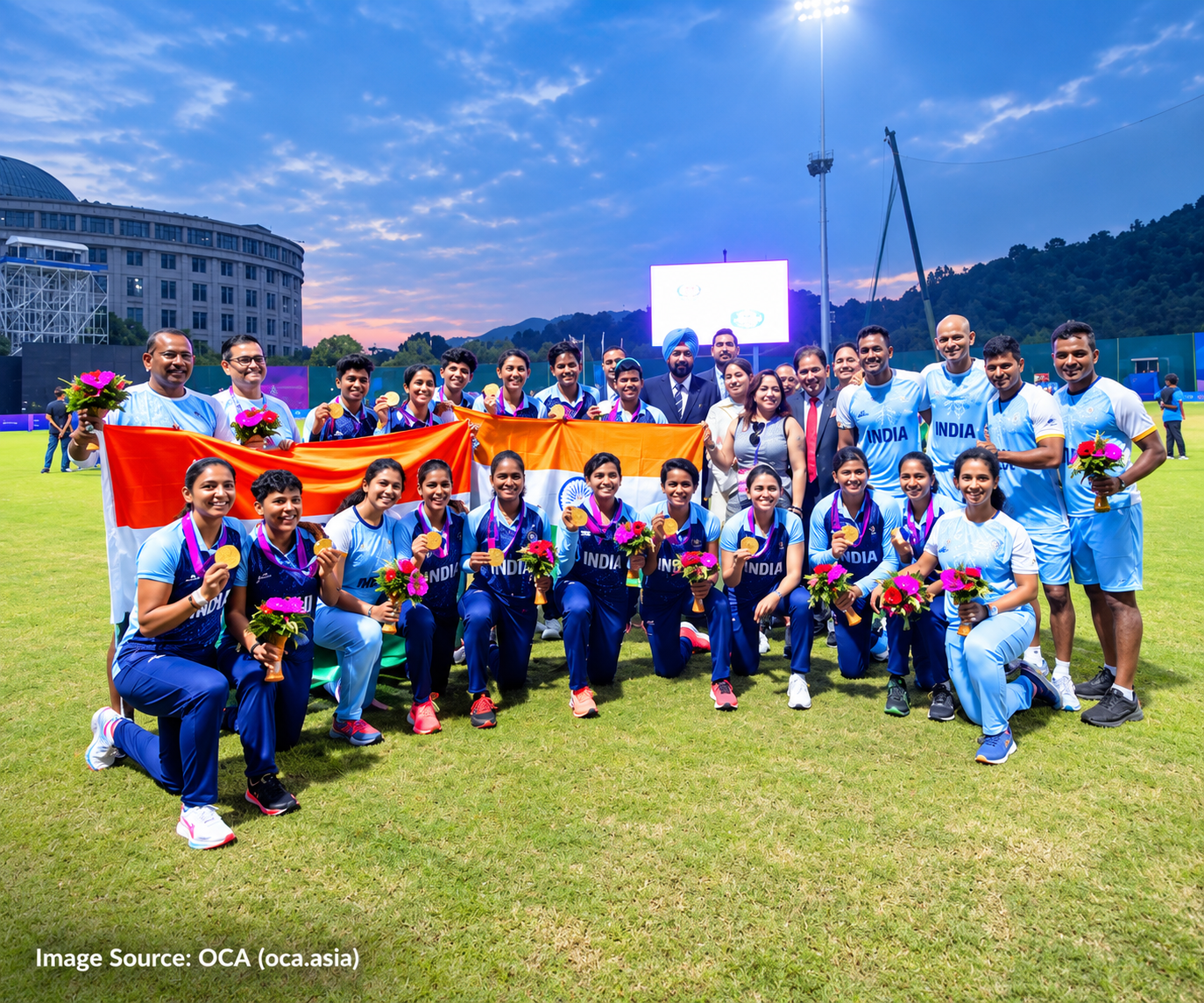
On 25 September 2023, the India women’s cricket team walked into the final in Hangzhou with one goal. They wanted gold. By the end of the day, they had it, after a 19-run win over Sri Lanka in a 20-over match. It was a proud day for the whole country. But the story is not about one star. Behind the scoreline stood a group of players who each did their own job well. Let us meet them.
A Brand-New Stage for the India Women’s Cricket Team
This was new ground for India. The team won gold on its Asian Games cricket debut, after declining to send teams on the two earlier occasions the sport was included. Pakistan had won gold both of those times, so this was a fresh chapter for the tournament too. So the India women’s cricket team was not defending a record. It was starting one. Every player in the squad was part of a first.
The setting was the Zhejiang University of Technology Pingfeng Cricket Field. Runs had not come easily all tournament, because the pitch was affected by rain the week before. On a tricky pitch, every run counts, and every player matters. A T20 match packs a lot into a short time. Each side gets 20 overs, and any single over can turn the game. That is why teamwork counts for so much in this format.
The Batters Who Built the Score Together
India won the toss and chose to bat. It was a brave call, because both semi-finals and the bronze medal match had been won by the team chasing. Then two batters made it work. Smriti Mandhana scored 46, and Jemimah Rodrigues scored 42. Together, they added 73 for the second wicket.
One steady partnership can change the mood of an innings. Here, it gave India a base to build on. The team finished on 116 for seven in 20 overs. It was not a huge total. But on that pitch, it gave the bowlers something real to defend.
How Titas Sadhu and the Bowlers Changed the Chase
Sri Lanka had come into the final in good form, so the chase was never going to be easy. An early breakthrough would matter. That breakthrough came from the seamer Titas Sadhu. Her devastating spell reduced Sri Lanka to 14 for three in the fifth over.
Three wickets were gone before the chase had even settled. Sri Lanka could not fully recover from that start. They finished on 97 for eight in their 20 overs, 19 runs short. In a low-scoring final, every over is a small contest of its own.
How the India Women’s Cricket Team Shared the Gold
The win came with lovely timing. It was India’s second gold at the Hangzhou Asian Games, after the men’s shooting team won the 10m Air Rifle gold earlier that day. Two golds in one day made it a special Monday for Indian sport. The medal ceremony had its own charm. OCA Acting President Raja Randhir Singh, a former Asian Games champion in shooting, presented the gold medal to captain Harmanpreet Kaur and her team. A champion from one sport was handing medals to champions of another.
The win belonged to the whole squad. Mandhana and Jemimah built the total, Titas Sadhu broke the chase open, and Harmanpreet led a team where every player contributed. Other teams had their moments too. Bangladesh took the bronze by restricting Pakistan to 64 for nine and reaching the target of 65 in 18.2 overs. Pakistan, who had won gold on both earlier occasions, returned home without a medal.
Why This Day Is Worth Remembering
Some wins are remembered for the margin. This one is remembered for the first. India had stayed away from Asian Games cricket twice before. In Hangzhou, the team turned up, played a tight final and came home with the top medal. Each step in that final was small: a toss call, a partnership, an early wicket. But together, they added up to 25 September 2023, a date Indian cricket fans can now circle on the calendar.
The Wise Take
The India women’s cricket team did not win gold because of one player. Batters built the score, a bowler broke the chase open, and a captain led the whole group. Each player did their part. The lesson is simple. When a team shares the work and each player owns a small role, even a first attempt on a new stage can end in gold. So the next time you watch a match, look beyond the star and notice the small roles that build a win
Also read our other article on Mangalyaan Team: How 500 Scientists From Ten ISRO Centres Took India to Mars Orbit on the First Try
Follow The Wise Indian for more articles like this.



