

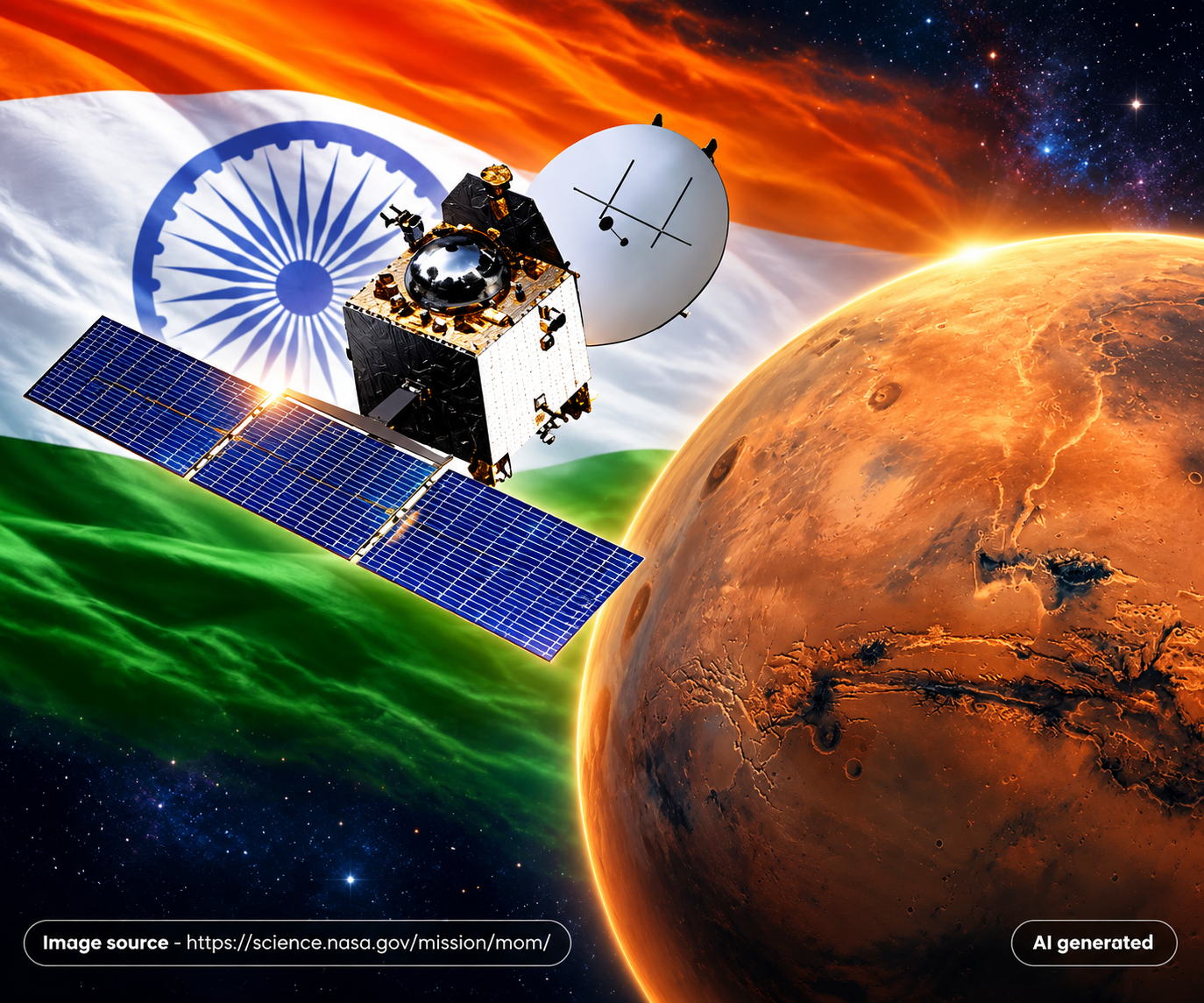
On 24 September 2014, India reached Mars orbit. The Mangalyaan team had built a spacecraft, sent it across space and waited anxiously for one final signal. The result made history.
According to EarthSky, India became the first Asian country to put a spacecraft in Mars orbit. ISRO became the fourth space agency to do so. It also said this was the first time any space power had reached Mars on its first attempt. Behind that success stood hundreds of scientists. Let us meet some of them.
Hundreds of Scientists and Just 18 Months to Build a Spacecraft
A book excerpt published by The Print says about 500 scientists from ten ISRO centres worked on the mission. It also says women held at least 27 per cent of the key executive positions. Time was short. Project director Subbiah Arunan has said the team was given only 18 months. So the mission needed the energy of a young team. Deputy operations director Nandini Harinath said most team members were first-timers on such a project.
The Leaders Who Guided the Mission From the Launch Pad to Mars
Business Standard profiled the mission’s key leaders right after the orbit insertion. Here are some of them:
- K Radhakrishnan: ISRO chairman, who had led the organisation since 2009.
- Mylswamy Annadurai: programme director, who looked after the budget, spacecraft configuration, schedule and resources.
- Subbiah Arunan: project director, who was responsible for building the spacecraft.
- P Kunhikrishnan: mission director of PSLV-C25, the rocket that carried Mangalyaan.
- V Adimurthy: the mission concept designer.
- Shivkumar: director of the ISRO Satellite Centre, who developed the mission’s telemetry system.
Two Deputy Operations Directors and the Women Who Helped Steer the Mission
Nandini Harinath and Ritu Karidhal shared the role of deputy operations director. They looked after different systems and handled mission operations at the U R Rao Satellite Centre in Bengaluru. ThePrint says their work included calculating the spacecraft’s path to Mars and designing software that could correct problems on its own.
At first, Nandini and her colleagues were not formally designated. They were simply told to start work from day one. Meanwhile, Moumita Dutta and her colleagues at the Space Applications Centre built and tested the scientific instruments.
Arunan said women led major areas of the mission, including navigation, communication, control systems, spacecraft design and tracking. He also said the women’s team stood by its calculations in reviews. Nandini had a modest view of the attention. She said her male colleagues worked just as hard and deserved the same recognition. She also felt that women need such examples, so they know success in science is possible.
What the Mangalyaan Team Faced on Orbit Day
On orbit day, the spacecraft fired its main 440 newton engine along with eight smaller ones. ISRO said the burn began at 7:17 am IST and lasted more than 23 minutes. It changed the spacecraft’s speed by 1,099 metres per second. There was one more test of nerves. EarthSky reports that the burn had to happen while the spacecraft was behind Mars and out of contact with Earth. So the team could only wait.
Then the signal returned. Mission control in Bengaluru confirmed that the spacecraft was in its planned orbit.
What the Mangalyaan Team Achieved for India
ISRO said the spacecraft settled into an elliptical orbit around Mars. It takes a little under 73 hours to circle the planet once. Its five scientific instruments were expected to begin studying Mars in the following weeks. The spacecraft completed its first six months in orbit in March 2015. ISRO then extended the mission by another six months, EarthSky reports.
Each of these steps depended on someone doing their part well. Some people designed, some tested, some calculated and some simply waited.
The Wise Take
The Mangalyaan team reached Mars because hundreds of people did their part carefully. About 500 scientists from ten ISRO centres worked toward one goal, and they had only a short time to do it. The lesson is simple. Big goals are rarely reached by one person alone.
When a team shares the work and respects each other’s skills, even a first attempt can reach the Red Planet. It is also a reminder for all of us. Whatever your role is, doing it with care matters, because someone else’s success may depend on it. One spacecraft, 500 people, one date that changed Indian history.
Also read our another article on Her Father Repaired Bicycles for ₹300 a Day. She Just Made Indian Judo History
Follow The Wise Indian for more articles like this.



