Ganesh Baraiya won his own case in the Supreme Court in 2018, though the rule that had kept him out was only rewritten in July 2025.
In 2018 a committee looked at a young man from Gorkhi village in Bhavnagar district. It decided he could not become a doctor. Ganesh Baraiya had already cleared NEET. He is three feet tall, weighs around 20 kg, and has an assessed 72 percent locomotor disability.
The Committee That Said No
The Medical Council of India denied him admission. It said his condition would stop him working as a doctor. Baraiya had scored 87 percent in Class 12 and 233 marks in NEET.
His school principal at Nilkanth Vidyapeeth in Talaja, Dr Dalpatbhai Katariya, helped him take the decision to court. He also covered legal costs the farming family could not meet. The Gujarat High Court then upheld the refusal.
What the Supreme Court Did for Ganesh Baraiya
So Baraiya appealed. The Supreme Court ruled in his favour in October 2018, under the Rights of Persons with Disabilities Act 2016. It let him take a seat without sitting NEET again.
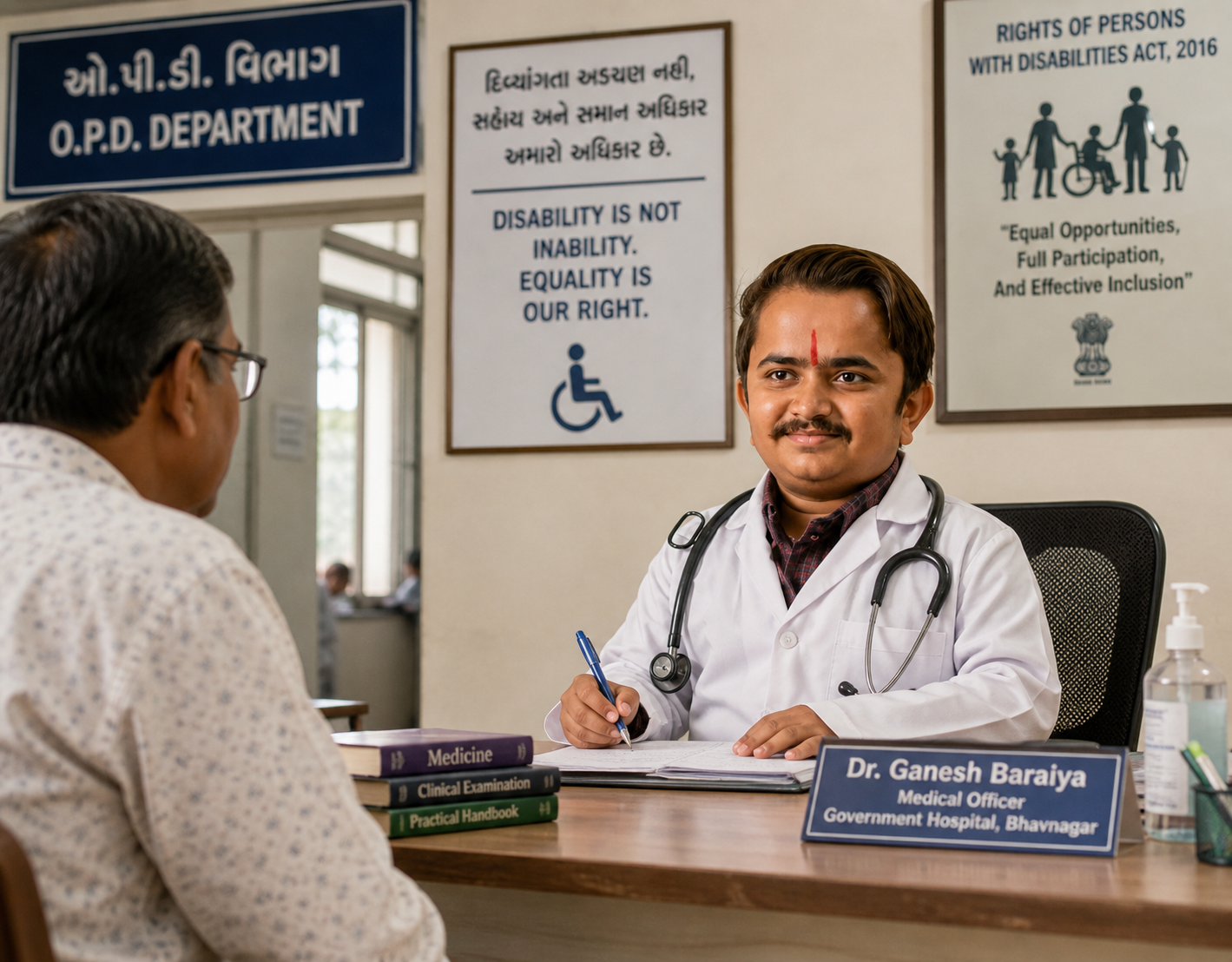
He joined Government Medical College, Bhavnagar, in August 2019. After finishing his MBBS and his internship, he began his first posting on 27 November 2025. He works as a medical officer at a government hospital in the same district.
The Rule Itself Stayed in Place
The judgment settled his case, though it did not change the framework. The 2019 rules for medical admissions still worked from a percentage. What a candidate could actually do did not come into it.
In October 2024 the Supreme Court held, in two linked cases, that a number alone cannot rule a candidate out. A board that finds someone unable to do the course must give reasons. Then in May 2025, hearing the case of an aspirant with five half-grown fingers, the court called reasonable accommodation a right rather than a favour.
What Changed in July 2025
The National Medical Commission set up an expert panel to review the rules. It then issued interim rules in July 2025, applying from the 2025-26 session. The old percentage no longer counts.
Candidates now submit a disability ID card with a signed affidavit. It sets out which tasks they can and cannot do, covering movement, writing, speech and sight. Boards look at what a person can do, not at a number.
The Wise Take
Seven years separate Ganesh Baraiya’s admission from the rule change, and that gap is the part most easily lost when a single case is told as a triumph. Winning in court secured one seat. It left the rule untouched, so every candidate after him had to fight the same argument again, and several did. The change came in the end from a run of judgments and a regulator’s review, not from one person’s persistence. What his case supplied was the first proof that the assumption behind the rule was wrong, which is usually where these things have to begin.