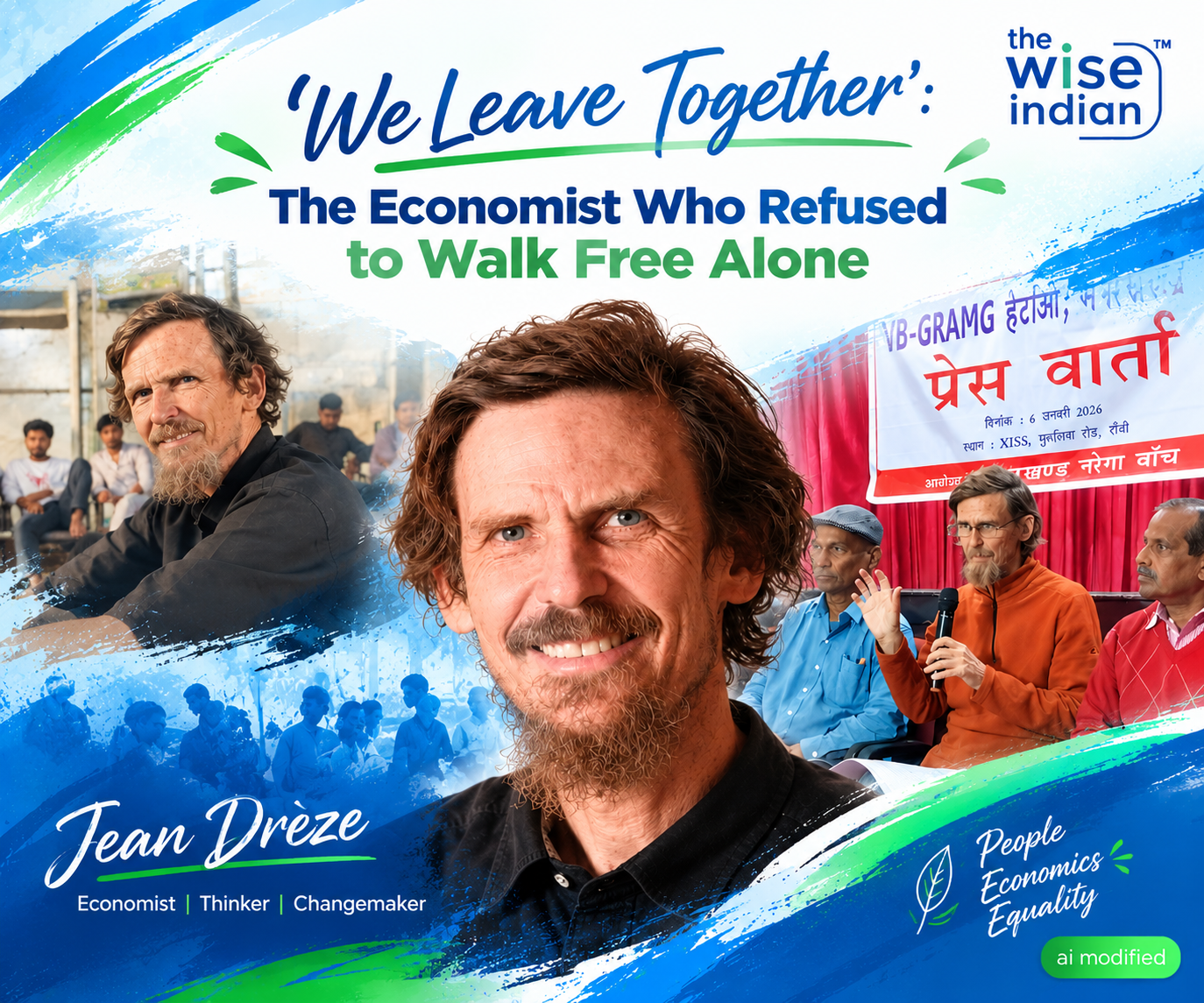
Economist Jean Drèze has drawn national attention after Delhi Police detained him on 10 October 2026. The Belgian-born economist refused to walk free while others stayed behind in custody. Since then, his quiet act has drawn fresh attention to five decades of work for India’s poorest people. Here is what happened, and why it matters.
Why Jean Drèze Was Detained Near Jantar Mantar in Delhi on 10 October 2026
Delhi Police detained Jean Drèze near Jantar Mantar on Saturday, 10 October. According to Siasat Daily, which cited a report by Article 14, three activists were with him. They were Paran Amitava, Anjali S and Aban Raza. Then police allegedly took the 67-year-old economist about 16 kilometres away to Adarsh Nagar police station in North West Delhi. Gulf News reported that police sealed off the protest site that day. Authorities closed 46 Metro stations and set up temporary detention centres. In addition, authorities reportedly suspended mobile internet around the protest area. A video of his detention later went viral after a journalist asked him who he was.
Why the Economist Refused to Leave Police Custody Until Every Other Detainee Was Released
At the police station, he met many other detainees. Most were men from Assam and West Bengal. In fact, several told him they had nothing to do with the protest. One was on his way to a hospital. Another had simply stepped out for breakfast. After some hours, police let Drèze and his three companions go. Jean Drèze declined to leave. He told Article 14 that either all detainees would be released together, or they would stay put. The group even wrote an application demanding the same.
The standoff lasted about 11 hours in total. Police released all the detainees at around 8 pm, according to Siasat Daily. One detainee praised the gesture and said people in this country must speak up for one another. Police did not comment on the episode. Some detainees alleged they were picked up because of their faith. These are allegations, and police have not responded to them. Drèze said he has lived in India for nearly 50 years. He had never seen such heavy force used against a protest, he added.
What the Cockroach Janta Party Protest and the Voter List Dispute Are Really All About
The protest was called by the Cockroach Janta Party, known as the CJP. It began online in May 2026 as a satirical movement. It has since grown into a youth-led campaign on unemployment, exam irregularities and accountability. The CJP is not a registered political party. It demanded the resignation of Chief Election Commissioner Gyanesh Kumar. The dispute centres on the Election Commission’s Special Intensive Revision of electoral rolls.
The Election Commission says the exercise removes dead, duplicate and ineligible voters. The commission calls the revision lawful and necessary for accurate rolls. Critics fear eligible citizens, especially from marginalised communities, could be left out. The Election Commission and the BJP reject the allegations of bias, as Gulf News noted.
Delhi Police said permission had not been granted for the gathering at Jantar Mantar. Detention figures differ widely. Police sources cited around 1,000 people. The CJP claimed more than 15,000. Gulf News reported at least 3,000. Amnesty International criticised the restrictions as lockdown-like. Opposition leaders were also reported detained during separate demonstrations that day.
A Lifetime of Work on Hunger, Jobs and Rights That Won a Global Inequality Award in June 2026
Jean Drèze was born in Leuven, Belgium, in 1959. He moved to India in the late 1970s. He became an Indian citizen in 2002. Today he lives in Ranchi, Jharkhand. He studied at the Indian Statistical Institute in New Delhi and once taught at the London School of Economics. He is also an honorary professor at the Delhi School of Economics and he co-authored books with Nobel laureate Amartya Sen, including An Uncertain Glory. Many media profiles call him the Barefoot Economist. He helped conceptualise and draft the first version of the NREGA, which became MGNREGA and also contributed to the Right to Information Act and the National Food Security Act.
He was also part of the Right to Food campaign. A 2001 Supreme Court case from that movement pushed states towards cooked mid-day meals in primary schools. Today, school meals are a staple, and the debate now covers eggs. On 5 June 2026, he received the Global Inequality Research Award in Paris. The World Inequality Lab and Sciences Po created the prize. It is presented every two years. Lucas Chancel and Thomas Piketty handed it over at the Paris School of Economics.
The first edition, in 2024, honoured Bina Agarwal and James K. Boyce. The jury honoured his work on poverty and inequality measurement in India. It also recognised his advocacy for NREGA and the National Food Security Act. He described his own work as research for public action and he accepted the award as a shared honour. He credited activists, rural workers and marginalised communities whose struggles shaped his research.
The Wise Take
The Jean Drèze story shows that principles often appear in small moments. He could have walked out within hours. He chose to stay for strangers instead. That choice matches the values he has argued for in his research. The larger debate is still open. The right to peaceful protest and fair voter lists matter to every citizen. Numbers and motives in this dispute remain contested. Whatever your view of the protest, his gesture of solidarity stands apart. Readers should follow verified reports and weigh claims from every side. His conduct, however, was reported by Article 14 and echoed by a fellow detainee.
Also read our other article on India AI Readiness Wins a World Bank Top 10 Spot: What the New Report Means for Jobs and Growth
Follow The Wise Indian for regular updates on stories that truly matter to every citizen. Stay connected with us for sharp analysis, untold perspectives, and a closer look at India’s social fabric.