

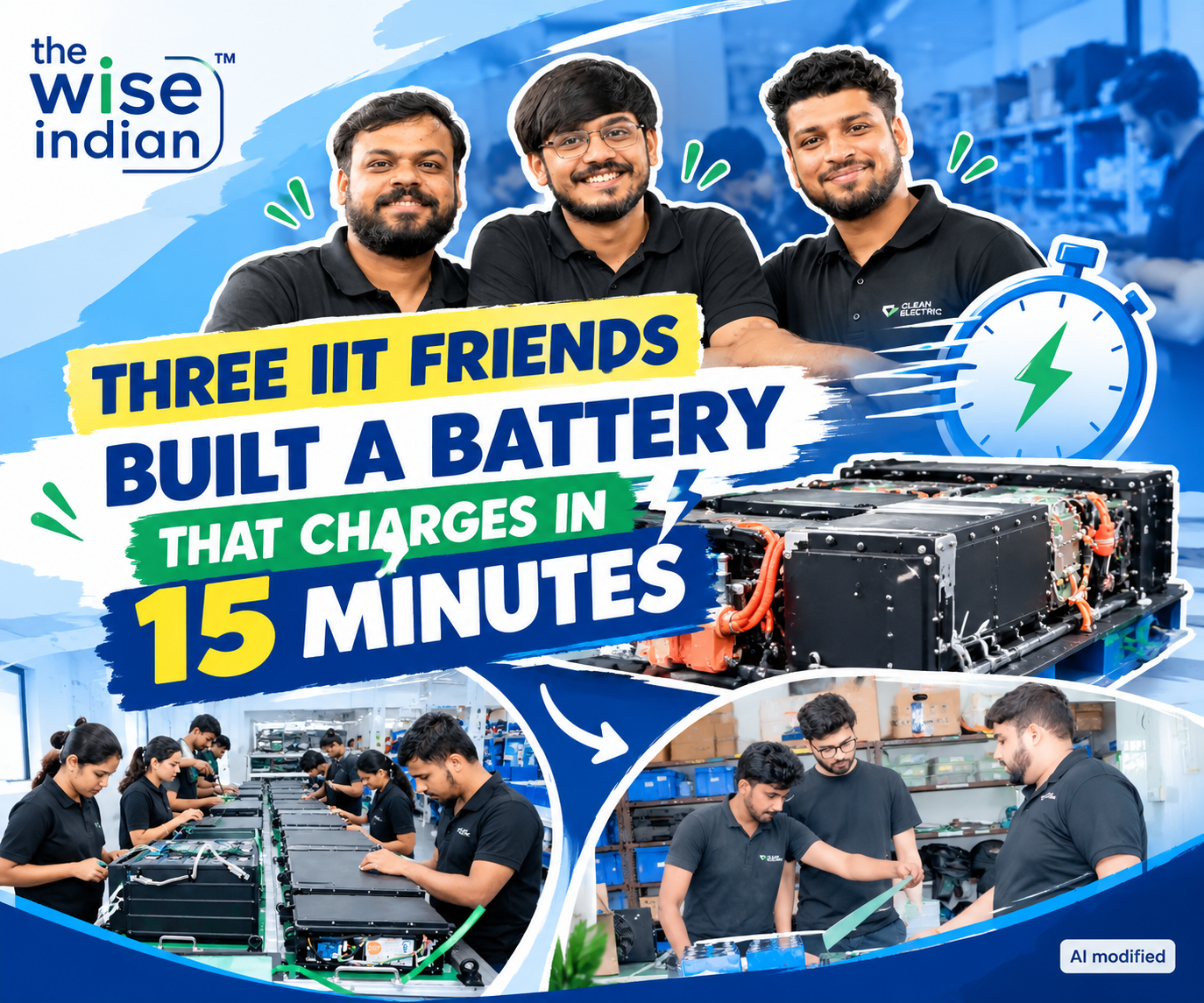
A Pune-based startup is changing how Indian electric vehicles manage their batteries. The Clean Electric founders are Akash Gupta, Abhinav Roy and Ankit Joshi. Their company builds immersion-cooled lithium-ion battery packs for electric two-wheelers, three-wheelers and four-wheelers. In September 2024, it raised $6 million in Series A funding.
Who Are the Clean Electric Founders?
The Clean Electric founders hold three clear roles in the company. Akash Gupta is the Chief Executive Officer. Abhinav Roy serves as the Chief Technology Officer. Ankit Joshi is the Chief Product Officer. YourStory reports that Gupta and Roy are IIT BHU batchmates. Another trade report describes the team as IIT BHU and IIT Mandi alumni. The company began in 2020, according to its own website. Its address is on the Pune-Nashik Highway in Kurali, Maharashtra. The startup describes its mission in simple terms. It says its hardware and software handle the energy storage equation.
That covers design, deployment, and life management as each battery ages. Its vision is to let companies focus on building their vehicles. Clean Electric then supplies the power. The website also lists its values. These include putting customers first, honesty, dedication, and creative innovation. The company also states a wider goal. It wants to make India clean and green through sustainable practices. Its website says dedication drives it to create robust, safe, and reliable products. Safety is therefore a recurring theme in how the company describes itself.
How Does Immersion Cooling Make EV Batteries Safer?
Heat is one of the biggest enemies of an EV battery. Too much heat shortens battery life. It can also raise safety risks. Clean Electric tackles this problem with direct-contact liquid cooling. This is a form of immersion cooling. Battery cells sit in a dielectric fluid that carries heat away. Worldwide, makers also use air cooling, liquid cooling and phase change materials. Immersion cooling is harder to scale, as Organiser notes. Even so, EVreporter says Clean Electric is among the first to produce it at scale. The outlet reports that the design raises coolant contact area by five to seven times. As a result, batteries run cooler and more evenly. They can also charge faster and last longer. The company also uses smart software.
Kalaari Capital says the patented design includes a proprietary temperature modulation algorithm. This gives precise control over the battery’s thermal state. The company says its packs can fast charge in 12 to 15 minutes. That speed matters for vehicles that work all day. Its website lists three core technologies: immersion cooling, a battery intelligence platform, and smart temperature modulation. The startup also targets problems that worry EV buyers. These include battery fires, long charging times, and frequent battery replacement. At its seed stage, Climate Angels said direct liquid cooling keeps cells fully in contact with coolant. The investor linked this design to better safety and a 1.5 times longer battery life. These are investor claims, so buyers should check real-world results.
From Seed Funding to a $6 Million Series
Clean Electric raised its seed round in 2022, according to Tracxn data cited by YourStory. The $2.2 million round was backed by Kalaari Capital and Climate Angels. LV Fund, 7Square Ventures and the CIIE Regional Innovation Foundation also took part. The plan was to build a Pune plant for 5,000 battery packs a month.
In September 2024, the startup announced a Series A round of Rs 48.5 crore. That is about $6 million. Info Edge Ventures, pi Ventures and Kalaari Capital co-led the round. Entrepreneur India reports total funding of about $9 million. The company planned to spend the money on research, sales, operations and new products. It also planned four-wheeler packs for early 2025. Heavy electric vehicle packs were planned for later that year. The Clean Electric founders had moved from lab prototypes to commercial production.
What Has the Startup Achieved So Far?
By its Series A, Clean Electric worked with 12 EV makers. YourStory reported operations in 35 cities across 10 states. The team had 80 members, and capacity was close to 20 MWh. CEO Akash Gupta also shared annual recurring revenue of $1.2 million. Bounce Infinity uses its batteries in electric scooters. For electric three-wheelers, EVreporter lists Omega Seiki Mobility and Baxy Mobility among its partners.
More recently, EVreporter reported over 3,000 FLO150 packs deployed in electric L5 autos. The FLO150 is a 15 kWh immersion-cooled battery pack. It uses immersion cooling and a cell-to-pack design. The company says more than 5,000 of its batteries now run on the road. It also plans to scale the technology to light commercial vehicles, buses and heavy trucks. However, challenges remain. In 2024, Gupta said its batteries cost 10 to 20 percent more than rivals. He expects that gap to shrink as production grows.
The Wise Take
The Clean Electric founders show how focused engineering can solve a real Indian problem. Heat damages batteries, and Indian summers are harsh. Their answer was to cool battery cells directly. Investors backed that idea, and real deployments now support the claims. Challenges remain, especially price and scale. Still, the story offers a useful lesson. Hard problems reward patient and careful work. Strong batteries may decide how fast India goes electric. Gupta, Roy and Joshi are already part of that answer. Keep an eye on this Pune startup as it grows.
Also read our other article on AI Built Disaster Plans for 75 Gram Panchayats. Another 2.5 Lakh Have None
Follow The Wise Indian for more inspiring stories.



