
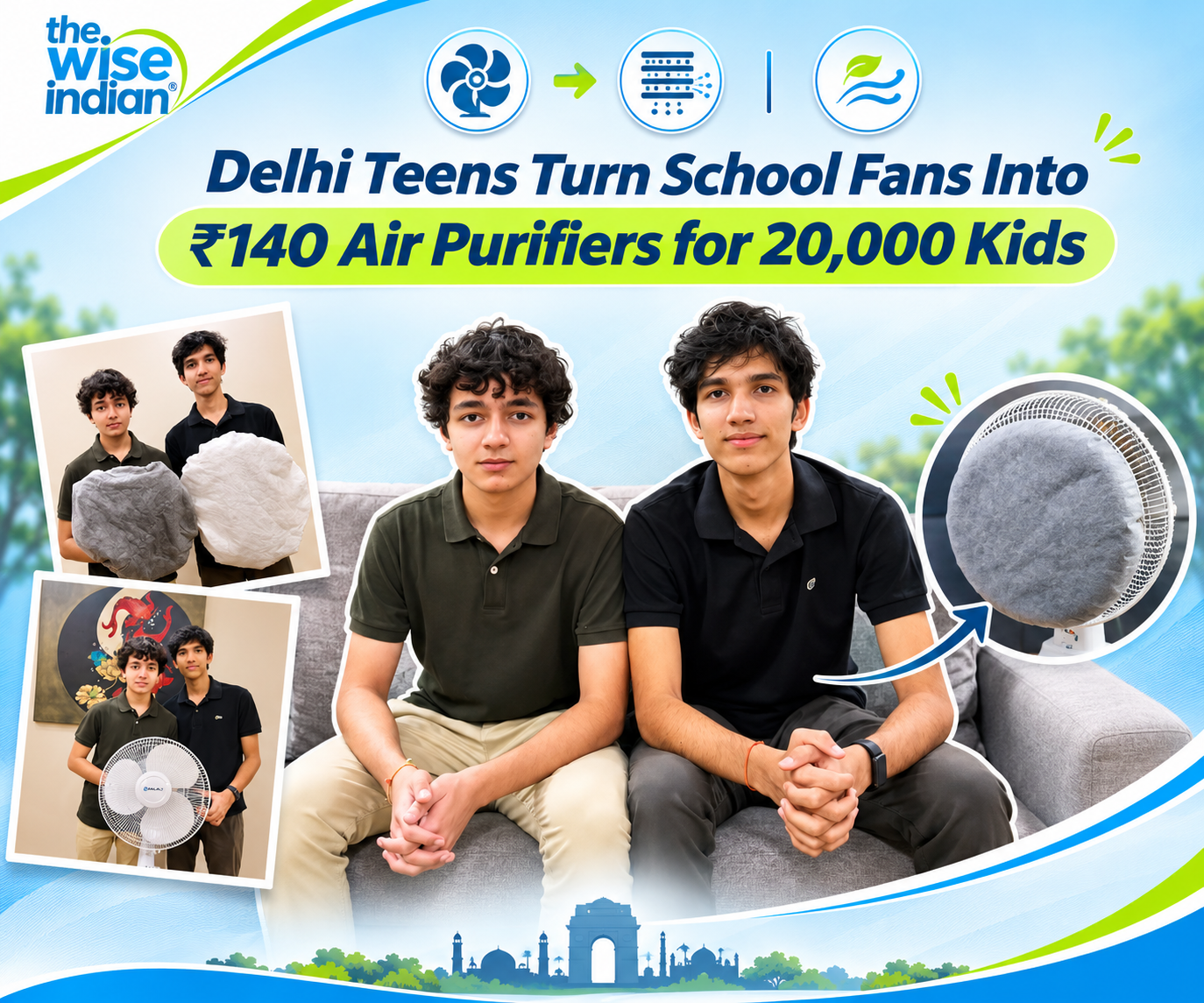
Two Delhi teenagers have found an affordable way to tackle indoor air pollution in schools. Krish Aggarwal and Samarth Meattle developed a filter that transforms ordinary classroom fans into air purifiers. Each filter costs approximately ₹140 to manufacture. Moreover, the innovation uses equipment that schools already have. Their initiative has reportedly reached around 20,000 students. It offers a practical alternative for schools that cannot afford expensive air purification systems.
How Project Vayu began with a classroom problem
Delhi’s air pollution affects children both outdoors and inside classrooms. During winter, pollution levels often rise sharply. As a result, schools face difficulties protecting students from harmful airborne particles. Children spend several hours inside classrooms every school day. However, many schools cannot afford individual air purifiers for every room. Krish Aggarwal and Samarth Meattle wanted to address this inequality. Krish studies in Class 12 at Sanskriti School, while Samarth attends Class 11 at Vasant Valley School. Both students recognised that access to cleaner air should not depend on a school’s financial resources.
The idea developed when Krish was studying in Class 9. Instead of building an entirely new purification machine, they explored ways to improve existing fans. Their approach focused on affordability, easy installation and practical use. They also wanted teachers to operate the system without technical assistance. Their early work involved testing different materials and examining filtration performance. They later collaborated with Hollingsworth & Vose, a global filtration manufacturer. The company supported their research and development efforts and supplied filter material. The Mobius Foundation also helped introduce the initiative to its first schools. Through these efforts, Project Vayu developed from a student idea into a practical classroom solution.
How an ordinary fan becomes an air purifier
The innovation uses a special filter attached to an ordinary table or wall fan. An elastic lining holds the filter securely around the fan grille. Teachers can install it in less than a minute without tools or additional electrical wiring. The filter contains electret media made from electrostatically charged fibres. These fibres attract and capture fine airborne particles, including PM2.5, which can penetrate deep into the respiratory system. Unlike a standalone purifier, the system uses an existing fan to move air through the filter. Its balloon-like design makes the technology particularly interesting.
When someone switches on the fan, airflow inflates the filter and creates a larger surface area for filtration. The expanded filter provides more than five square feet of filtering surface, according to the project’s technology information. The design also aims to maintain airflow without requiring a stronger fan motor. Its construction allows ordinary classroom fans to operate with the attachment. Consequently, schools avoid purchasing separate purification machines. The installation process also supports easy maintenance. Teachers can remove an old filter and fit a replacement quickly. This makes the system practical for classrooms with limited technical support.
How ₹140 filters are reaching thousands of students
Affordability remains central to the initiative. Each filter costs approximately ₹140 to manufacture. The official project website explains its cost structure. Filter media accounts for ₹85, while the elastic lining costs ₹15. Stitching and transportation account for the remaining ₹40. However, schools do not have to purchase the filters because the initiative distributes them free of charge. It also provides fans when classrooms lack suitable equipment. Hollingsworth & Vose supports the work by supplying filter material. The project began with a pilot across 295 classrooms in Delhi.
During this phase, the team installed 602 filters and reached approximately 8,000 students. Later, the initiative expanded to additional schools and under-resourced medical facilities. The founders told NDTV that their work had reached around 20,000 students. However, a November report by PTI cited more than 10,000 beneficiaries. These figures reflect reports from different stages, so the larger number should be understood as the founders’ reported estimate. Maintenance is another important part of the programme. Filters collect particles as air passes through them. Over time, their white material can turn grey or black.
The founders recommend replacing them during the winter pollution season. Schools receive replacement filters without bearing the expense. The initiative now aims to reach more schools beyond Delhi. The founders also want to work with government institutions, NGOs and corporate partners. Such partnerships could help extend the programme to communities with limited resources.
Recognition for a practical environmental innovation
The initiative has also received recognition beyond participating schools. Krish Aggarwal was included in the 2026 Diana Award Roll of Honour. The award recognises young people who make meaningful contributions through social action and humanitarian work. His recognition highlights the importance of youth-led environmental initiatives. Rather than waiting for expensive infrastructure, the students developed a solution around equipment already available. Their work also demonstrates how research partnerships can support young innovators. The project received early contributions from Savya, who helped shape its foundational direction. He later moved to Stanford University for further studies.
Krish and Samarth have continued developing the initiative and expanding its reach. However, introducing a new solution to schools remains challenging. Institutions need confidence in its safety, performance and maintenance requirements. The founders have acknowledged that securing approvals and overcoming administrative delays remain major obstacles. Testing also requires careful interpretation. In a closed room of approximately 200 square feet, reported PM2.5 levels fell from 158 to 11 micrograms per cubic metre within an hour. That represents a reduction exceeding 90%. In larger rooms, the founders reported reductions of around 60% within an hour. Results can vary with room size, ventilation and open doors. Therefore, these findings should not be treated as guaranteed outcomes for every classroom.
The Wise Take
Cleaner classroom air should not become a privilege reserved for well-funded schools. Project Vayu highlights how young people can approach environmental problems with practical thinking. Instead of replacing existing equipment, Krish and Samarth found another way to use it. The reported reach of approximately 20,000 students demonstrates the potential of affordable solutions. However, wider adoption will depend on reliable testing, regular maintenance and institutional support.
Schools must also understand the limitations of fan-based filtration. The larger lesson extends beyond one invention. Students can identify problems in their communities and develop solutions through collaboration. With continued support, affordable innovations can help make essential resources more accessible. Sometimes, meaningful change begins with a simple question about something already present in a classroom.
Also read our other article on Balisto Agritech: How Two IIT Bombay Graduates Are Bringing Electric Technology to Indian Farms
Follow The Wise Indian for more technology-related information, insights, and daily updates on India’s tech landscape