
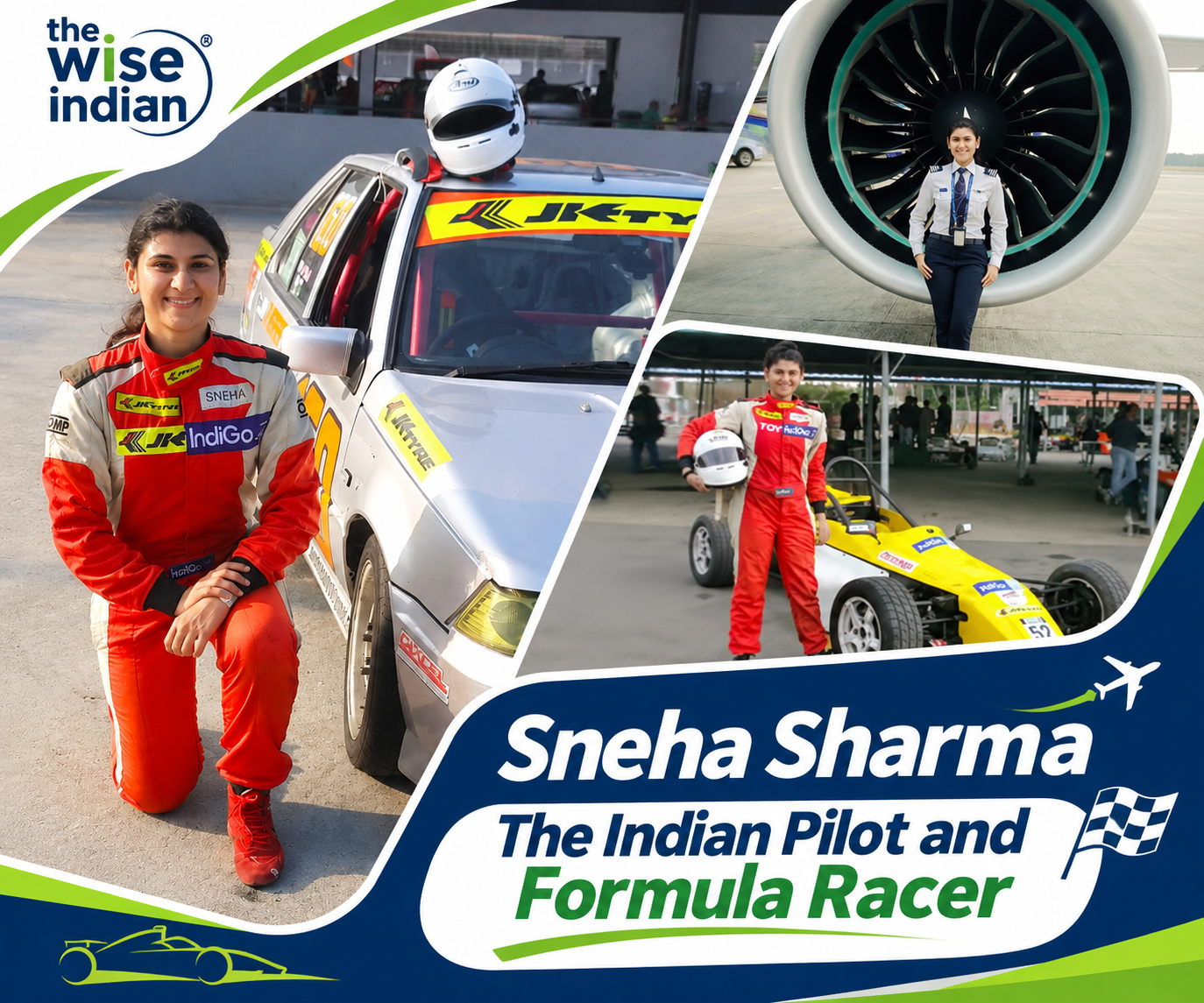
Sneha Sharma has built a career across two worlds: commercial aviation and competitive motorsports. Both demand precision, discipline and quick decisions. In fact, she has competed in national racing championships and the Formula 4 South East Asian series. Furthermore, her journey began when she discovered go-karting in Mumbai as a teenager. Over time, it grew through years of practice, financial sacrifice and professional training. Therefore, her story is not simply about speed. It is about pursuing two demanding ambitions and earning a place in a sport where women remain underrepresented.
Early Passion for Speed and Machines
Born in Kolkata and raised in Mumbai, Sneha Sharma became interested in flying during childhood trips aboard ships. Meanwhile, her father worked in the Merchant Navy. Watching aircraft pass overhead helped shape her ambition to become a pilot. However, her interest in speed appeared just as early. At around 14, she discovered a go-karting track in Mumbai and became fascinated.
For practice, she began spending pocket money on practice sessions, sometimes giving up lunch money for a few laps. With limited access to formal coaching, she approached mechanics at the track. They taught her cornering, braking and racing lines. Regular practice then helped her move from casual karting towards competitive events. Red Bull’s 2018 profile records how mechanics became her first teachers and supported her entry into organised racing.
Building a Career in Commercial Aviation
Her progress on the track did not mean aviation disappeared from her plans. At 17, she travelled to California for flying training. Afterward, she obtained her flying qualifications and returned to India. There, she worked to convert her licence for Indian operations. Rediff reported in 2018 that she held an airline transport pilot licence. Furthermore, it reported that she had worked with IndiGo since 2012. However, flying education involved considerable expense. She told the publication that she had taken a student loan to fund training.
In addition, a professional aviation career offered another advantage. Motorsports can be costly, with expenses for training, equipment, travel and competition. Therefore, a steady income helped her support racing without relying entirely on sponsorship. Both careers demanded careful planning, preparation and concentration. She had to organise practice around flying schedules and protect time for physical conditioning. In interviews, she has described waking early and following a strict routine. Such discipline helped her maintain progress in two fields with very different working environments.
From National Racing to International Competitions
After returning to India, she explored different motorsport formats before moving towards single-seater racing. Meanwhile, her experience included karting, the Volkswagen Polo Cup and the Toyota Etios series. Then, in 2014, she entered the LGB category of the JK Tyre racing championship. It is a national single-seater competition. Importantly, the terminology needs care: Indian reports sometimes described LGB4 as Formula 4. However, it should not automatically be confused with every internationally sanctioned Formula 4 series.
Her results showed her ability to compete in a competitive field. In September 2016, The Times of India reported two LGB4 finishes. She placed eighth and sixth at Kari Motor Speedway in Coimbatore. The report also noted 18 podium finishes across 35 races over nine years. Those numbers reflected years of regular participation, rather than a sudden breakthrough. She continued to seek stronger competition and opportunities to represent India beyond its borders. Sneha Sharma’s racing career also took her beyond the domestic circuit. In 2019, she competed in the Formula 4 South East Asian Championship in Thailand.
Evo India reported that she led the women’s category after the third round. She won the women’s cup, collecting trophies across all four races. Additionally, she finished among the top eight overall internationally. As a result, this performance showed her ability to adapt to a different circuit and new competitors. The series also gave her experience racing wheel-to-wheel against drivers from several countries. Data analysis and feedback from engineers helped her assess performance and improve between races. Around that period, profiles described her as an airline captain and racing driver. Indeed, both roles involve responsibility, technical understanding and decisions under pressure. Nevertheless, her results on the track remain the strongest measure of her racing work.
Challenging Gender Stereotypes in Motorsports
For Sneha Sharma, competing in a male-dominated sport brought challenges beyond the physical demands of racing. In interviews, she described how some male competitors questioned women drivers or tried to intimidate them. However, she chose to focus on performance rather than gender. The Times of India quoted her saying that drivers become simply racers once they put on their helmets. Additionally, she discussed limited practice time and the difficulty of maintaining fitness alongside flying duties.
Indeed, the physical demands became clear in 2017. Consequently, knee problems interrupted her racing campaign and required rehabilitation. Red Bull’s profile linked the injury to an intense schedule and an unsuccessful recovery effort. Her experience highlights the need for funding, training time, physical preparation and access to competition. Moreover, women entering the sport need equal opportunities to learn, secure sponsorship and prove themselves through results.
The Wise Take
The significance of Sneha Sharma’s journey lies in her choices. She did not follow a straight path from karting to full-time racing. Instead, she pursued education and professional aviation while working around motorsports’ financial realities. Later, she returned to racing when circumstances allowed. Moreover, her story challenges the idea that women must choose between technical professions and competitive sport.
At the same time, it should not become an inspirational slogan. In practice, racing requires sustained investment, strong support systems and opportunities to compete. Aviation, meanwhile, carries serious professional responsibilities. Ultimately, for young people interested in either field, her journey offers a practical reminder. Ambition needs preparation, patience and realistic planning. Her presence on racing grids has also helped make women’s participation harder to overlook.
Also read our other article on How Sonali Ghosh Became Kaziranga’s First Woman Field Director and Led Its Flood Rescues and Anti-Poaching Work
Follow The Wise Indian for more inspiring stories.