

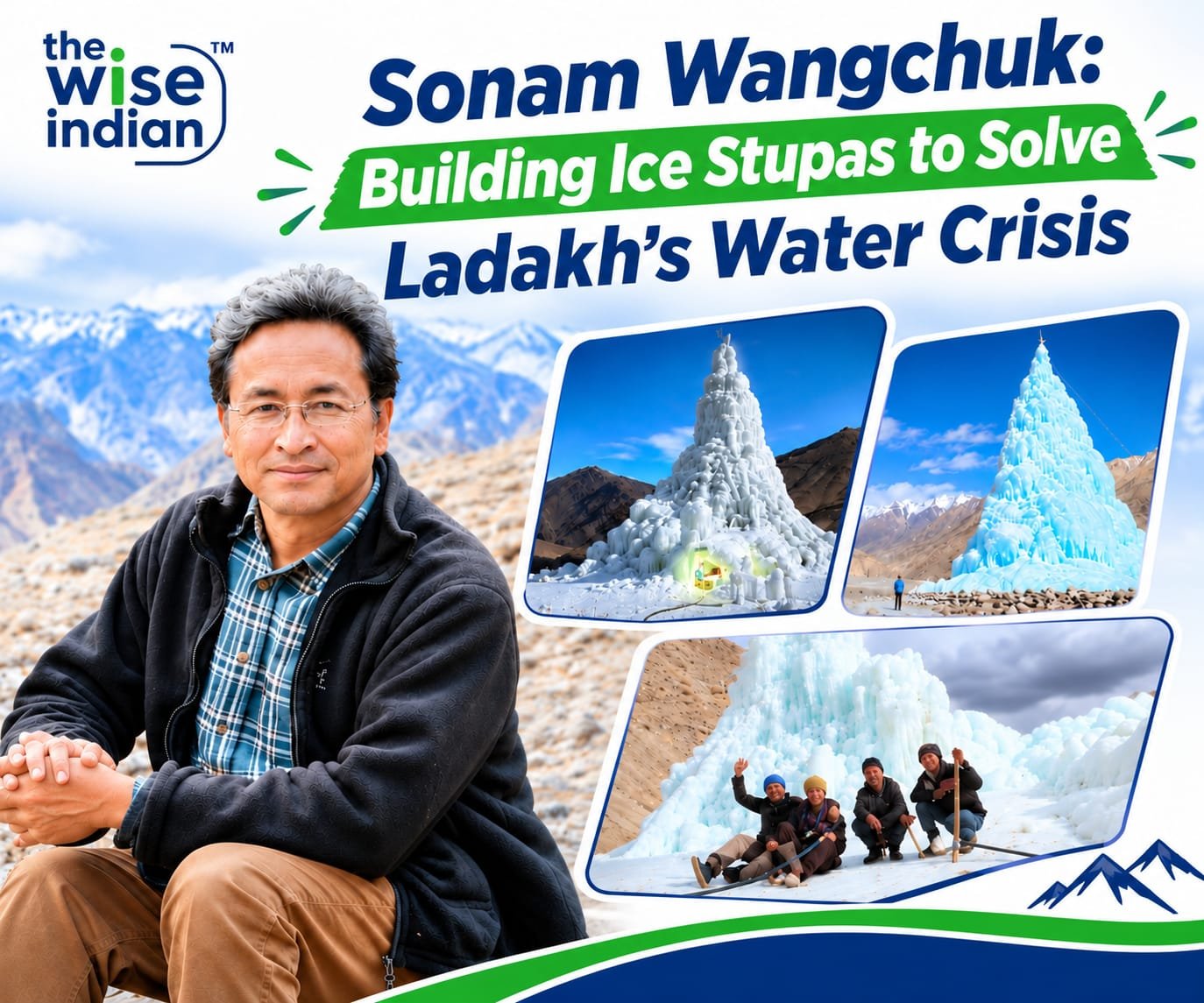
In the high-altitude desert of Ladakh, water is one of the most valuable resources for survival. Farmers depend on glacial streams and seasonal snowmelt to irrigate their fields, but these natural supplies do not always arrive when they are needed most. Recognising this challenge, engineer and innovator Sonam Wangchuk developed an unusual solution that turns freezing winter temperatures into an opportunity for water conservation.
His innovation, known as the Ice Stupa, creates enormous artificial ice structures that gradually release stored water during the warmer months. By combining engineering principles with local environmental knowledge, he introduced a practical approach to seasonal water shortages. His work has also demonstrated how communities can use available natural resources to develop solutions for environmental challenges.
Growing Up in Ladakh and Understanding Water Scarcity
Sonam Wangchuk is an engineer, education reformer and environmental innovator from Ladakh, a mountainous region in northern India. Growing up in this challenging landscape helped him understand the difficulties experienced by communities living in the Himalayan cold desert. Ladakh receives very little annual precipitation because the Himalayas block much of the moisture carried by monsoon winds. Consequently, agriculture depends heavily on water supplied by melting snow and glaciers. However, the timing of this natural water supply creates a serious problem for local farmers.
During April and May, when agricultural activities begin, the available glacial meltwater is often insufficient to meet irrigation requirements. By the middle of summer, rising temperatures accelerate glacier melting, sometimes releasing more water than farmers can immediately use. This seasonal imbalance affects crop cultivation and places additional pressure on rural livelihoods. Sonam Wangchuk recognised that communities needed a way to preserve winter water and make it available during the critical planting season. His understanding of local conditions eventually contributed to the development of an innovative water-storage technique.
The Idea Behind Artificial Ice Stupas
The development of Ice Stupas built upon earlier experiments with artificial glaciers in Ladakh. Engineer Chewang Norphel had previously created artificial glaciers by directing water into shaded areas, where it could freeze and form reservoirs of ice. Wangchuk explored how this approach could be improved through a structure that stored more ice while reducing its exposure to direct sunlight. His design took inspiration from the cone-shaped appearance of traditional Buddhist stupas. These artificial structures resemble towering ice mountains that gradually release water as temperatures increase.
The central engineering principle involves reducing the surface area exposed to sunlight relative to the volume of stored ice. This helps the structure melt more slowly than a broad, flat ice reservoir. The first experimental structures were developed with the participation of young people at the Students’ Educational and Cultural Movement of Ladakh (SECMOL). The innovation demonstrated how winter temperatures could become a natural water-storage resource rather than simply an environmental challenge. In 2016, Wangchuk received the Rolex Award for Enterprise for his work on the Ice Stupa project, bringing international recognition to the initiative.
How Ice Stupas Store Water During Winter
The construction of an Ice Stupa relies on gravity, water pressure and naturally freezing temperatures. First, water from a nearby stream is transported through a pipeline to a suitable location in the village. The pipe is arranged vertically, allowing water to rise and spray into the freezing winter air. As the droplets fall, they freeze and gradually accumulate around the outlet. Repeated freezing creates a large cone-shaped structure that can store substantial quantities of water. Unlike conventional water-storage systems, the technique does not require electricity to operate because natural gravity provides the necessary pressure.
The cone-shaped design also reduces the ice surface exposed to sunlight, helping the structure survive into spring. When temperatures begin rising, the stored ice melts gradually and supplies water to nearby agricultural fields. Villagers can participate in building and maintaining these structures, making the technology accessible to communities with limited infrastructure. The system therefore combines relatively simple engineering with the natural conditions of the Himalayan environment. Its success depends on suitable winter temperatures, available stream water and careful selection of construction locations.
Supporting Farmers and Expanding the Project Across Ladakh
The main objective of Ice Stupas is to address the gap between water availability and agricultural demand. In Ladakh, farmers need irrigation water during early spring, but natural glaciers often release sufficient meltwater only later in the season. Artificial ice reservoirs help bridge this gap by storing water during winter and releasing it when newly planted crops require irrigation. The additional supply can support farming, tree plantation and vegetation in otherwise dry landscapes. It can also help villages maintain agricultural activities and protect traditional livelihoods. According to the Ministry of Tribal Affairs, an initiative undertaken with SECMOL aimed to establish Ice Stupas in 50 villages.
The ministry reported that 26 structures had been built by villagers during the preceding project period, storing an average of approximately 300,000 litres of water each. This represented a combined storage capacity of around 7.5 million litres. The initiative also explored opportunities for eco-tourism and local employment through activities such as the Ladakh Ice Climbing Festival. These developments demonstrated that water conservation projects could support both environmental needs and community participation. However, the results depend on local conditions, and individual structures cannot provide the same amount of water in every location.
Beyond Ice Stupas: Education and Sustainable Development
Although artificial glaciers brought international attention to his work, Sonam Wangchuk has also spent decades promoting educational reform and sustainable development in Ladakh. In 1988, he helped establish the Students’ Educational and Cultural Movement of Ladakh (SECMOL) with other young Ladakhis. The organisation works to improve educational opportunities for students through practical learning and alternative teaching methods.
Its campus near Leh demonstrates environmentally conscious construction and the use of renewable energy, including solar power. Students participate in activities that encourage creativity, teamwork and a better understanding of local challenges. This approach reflects Wangchuk’s belief that education should help young people develop solutions to real-world problems rather than depend entirely on classroom learning. His wider vision also includes encouraging research into environmental protection, appropriate technology and sustainable livelihoods in mountain regions.
The Ice Stupa initiative follows the same philosophy by combining scientific observation with community involvement. His work shows how engineering, education and environmental awareness can contribute to the development of remote communities. At the same time, artificial glaciers are not a complete answer to Ladakh’s changing water conditions. Their effectiveness depends on winter temperatures, stream availability, maintenance and the timing of seasonal melting. They are best understood as one practical adaptation strategy alongside broader water-management and climate-resilience measures.
The Wise Take
Sonam Wangchuk Ice Stupa innovation demonstrates how carefully observing nature can lead to practical solutions for difficult environmental problems. By turning unused winter water into a resource for spring agriculture, he introduced an approach that responds to the specific needs of Himalayan communities. His work also highlights the importance of involving local people in designing and maintaining sustainable technologies.
Although Ice Stupas cannot solve every water challenge, they offer a valuable example of engineering that works with nature rather than against it. His contributions to education and environmental innovation further demonstrate how local knowledge can inspire ideas with wider applications. Ultimately, the project reminds us that meaningful innovation does not always begin with expensive machinery or complicated technology. Sometimes, it begins with recognising a problem, understanding the environment and finding a simple way to make available resources more useful.
Also read our other article on Binalakshmi Nepram: The Manipur Activist Helping Women Survivors of Gun Violence Rebuild Their Lives
Follow The Wise Indian for more inspiring stories.