
India’s traditional crafts carry centuries of knowledge, cultural identity and extraordinary craftsmanship. Yet many artisans who preserve these traditions struggle to earn a stable income. Patan Patola weaving in Gujarat and Toda embroidery in the Nilgiris have both received a GI tag. Their names are protected. However, the people behind them still need dependable markets, fair payment and opportunities to pass their skills on. This reveals India’s craft-preservation challenge. Protecting a product’s identity is not the same as protecting an artisan’s livelihood.
What a GI Tag Actually Protects
A Geographical Indication, or GI, identifies goods linked to a particular geographical area. Their qualities, reputation or characteristics must be associated with that location. In India, the system operates under the Geographical Indications of Goods (Registration and Protection) Act, 1999. Registration provides legal protection to the registered name. It also helps authorised users challenge unauthorised use. Consequently, consumers can recognise products associated with particular regions. Genuine producers can also strengthen their products’ reputation.
However, a GI tag is not a wage scheme, pension or guaranteed purchase order. It does not automatically provide training, affordable raw materials, marketing support or customer access. Nor does it ensure that everyone involved in producing a craft receives equal benefits. The GI framework protects geographical identity. The economic conditions needed to sustain production require separate support.
Patan Patola: A Masterpiece That Takes Months to Make
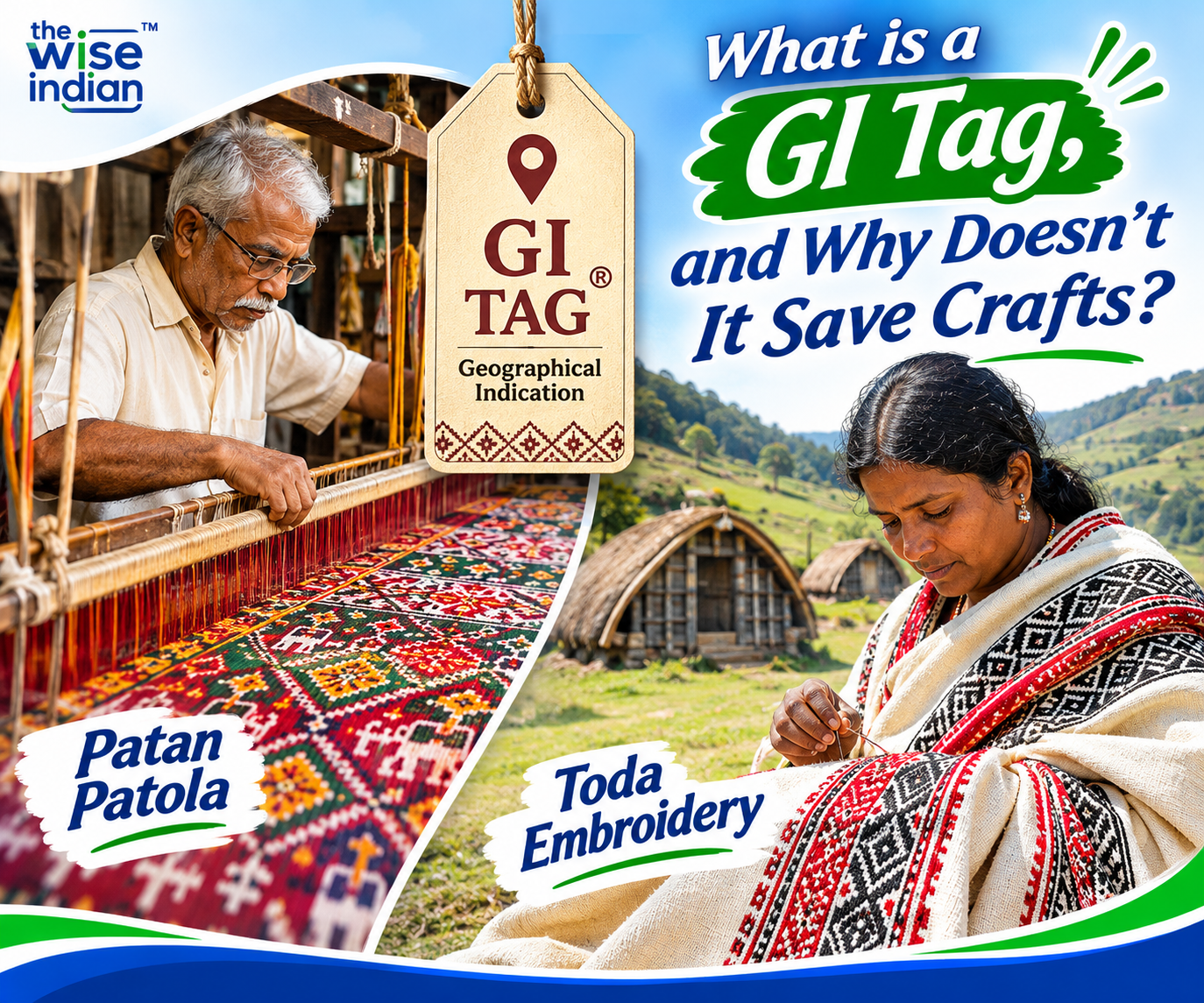
Patan Patola, produced in Patan, Gujarat, is renowned for its complex double-ikat weaving. Artisans tie and dye both the warp and weft threads before weaving begins. Each thread must follow a carefully planned design. The threads must also align precisely on the loom. This demanding process requires experience, patience and coordination. A single saree can take months to complete. Its cost reflects the time, silk and specialised labour involved. Patan Patola received a GI tag in 2013. Yet legal recognition has not removed the challenges facing its weaving community.
A 2025 qualitative study found that the number of traditional pioneer families actively weaving had fallen sharply. It identified only three such families among the prominent weaving houses examined. Other residents have also learned the craft and joined production. This has created additional employment opportunities. However, the study describes Patola earnings as supplemental for some participants. Training programmes face another difficulty. Learners may begin enthusiastically, but not everyone completes the process. Therefore, prestige and high retail prices do not automatically translate into secure earnings for every artisan.
Toda Embroidery: Cultural Knowledge and Women’s Livelihoods
Toda embroidery is practised by women from the Toda community in Tamil Nadu’s Nilgiri Hills. Traditionally, it decorates the community’s distinctive shawl, known as the poothkuli. The embroidery features red and black geometric patterns on white cloth. Artisans create these designs through a counted-thread technique. This requires close attention to the fabric’s structure.
Toda embroidery received a GI tag in March 2013. The recognition helps protect its regional identity. Meanwhile, collaborations with organisations and designers have introduced the craft to wider markets. They have also helped develop products for contemporary customers. However, UNESCO’s craft documentation identifies continuing challenges. Remote settlements make market access difficult. The community’s dwindling population also raises concerns. Younger generations are showing declining interest in the craft. This is not simply a question of whether young people value their heritage. Economic opportunities matter too. If embroidery offers irregular orders or low piece-rate payments, younger people may choose more predictable occupations. For practising women, a sustainable future depends on markets that value their time and skill.
Why Legal Recognition Is Not Enough
These two crafts reveal different but connected pressures. Patan Patola requires expensive materials, specialised equipment and long production periods. It also demands considerable technical skill. Meanwhile, Toda embroidery is closely connected to community knowledge and women’s work. Its producers may face geographical barriers and limited bargaining power. In both cases, a protected name can distinguish authentic work. However, it cannot create demand by itself. Artisans need transparent pricing, direct access to buyers, reliable orders and fair compensation. They also need affordable raw materials, design development, quality standards, packaging and digital marketing.
Producer groups and cooperatives can help artisans pool resources and negotiate collectively. Furthermore, training must connect learners with paid work. Learning a traditional technique should become a realistic livelihood rather than an unpaid obligation. Government agencies, craft organisations and retailers must also communicate clearly about authenticity. Consumers should understand the production time and skill behind each item. Consumers have an important role too. Choosing genuine handmade products and understanding their higher prices can sustain skilled work. These measures do not replace GI protection. Instead, they make that protection more meaningful.
The Wise Take
A craft survives when the people practising it can afford to continue. A GI tag is valuable because it recognises geographical identity and provides legal protection against misuse. However, Patan Patola and Toda embroidery show that legal status alone cannot guarantee fair incomes, new learners or dependable demand.
Preservation must therefore move beyond certificates and promotion. It should include fair compensation, accessible markets, practical training and social security. Artisans must also have opportunities to shape their traditions’ future. Ultimately, the real measure of success is not simply how many crafts receive GI tags. It is whether weavers and embroiderers can build secure lives while keeping their knowledge alive for the next generation.
Also read our other article on Lakhpati Didi Initiative: How 3.5 Crore Rural Women Are Building Financial Independence Across India
Follow The Wise Indian for more stories about the people and ideas quietly reshaping India.