
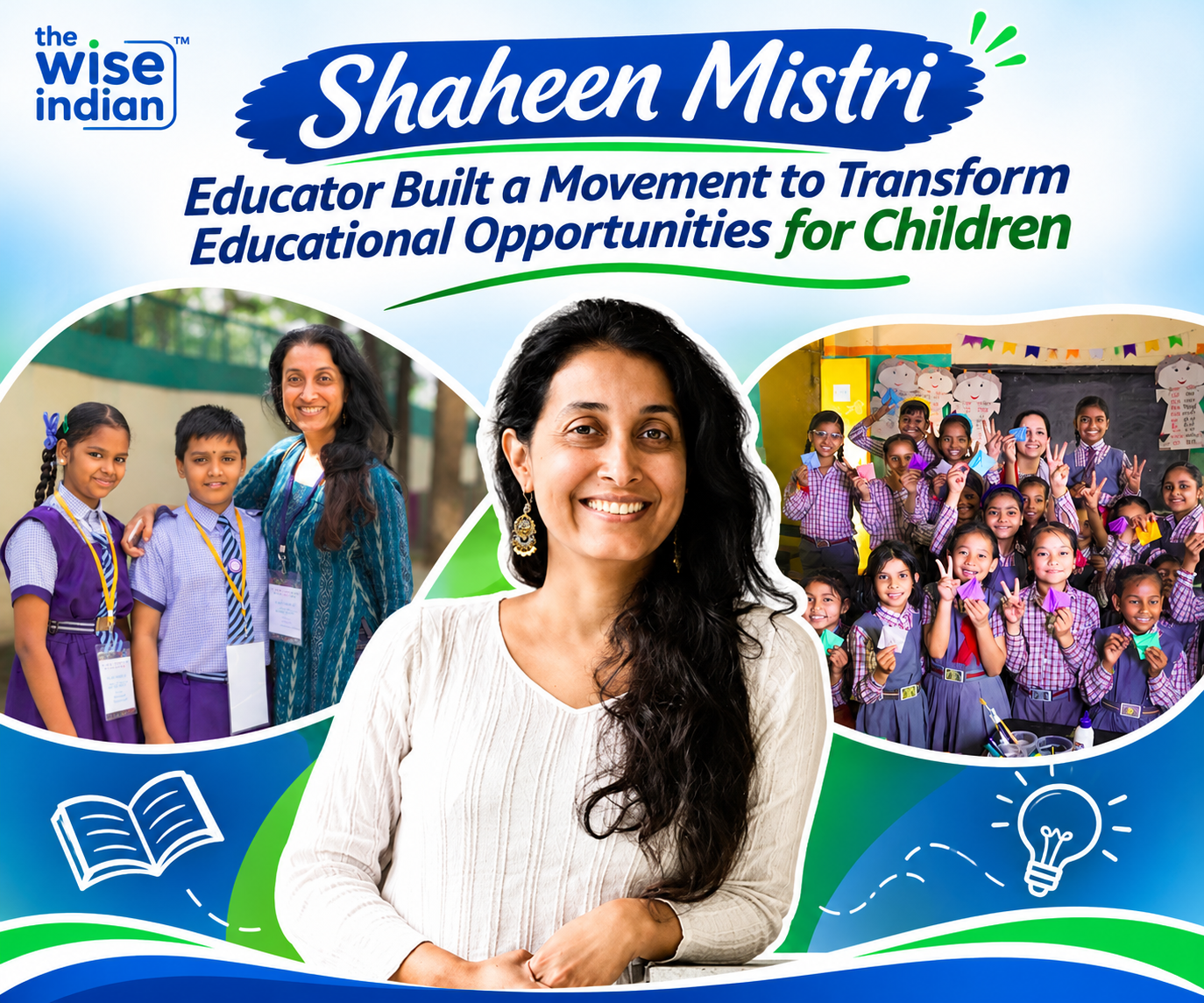
In a country where millions of children continue to experience unequal access to quality education, one educator has spent decades working to change their opportunities. Shaheen Mistri began her journey with a small classroom and a group of children who needed access to better learning opportunities. Rather than accepting educational inequality as an unavoidable reality, she decided to work directly with communities and build solutions that could reach more children. Her efforts eventually led to the establishment of two influential organisations, Akanksha Foundation and Teach For India. Today, her journey represents how an individual’s commitment can develop into a wider movement involving teachers, students, volunteers and education leaders across the country.
From a Small Classroom to a Larger Purpose
Born on March 16, 1971, in Mumbai, Shaheen Mistri spent much of her childhood living in different countries because of her father’s banking career. She attended several schools and experienced different educational environments. These experiences exposed her to different cultures and approaches to learning, but her return to India introduced her to a different reality. At 18, while studying at St. Xavier’s College in Mumbai, she encountered children from disadvantaged communities who had limited access to educational opportunities. Their circumstances made her question why a child’s background could determine the quality of education they received.
One experience that influenced her thinking involved seeing children asking for money near a traffic signal. The encounter made the differences between children’s everyday lives difficult to ignore. Instead of limiting her response to sympathy, she began volunteering and teaching children from low-income communities. Through these interactions, she understood that education could offer children more than academic knowledge. It could help them develop confidence, discover their abilities and make independent choices. This early involvement gradually shaped the direction of her work and became the foundation of her commitment to educational equality.
Building the Akanksha Foundation
In 1991, Mistri and a group of college friends started the Akanksha Foundation by teaching 15 children in a donated classroom at Holy Name High School in Mumbai. The initiative began with limited resources, but its purpose was clear: children from low-income communities deserved meaningful educational support. Initially, Akanksha focused on after-school programmes that provided additional learning opportunities. Volunteers and educators worked with children who often lacked access to the resources available in better-supported educational environments. As the programme developed, Mistri began exploring how the organisation could create a more lasting impact rather than simply offering supplementary classes.
Over the following years, Akanksha expanded its reach considerably. Its after-school programme eventually grew to 60 centres, serving more than 3,000 children. A major development came in 2007, when the organisation launched its School Project in partnership with municipal corporations in Mumbai and Pune. This approach brought its educational work directly into municipal schools. Instead of operating separately from the public education system, Akanksha began exploring how better teaching practices, supportive learning environments and stronger school communities could improve children’s experiences. The foundation subsequently expanded its school network, demonstrating how a small classroom initiative could develop into a larger educational organisation.
Founding Teach For India to Reach More Children
Although Akanksha had grown, Mistri recognised that educational inequality required action beyond the work of a single organisation. She wanted more young people to understand the challenges faced by children in under-resourced schools and contribute to improving the education system. An important influence came in 2006, when she met Wendy Kopp, the founder of Teach For America. Kopp’s approach of recruiting graduates to teach in underserved schools introduced Mistri to a model that could be adapted to Indian circumstances. After engaging with education experts and other stakeholders, she began developing a similar initiative for India.
In 2008, Mistri founded Teach For India, creating a two-year Fellowship programme for graduates and young professionals. Selected Fellows work as full-time teachers in under-resourced schools, gaining direct experience of classroom challenges while supporting children’s learning. However, the programme was designed to extend beyond the two years spent teaching. After completing their fellowships, participants join an alumni network and can continue contributing through education, entrepreneurship, public service and other leadership roles. The larger ambition is to develop people who understand educational inequality through experience and remain involved in addressing it throughout their careers.
Shaheen Mistri’s Vision Beyond Academic Learning
Mistri’s work has never been limited to improving examination results or increasing school enrolment. She has consistently emphasised student voice, creativity, confidence and leadership. Through Teach For India, several initiatives have encouraged children to participate actively in shaping their learning experiences. The Kids Education Revolution, launched in 2016, brings students and educators together to discuss how schools can become more inclusive and responsive to children’s needs. It promotes the idea that students should participate in decisions about education rather than remain passive recipients of teaching.
Other initiatives have explored the role of creativity and professional development. Maya Musical uses theatre and performance to encourage children to express themselves, while Firki provides teachers with professional learning resources. TFIx supports education entrepreneurs who want to adapt the fellowship model to different communities and regional contexts. These programmes reflect a broader understanding of educational development: children need supportive environments, teachers need opportunities to improve, and communities need people willing to work together. Through these efforts, Mistri has helped create opportunities for educational leadership beyond conventional classroom teaching.
Measuring the Impact and Recognising the Work
The growth of both organisations provides an indication of how far the original initiative has travelled. According to Akanksha Foundation’s official timeline, the organisation now operates 28 schools across Mumbai, Pune and Nagpur. Its work has moved beyond after-school education towards partnerships with municipal institutions and the development of long-term school models. This approach seeks to improve educational experiences while working within the public education system.
Teach For India has also developed a substantial network. Its currently published impact figures report approximately 1,100 Fellows teaching across nine cities and 300,000 students directly impacted in its classrooms. The organisation also reports more than 5,800 alumni, over 170 organisations established by alumni and an extended movement reaching approximately 65 million children. These figures describe the organisation’s reported reach and should not be interpreted as independently verified national education outcomes. Nevertheless, they demonstrate the scale of the network that has developed around its original mission.
Her contributions have received recognition from several institutions. Mistri became an Ashoka Fellow and was named a Global Leader for Tomorrow by the World Economic Forum. In 2019, she received the Jamnalal Bajaj Award for Development and Welfare of Women and Children. She has also received NITI Aayog’s Women Transforming India Award. Beyond organisational leadership, she has shared her experiences through Redrawing India, a book reflecting on the people and ideas behind the education movement.
The Wise Take
The story of Shaheen Mistri demonstrates how a commitment to education can grow beyond an individual’s efforts and become a collective movement. Her journey began with 15 children, but the organisations she established have since brought together thousands of educators, students and volunteers. Her work also highlights an important distinction: educational equality is not achieved simply by placing children inside classrooms.
It requires supportive teachers, meaningful learning experiences, opportunities for self-expression and systems that recognise every child’s potential. Although significant challenges remain in India’s education sector, her initiatives show how sustained collaboration can contribute to addressing them. Ultimately, her legacy is not defined only by the institutions she founded, but also by the people she has encouraged to participate in building a more equitable education system.
Also read our other article on Clean Air Should Not Be a Luxury: How AIIMS Advice Exposes India’s Unequal Access to Pollution Protection
Follow The Wise Indian for more stories about the people and ideas quietly reshaping India.