
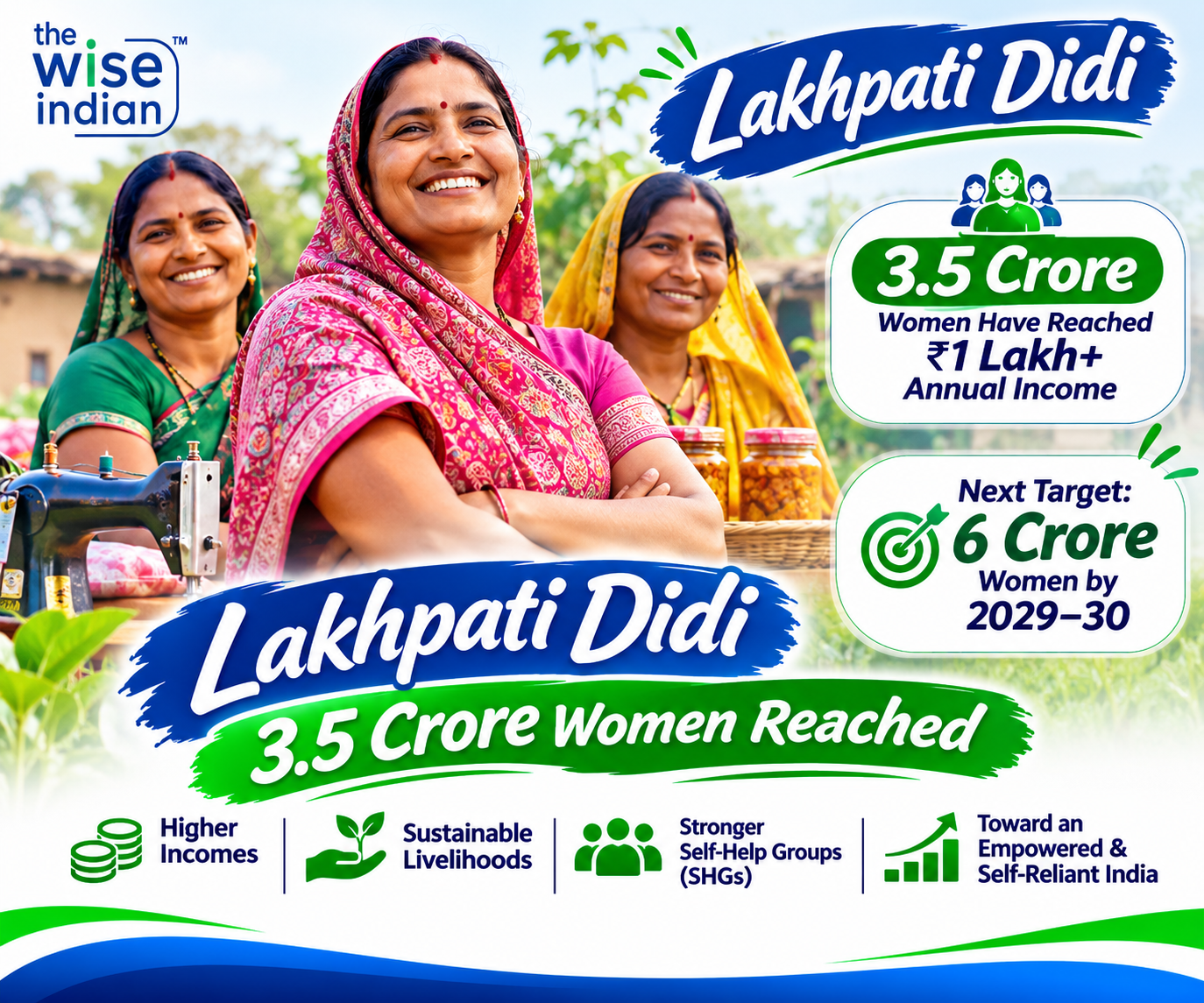
India’s rural women are increasingly becoming contributors to household income and local economic development. The Lakhpati Didi initiative has emerged as an important part of this transformation. It connects women with financial resources, livelihood opportunities and entrepreneurship support. By September 2026, approximately 3.5 crore women had achieved the programme’s income milestone. Now, the government aims to extend this opportunity to six crore women.
Understanding the Lakhpati Didi Initiative and Its Purpose
The Lakhpati Didi initiative focuses on helping rural women associated with Self-Help Groups (SHGs) establish sustainable livelihoods. A Lakhpati Didi is a woman whose household earns at least ₹1 lakh annually through different income-generating activities. However, the definition involves more than crossing a financial threshold once. The household must maintain this income for at least four agricultural seasons or business cycles. The programme also uses an average monthly household income benchmark of ₹10,000. Therefore, a temporary increase in earnings does not automatically qualify a household.
The initiative operates under the Deendayal Antyodaya Yojana–National Rural Livelihoods Mission (DAY-NRLM), managed by the Ministry of Rural Development. Its foundation lies in organising rural women into groups that encourage savings, financial inclusion and collective entrepreneurship. Through these groups, members can access banking services, develop business skills and explore different livelihood opportunities. Furthermore, collective participation helps women gain confidence when approaching financial institutions and markets. The initiative therefore connects income generation with broader economic participation. Its central purpose is to help women develop reliable livelihoods rather than depend on occasional earnings.
How Self-Help Groups Help Women Become Lakhpati Didis
Self-Help Groups form the backbone of the programme. Women join these groups to save money regularly, access financial services and support one another’s economic activities. Over time, they can build financial discipline and explore opportunities beyond traditional household responsibilities. The government supports these groups through revolving funds, community investment funds and bank linkages. These resources help members establish or expand small enterprises. Additionally, training programmes introduce women to financial management, entrepreneurship and practical livelihood skills.
The opportunities extend across several sectors. Women participate in agriculture, livestock rearing, dairy production, food processing, tailoring, handicrafts and small retail businesses. Their activities often depend on local resources, existing skills and market demand. For example, a woman may increase household earnings through dairy farming, while another may establish a food-processing enterprise. The Start-up Village Entrepreneurship Programme also supports rural entrepreneurs through business training and financial assistance. However, access to credit alone cannot guarantee success. Women also need practical guidance, dependable customers and opportunities to sell their products. This combination makes livelihood support an important part of the Lakhpati Didi initiative.
From 3.01 Crore Women to a Six Crore Target
The initiative achieved its original target of three crore women ahead of schedule. On February 21, 2026, Union Rural Development Minister Shivraj Singh Chouhan announced that 3.01 crore women had reached the income milestone. The government subsequently expanded its ambition to six crore Lakhpati Didis. Chouhan identified 2029–30 as the target timeline during that announcement. This achievement marked an important expansion of the rural livelihood mission. It also demonstrated the scale of the Self-Help Group network supporting women across the country.
Progress continued during the following months. A Ministry of Rural Development update published on July 28, 2026, reported more than 3.46 crore Lakhpati Didis. During a government review on September 3, Chouhan referred to approximately 3.5 crore women achieving the milestone. The same review highlighted more than 10 crore rural women organised into approximately 92–93 lakh Self-Help Groups. Banks had extended cumulative credit exceeding ₹13.67 lakh crore to these groups. These figures demonstrate the scale of the programme, although administrative achievement figures should not be confused with independently audited household income data. The six crore target therefore represents both progress and a considerable implementation challenge.
Markets, Financial Support and the Road Ahead
Reaching more women requires support beyond initial loans and training. Rural entrepreneurs need access to customers, suitable infrastructure and reliable markets. To address these needs, the government has promoted platforms such as Saras, eSaras and partnerships with digital marketplaces. These channels can help women sell products beyond their villages and connect with wider customer networks. Saras Melas also provide opportunities to display products, meet buyers and understand market preferences. In June 2026, the Ministry outlined plans for 700 SHE-MARTs and 1,000 district fulfilment centres to strengthen marketing opportunities.
Financial access remains equally important. During the September review, the Rural Development Minister highlighted difficulties women encounter while seeking bank loans. Delayed approvals, paperwork and inadequate credit limits can restrict enterprise growth. The government therefore discussed improving bank coordination and establishing a helpline to address lending difficulties. It also outlined ambitious future credit plans, including ₹10 lakh crore for Self-Help Groups and ₹1 lakh crore for individual women entrepreneurs over five years. These measures aim to improve access to capital and encourage women-led businesses.
However, the next phase may prove more challenging than the initial expansion. According to the minister’s September remarks, many women who achieved the earlier milestone were already earning between ₹60,000 and ₹80,000 annually. Reaching six crore will require supporting women earning considerably less. Some may need stronger training, better market connections and sustained financial assistance. Consequently, the programme’s success will depend on whether support reaches economically disadvantaged communities and creates businesses that remain viable over time.
The Wise Take
The Lakhpati Didi initiative represents an important effort to strengthen rural women’s economic participation. Its progress shows how collective organisation, financial access and livelihood opportunities can create pathways towards greater independence. Nevertheless, the number of women reaching an income milestone tells only part of the story. Sustainable earnings, control over financial decisions and long-term business stability matter equally. As India moves towards its six crore target, the real achievement will be ensuring that more rural women can build livelihoods that last.
Also read our other article on Does Drinking Bone Broth Help Thicken the Uterine Lining? Insights from ARC Fertility Centre in Ambattur, Chennai
Follow The Wise Indian for more stories about the people and ideas quietly reshaping India.