

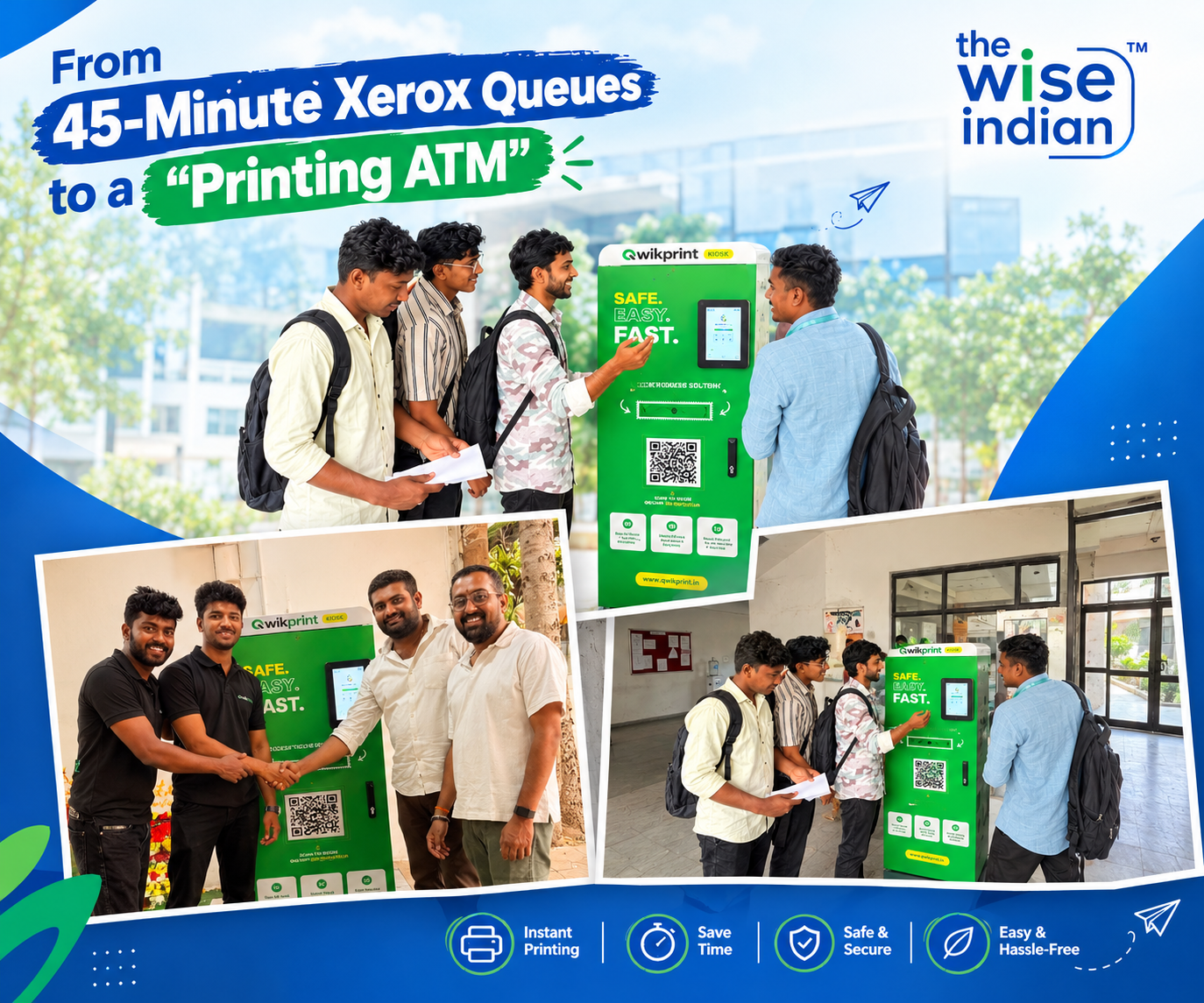
Every college student knows the long Xerox queue. You need only two pages, yet you still wait for nearly an hour. Two Chennai friends decided to end this wait with a self-service printing kiosk. As a result, they built QwikPrint, a startup that makes printing quick and available anytime.
A Familiar Queue That Refused to Shrink Over Time
Long before anyone imagined a self-service printing kiosk, the Xerox shop ruled Indian campuses. Pranav Senthil, founder of QwikPrint, estimates that India has about three million such shops. Moreover, he says you will find 20 to 25 shops around universities, government offices and RTOs. Yet the queues never seemed to disappear. Pranav lived this reality during college. His campus had around 18 Xerox shops. Still, he waited about 45 minutes for every printout. It did not matter whether he needed one page or a hundred.
As The New Indian Express reported in May 2026, many students share this same routine. Meanwhile, adding more shops did not fix the problem. Even with five shops nearby, Pranav explains, a line forms in all five. That crowd then creates demand for a sixth shop. In short, the real issue was never the number of shops.
Two Friends Who Asked Why the Wait Never Ended
Subeshwar P had his own version of this story. One day, he urgently needed to print a medical insurance bill. First, he searched for an open shop. Then he waited in line. Together, those steps ate up nearly an hour. Both friends felt the same irritation. So they asked two simple questions. Why are there so many Xerox shops? And why does the country still need even more of them?
Their inspiration came from two familiar ideas. First, Pranav compares the model to ATMs, which transformed banking decades ago. Second, the rise of quick-commerce platforms made them question why printing still took so long. Moreover, they already had software experience from an earlier startup. That background made the software side easier. Every transaction depended on a person behind a counter, an open shop and a moving line. Therefore, they decided to remove the counter itself.
How the Self-Service Printing Kiosk Works in 60 Seconds
A self-service printing kiosk works much like an ATM. First, you scan a QR code and upload your file from a phone or laptop. Next, you choose the copies and print settings, then pay digitally. After that, a one-time password releases your printout. The company says the whole process takes about 60 seconds. Besides, the kiosks need no staff and run around the clock. So a closed shop no longer blocks an urgent assignment.
Privacy matters here too. Many people print ID proofs, forms and bills that they do not want strangers to see. Therefore, the company says it uses encryption and privacy-focused systems. Its product listing on IndiaMART adds that files are deleted right after printing. The same listing mentions colour and black-and-white printing, UPI and card payments, and 1,900 sheets of paper capacity. On the official QwikPrint website, Pranav describes a simple thought. If food can arrive in minutes, printing should not lag behind. He adds that, as students, the friends often found shops closed or crowded.
Building Trust and Hardware While Still in Their Twenties
QwikPrint launched in June 2025. Their company, QwikPrint Technologies Private Limited, is based in Chennai. Since then, it has grown steadily. By May 2026, the company reported nearly 45 kiosks across Chennai, Bengaluru, Hyderabad, Pune and Delhi. Moreover, campuses such as Rajalakshmi Engineering College, Dhaanish Ahmed College of Engineering and PSG iTech now host them. Also, the team plans more kiosks in West Bengal and Maharashtra. Meanwhile, the startup has also found opportunities in Belgium, Poland, Saudi Arabia and Qatar.
Beyond kiosks, QwikPrint also offers a cloud platform that sends online print orders to partner shops. Furthermore, it runs a franchise programme for businesses and individual investors. However, the road was not smooth. The founders were still in their early twenties. Because of that, suppliers, universities and franchise partners hesitated to trust them at first. Pranav calls building credibility one of their biggest challenges.
Hardware brought another test. Many suppliers were ready to make 100 or 200 machines. In contrast, very few wanted to build five or ten early prototypes. Still, they pushed ahead, and student response has been overwhelmingly positive. Today, students upload files on their phones and walk to the kiosk. Then they collect printouts immediately. As a result, they no longer worry about an 8 pm shop closing. They also skip the early wake-up before class just to print.
The Better India covered this journey in October 2026. It noted that the founders see potential in universities, hospitals and government offices. Subeshwar hopes to see QwikPrint in every university, hospital and government office. In his view, a self-service printing kiosk should make essential services quick and hassle-free.
The Wise Take
QwikPrint proves that big ideas often hide inside daily frustrations. Pranav and Subeshwar did not chase a grand prediction about the future. Instead, they questioned something that everyone else accepted. Because of that, a 45-minute wait can now shrink to about 60 seconds. Their self-service printing kiosk may not replace every Xerox shop. Whether printing becomes as common as the ATM remains to be seen. Still, the lesson is already clear.
First, start with the problem you know best. Next, ask why it still exists. Finally, keep going when people doubt your age or experience. After all, the founders were in their early twenties when they began. For students and young job seekers, that is a hopeful message. So the next time a friend asks why you two should not start something, listen closely.
Also read our other article on Sarvesh Sharma, the Son of a Daily-Wage Labourer, Turned an ₹87,000 Drone Prototype Into a ₹3.5 Crore Defence Project
Follow The Wise Indian for more inspiring stories.