

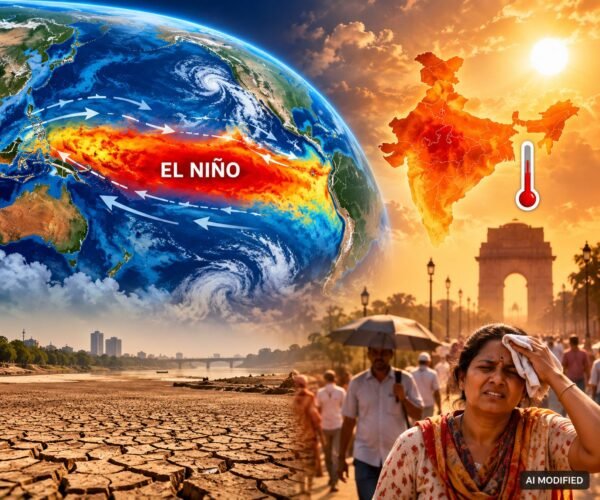
There is a patch of ocean in the eastern Pacific that is running a fever. On September 21, the sea surface temperature in the region where El Niño develops was 3.08 degrees Celsius warmer than the 1991-2020 average. That is not a small anomaly. It is the kind of number that makes meteorologists sit up and take notice. People call this phenomenon “Super El Niño.”
It is not an official scientific classification. The World Meteorological Organisation and the India Meteorological Department do not use it in their formal literature. They classify El Niño events as weak, moderate, strong, or very strong, based on how much the sea surface temperatures deviate from normal. “Super El Niño” is the colloquial shorthand for an exceptionally strong event, the kind that comes along once every few decades.
What El Niño Actually Does
El Niño is a periodic warming of the central and eastern tropical Pacific Ocean that occurs every two to seven years. It happens when weakening trade winds allow warm water to spread eastward instead of staying pooled in the west. This shift in ocean heat alters atmospheric circulation patterns across the globe, changing where rain falls and where it does not.
For India, the connection is direct. El Niño typically suppresses the southwest monsoon. During the 2015-16 Super El Niño, the IMD had predicted 93% of the long-period average rainfall, later revised it down to 88%, and the actual figure came in at 86%, with widespread drought-like conditions.
This year, the IMD forecast a below-normal monsoon at 90% of the long-period average. The national rainfall deficit stood at about 15% below normal up to September 22. The monsoon is now withdrawing, and heavy rains have already damaged kharif crops across southern and eastern India.
The Projections That Matter
A study released by the University of Chicago’s Climate Impact Lab on September 23 projects that the current Super El Niño could cause an estimated 15,800 additional heat-related deaths in India between September 2026 and February 2027, compared to a normal year. Nearly half of those deaths are expected between December and February, during what should be India’s cooler months.
Globally, the study projects 451,000 additional heat-related deaths during the first six months of the El Niño event. The Sahel region of Africa is expected to be the worst hit, with 66,800 deaths, followed by Indonesia at 19,300 and the Philippines, Vietnam, Thailand, and Cambodia at 19,400 combined.
The report describes this El Niño as a “postcard from our future,” bringing temperatures that climate change is projected to deliver 20 years from now. It warns of 44% more extremely hot days than a normal year.
Beyond India
The effects extend beyond South Asia. East Africa may see increased flooding and landslides, a pattern that has already displaced hundreds of thousands in previous El Niño years. Southern Africa faces heightened drought and water stress, with maize harvests in Zambia, Zimbabwe and Malawi already under pressure. Parts of Latin America and the Caribbean could experience flooding, landslides, and disruptions to hydropower, with Colombia and Venezuela particularly exposed. Indonesia has already seen conditions conducive to wildfires, and Central America has faced drought-related agricultural losses, pushing up food prices in Guatemala and Honduras.
The World Meteorological Organisation has warned that this year’s El Niño may be stronger than anything since monitoring began. The UN has called it a “threat multiplier,” worsening vulnerabilities far beyond what was seen in the 20th century.
Australia is also on alert, with the Bureau of Meteorology warning of increased bushfire risk and reduced rainfall across its eastern states. In Southeast Asia, Malaysia and Indonesia are bracing for transboundary haze as dry conditions intensify peatland fires. Vietnam’s Mekong Delta, a rice bowl for the region, is facing saltwater intrusion as river levels drop. In the Pacific Islands, some nations are preparing for drought while others brace for cyclones, a split that has become a hallmark of El Niño years.
Economic Blow
The economic ripple effects are equally concerning. Global food prices may rise as harvests fail across multiple continents simultaneously. Coffee prices have already spiked in Brazil and Vietnam, the world’s two largest producers. Cocoa prices are climbing in West Africa. Rice exports from Thailand and Vietnam may decline as governments prioritise domestic supply. The World Bank has warned that food insecurity could increase across sub-Saharan Africa and South Asia. Household budgets in these regions are already stretched.
Previous Super El Niño events show that the damage rarely stays within one region. The 1997-98 event caused an estimated $45 billion in global damages. Floods hit Peru, droughts struck Indonesia, and wildfires swept across Australia at the same time. The 2015-16 event left 60 million people in southern Africa and the Horn of Africa needing food assistance. This time, researchers are still measuring the scale.
The Wise Take
The term “Super El Niño” has caught public attention because it sounds dramatic. The science behind it is more sober. The data shows an unusually warm Pacific Ocean, an underperforming monsoon, and a projected rise in heat-related deaths. India may face the greatest impact during winter, when it is least prepared for extreme heat.
The Climate Impact Lab’s estimate of 15,800 additional deaths is not a certainty. It is a projection, based on temperature-mortality relationships applied to seasonal forecasts. It comes with an uncertainty range of plus or minus 1,600. But even the lower end of that range is a significant public health burden.
What makes this El Niño different is the context in which it is arriving. It is unfolding on top of a warming climate that is already pushing temperatures higher and making weather patterns more volatile. The study’s authors call it a glimpse of what lies ahead without new investments in adaptation. Heat warning systems, cooling centres, hydration stations, and worker protections are not abstract policy ideas. They are the difference between a projection and a body count. The Pacific is already running hot. The question is whether India’s response will be ready when the heat arrives.
For more such articles, keep reading The Wise Indian.



