

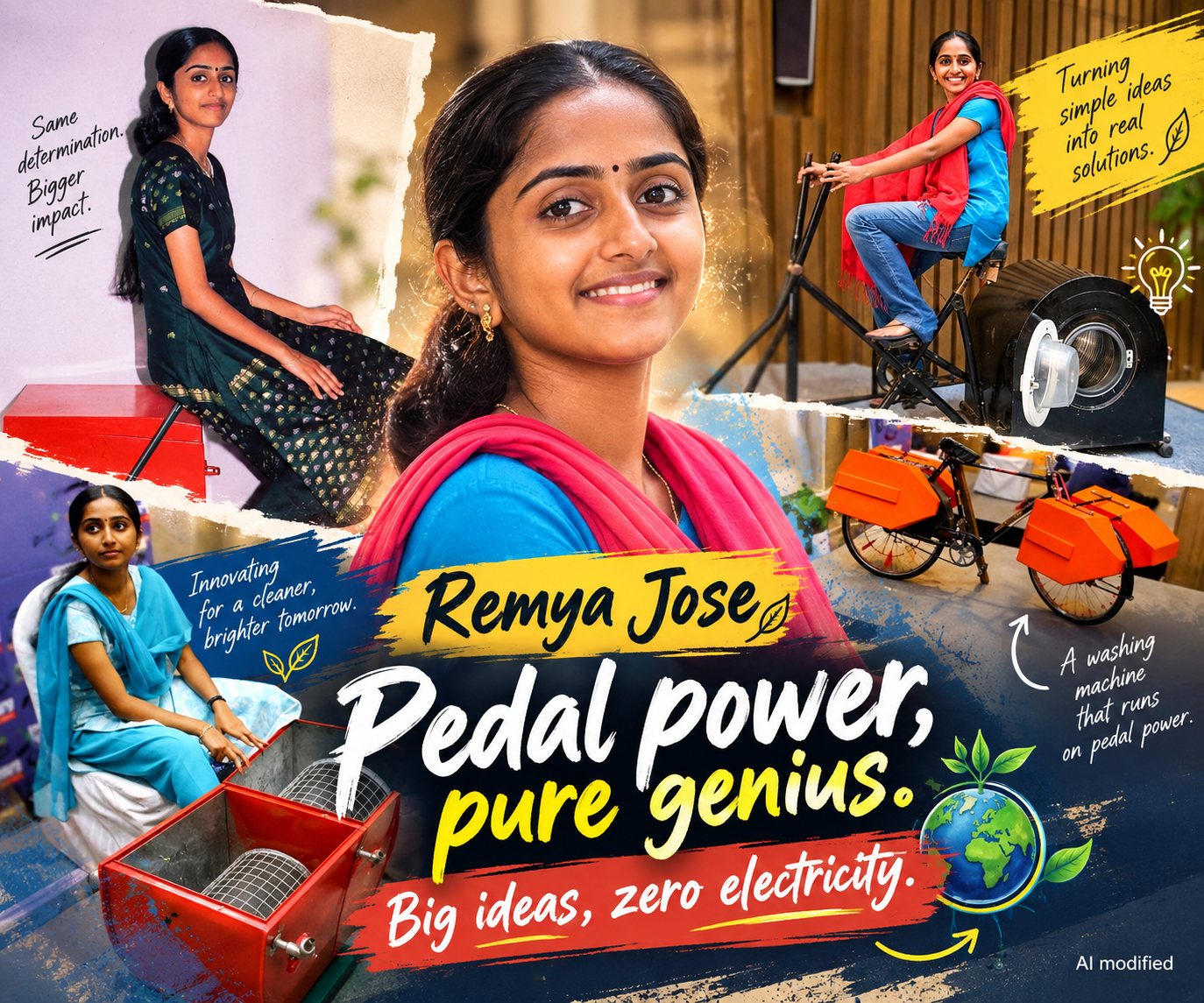
In 2005, a national innovation award in India went to an unexpected winner. She was a schoolgirl from Kerala named Remya Jose. The award honoured a machine she had built at just 14. Her invention was a washing machine that ran without electricity. It was built from a bicycle, for about Rs 2,000. Two decades later, the story still deserves telling. Not only for what she built. Also for what she chose next.
The Burden Remya Jose Carried at 14
Remya’s problem began at home. During her Class 10 year, her mother fell ill. Her father was undergoing treatment for cancer. At school, she studied in another town. She changed three buses each way, spending nearly four hours a day travelling. Back home, there was laundry to do. The family had no washing machine, and buying one was out of reach. So the chore fell to Remya and her twin sister, Soumya. Day after day, they soaked, scrubbed and wrung the family’s clothes by hand. After her board exams, Remya began putting a question on paper. Could a machine do this work without electricity?
How the Pedal-Powered Washing Machine Worked
The machine she drew was refreshingly simple. A cylinder held the clothes, water and detergent. Attached to it was a cycle-like pedal unit. First, you loaded the laundry. Then you pedalled for three to four minutes. The cylinder spun at high speed, and the clothes were washed clean. Next, continued pedalling centrifuged the load, leaving it about 80 per cent dry. When she was not washing, the same unit worked as an exercise machine. The estimated cost was about Rs 2,000. She defended the idea behind the design, too. In an interview, she explained that ordinary electric machines clean with one force, the spinning motion of water. Her machine used two, adding a beating effect that she believed worked better.
Remya Jose and the National Innovation Award
The National Innovation Foundation (NIF) noticed. NIF is a government-backed body that finds and honours grassroots inventors. In 2005, it honoured Remya’s machine at its third national grassroots innovation competition. The Better India reports that she received its Student Award. That was not all. NIF had also filed a patent for the machine in 2003. The application number was 643/CHE/2003. The patent was later granted as No. 207634, with renewal fees paid through its eighth year. Her hometown honoured her too. Her church organised a ceremony where the Bishop presented her with a trophy, and her talents went beyond this machine. She had earlier won school prizes for a transmission tower model and a casserole that worked as a thermal cooker.
What Remya Jose Did Next
Then came the question NIF asks every winner. Would she pursue the invention further? Remya said she would prefer not to. She never built a company around this machine. But she did not leave invention behind, either. Years later, BrightVibes reported that she worked as a “serial innovator” at NIF itself. The girl who skipped one product launch had moved behind the scenes instead. Even in school, her mind kept building. For her Class 12 practical exams, she made a model refrigerator that kept vegetables fresh for up to a week. The washing machine, meanwhile, became something quieter. It became proof, on paper and in a patent, of what one teenager could solve. And that proof has been retold for twenty years.
The Wise Take
Remya Jose did not change the washing machine industry. She changed something smaller and just as rare. At 14, she looked at an unfair burden and answered it with a drawing. The machine never became a product. Yet years later, one report placed her back at NIF, working on invention itself. That detail completes the story rather than closing it. Big outcomes need timing, money and luck. But a good idea, honestly built, belongs to the builder forever. Sometimes one invention, and one award, is enough to prove the point.
Also read our other article on Rohan Bopanna and Rutuja Bhosale at the Asian Games: How India’s 43-Year-Old Veteran and His Partner Fought Back to Win Gold
Follow The Wise Indian for more stories about the quiet geniuses who shaped India.



