

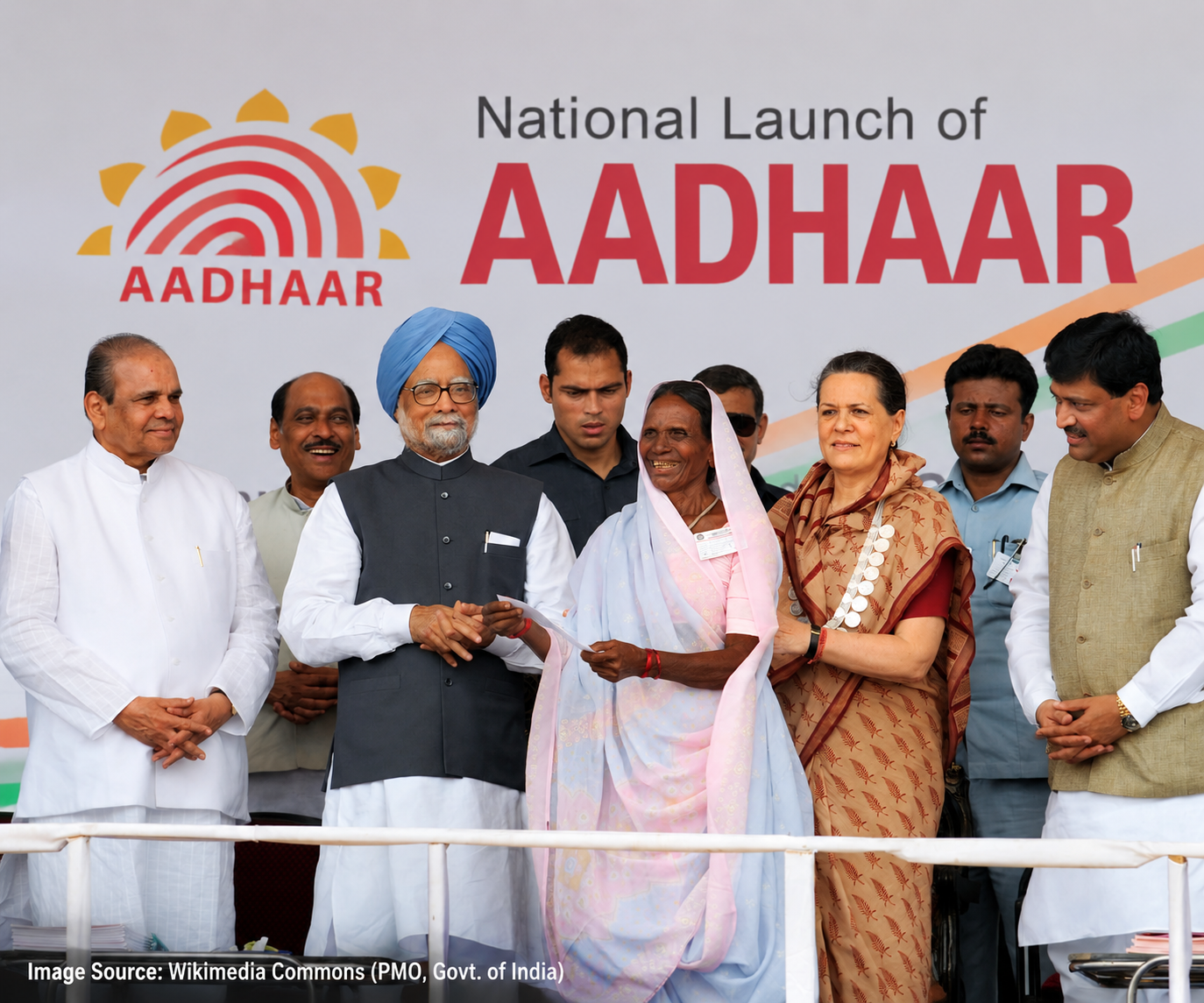
On 29 September 2010, in a small village in Nandurbar district, Maharashtra, a farm labourer became the first person in India to receive an Aadhaar number. Her name was Ranjana Sonawane. But there was no city in the picture that day. Just a village of about 1,900 people, roughly 505 kilometres north of Mumbai. That was the point. So India’s first Aadhaar number did not go to a city.
Ranjana Sonawane: The Woman Who Received India’s First Aadhaar Number
Ranjana lived in Tembhli, a village in the Shahada taluka of Nandurbar district. She belonged to a tribal community. She and her husband, Sadashiv, worked as daily-wage farm labourers. On a working day, she earned about ₹50. Life in Tembhli was simple and hard. Most families lived off the land, growing cotton, banana, and sugarcane. Meanwhile, others migrated for part of the year in search of work.
When she received the letter with her number, she could not read it. The 12-digit number printed on the page meant nothing to her yet. But she understood what it might mean for her family.
Why the First Aadhaar Number Went to Tembhli
Nandurbar was not a random choice. It was one of the poorest districts in Maharashtra. Its literacy rate was under 50 per cent. Its per capita income stood at ₹11,789, the lowest in the state. And three out of four families there lived below the poverty line. Then there was the political weight. Every Assembly and Parliamentary seat in the district was reserved for Scheduled Tribes.
That day, Prime Minister Manmohan Singh explained the choice plainly. Nandurbar, he said, was “a symbol that this scheme will first benefit the tribals and the needy people in this country.” So the country’s biggest identity project would not begin in Delhi or Mumbai. It would begin in the places where identity had mattered least and the need had run deepest.
The Day Tembhli Received India’s First Number
India set up the Unique Identification Authority of India (UIDAI) in January 2009. Nandan Nilekani, co-founder of Infosys, took charge later that year. In April 2010, the project got its name and logo: Aadhaar. After that came 29 September 2010. Manmohan Singh and UPA chairperson Sonia Gandhi travelled to Tembhli to launch the project and hand out the first numbers. Nilekani came too, along with Maharashtra Chief Minister Ashok Chavan, Governor K. Sankaranarayanan and Planning Commission Deputy Chairman Montek Singh Ahluwalia.
Ten villagers received their numbers on the stage. Ranjana was first. Then, around 1,400 residents of Tembhli received their own. UIDAI issues a 12-digit random number, linked to ten fingerprints, two iris scans and a photograph. Its promise was simple: one identity a person could carry to any office, anywhere in the country.
What Aadhaar Changed, and What It Did Not
The village did get something out of the visit. A cement road came in, along with electricity connections, streetlight poles and a drainage scheme. Residents later pointed out that the road ran mostly around the venue of the function. Even so, the change was real. Ranjana’s own life did not turn around. Years later, she told reporters that employment had not come, not before, and not then. Yet Aadhaar did give her one small, practical thing: an LPG cylinder connection under a government scheme.
So that is the honest shape of the story. A single number did not lift a family out of poverty. But the system built from it grew far beyond Tembhli. Today, Aadhaar is the world’s largest biometric identity system, and more than 130 crore people hold one. Since then, the Aadhaar Act of 2016 has given it legal backing. Fourteen years on, Ranjana Sonawane looked back at the attention her village had received. She described it as a “false show” of publicity. Yet she had expected more, and many people in her position would have felt the same.
The Wise Take
India’s first Aadhaar number did not go to a minister, a celebrity or a big city. It went to a farm labourer who could not read the number printed on the letter she held. That is the lesson worth keeping. A system proves itself not by who it names in its speeches, but by who it reaches first.
Ranjana Sonawane never became rich for being first. But the number she received that morning became part of something more than 130 crore people use today. Sometimes the first step in a very large journey belongs to someone who never gets the credit for the rest of it.
Also read our other article on AstroSat Space Observatory: How India Joined the Short List of Nations Studying the Universe From Orbit
Follow The Wise Indian for more stories about the changemakers, athletes and everyday heroes quietly shaping a better India.



