

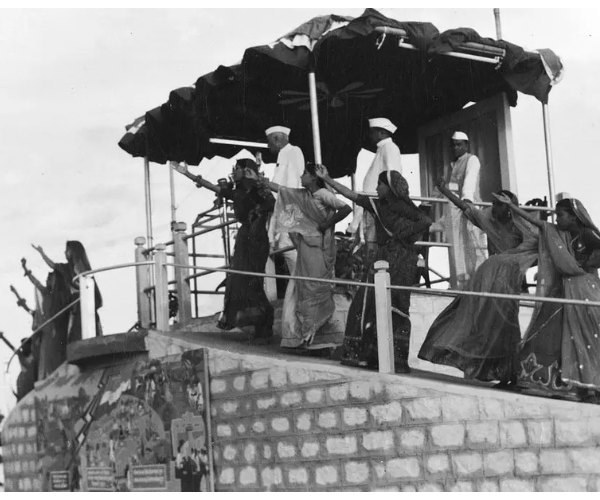
On 2 October 1959, Jawaharlal Nehru stood in Nagaur, Rajasthan, and launched Panchayati Raj in India. He chose Gandhi’s birthday for the occasion, and he said so plainly. “It is fitting that the programme of panchayati raj should be inaugurated on Mahatma Gandhi’s birthday,” he said. Rajasthan became the first state to adopt the system. More than six decades later, that single decision still shapes how rural India governs itself. Every gram panchayat in the country today traces back to that morning in Nagaur.
Panchayati Raj Begins at Nagaur
Nehru called the launch a historic event. “We are going to lay the foundations of democracy or panchayati raj in our country,” he said at Nagaur. He also linked the idea directly to the villages. “The progress of our country is bound up with the progress in our villages,” he added. The thinking behind Panchayati Raj was straightforward. Villages should run their own affairs instead of waiting on distant officials. Before 1959, rural administration relied heavily on appointed officers. Elected village bodies had little real authority. Panchayati Raj changed that balance. It handed genuine powers to councils chosen by the people who lived there.
The Committee That Gave It a Shape
The blueprint came from a committee, not a speech. In 1957, the government appointed the Balwantrai Mehta Committee to study rural development. It recommended a three-tier system. A Gram Panchayat at the village level, a Panchayat Samiti at the block level, and a Zila Parishad at the district level. Each tier would handle its own responsibilities. Each would answer to elected members rather than appointed ones. The committee’s logic was simple. Decisions about a village are best taken close to the village. A distant officer rarely knows what a local road or a local well needs. Rajasthan acted on the recommendation first. Several other states followed through the 1960s, at their own pace. For the next thirty years, though, the system depended on state goodwill. Nothing in the Constitution required states to keep it.
What a Village Council Can Change
One village in Maharashtra shows how far a council can go. Hiware Bazar sits in Ahmednagar district. Popatrao Pawar took charge as its sarpanch in 1989. The village was struggling then. Its land was dry, its wells were few, and its young people were leaving for the cities. Pawar and the village council started with water. Check dams and contour trenches slowed the rain before it ran off. Trees came back to the hills. The results took years, but they arrived. Down To Earth reported in 2012 that milk production had risen from 150 litres a day in the mid-1990s to 4,000 litres.
Wells had grown from 97 to 217. Irrigated land expanded from 120 hectares in 1999 to 260 hectares in 2006. The same report described a village that had produced 54 millionaires. Families that once migrated now stayed. Hiware Bazar became a model studied across India. Pawar served as sarpanch for long stretches. In 2021, his panel won all seven seats in the gram panchayat election.
From Nagaur to Constitutional Status
For decades, Panchayati Raj had no constitutional backing. That changed in 1992. Parliament passed the 73rd Constitutional Amendment, and it came into force on 24 April 1993. The amendment gave village councils a firm legal foundation. It fixed a five-year term for every panchayat and it also reserved one-third of all seats for women. It also created State Election Commissions to conduct panchayat polls. The amendment listed 29 subjects for village councils, from water to education.
It also gave every village a Gram Sabha, a body of all registered voters that must approve the council’s plans. Every year, 24 April is observed as National Panchayati Raj Day. The change mattered most for women. Thousands of them now lead councils that once shut them out. The system is far from perfect. Many panchayats still lack funds and trained staff. But the structure Nagaur began now has the force of law behind it.
The Wise Take
Nehru launched Panchayati Raj on Gandhi’s birthday in 1959. The idea was to trust villages with their own future. Hiware Bazar showed what that trust can produce when it lasts. Its turnaround took decades of patient work, not one grand scheme. One man’s long tenure mattered. But the system mattered more. It gave the village a way to keep choosing its own path, election after election. That is the lesson worth keeping. Democracy at the village level is not a ceremony or a plaque on a wall. It is a council that meets, plans, and keeps at the work.
Also read our other article on Andhra State Formation: How Potti Sriramulu’s 58-Day Fast for a Telugu-Speaking State Changed India’s Map
Follow The Wise Indian for more stories about the people and events that shaped modern India



