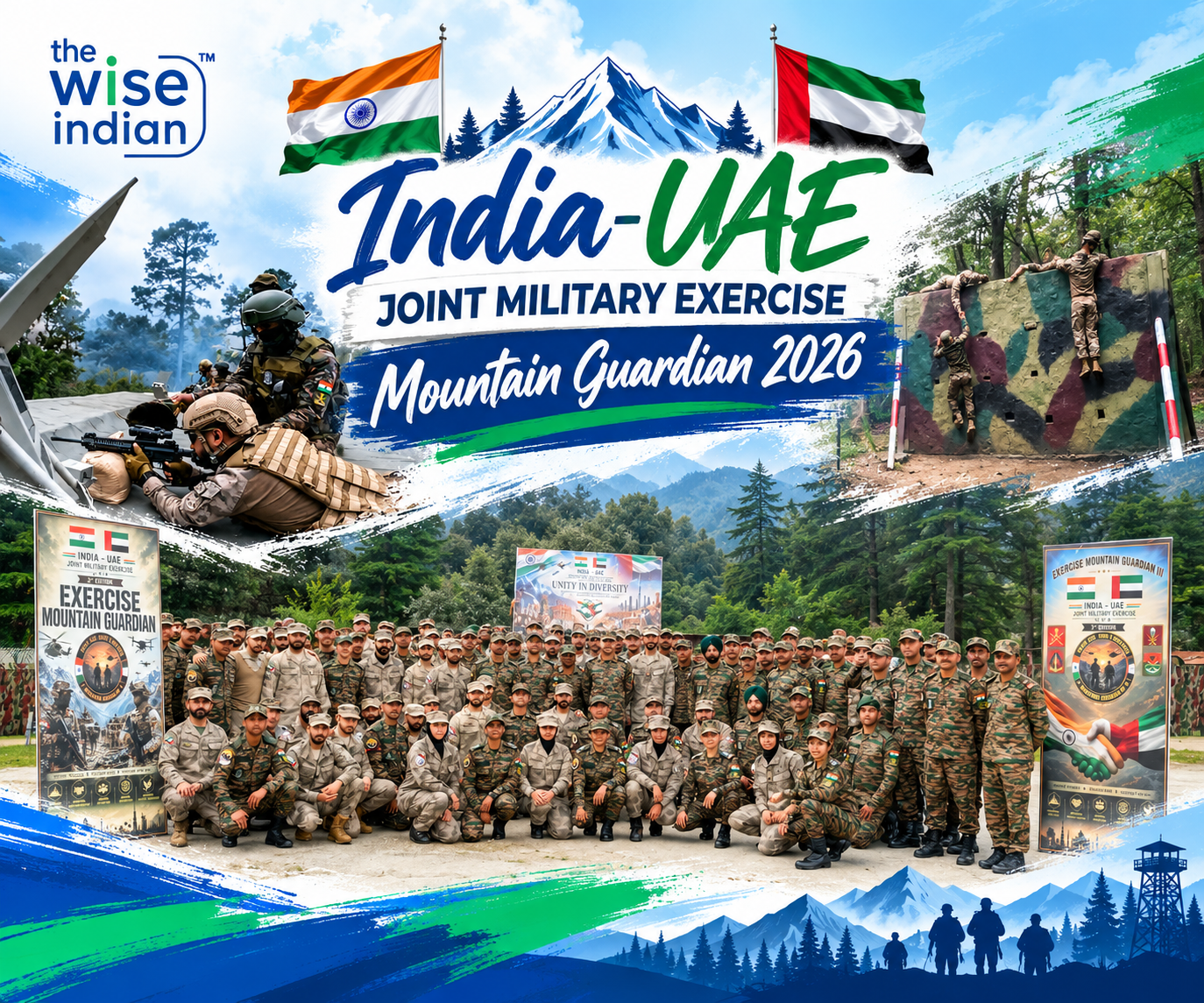
Mountain Guardian 2026 is an India-UAE army exercise now under way in Uttarakhand. It began on 5 October at Chaubatia and runs until 18 October. Troops from both countries are training together in mountain terrain. Here is what the exercise involves and why it matters.
What Is Mountain Guardian 2026?
Mountain Guardian 2026 is a joint military exercise between the Indian Army and the UAE Army. It takes place at the Foreign Training Node in Chaubatia, Uttarakhand. The opening ceremony was held on 5 October. The exercise lasts 14 days and ends on 18 October. It is bilateral, so only India and the UAE take part. Its purpose is clear. Both armies want to share professional experience, improve tactical skills, and exchange best practices in operational procedures. Reports say it should strengthen military cooperation and reinforce friendship, trust, and mutual understanding between both countries.
Chaubatia is a hill station in the Himalayan region of Uttarakhand. Therefore, the setting suits mountain training. Mountain terrain brings steep slopes, limited mobility, sparse infrastructure, and changing weather. Hence, soldiers must plan carefully and move with discipline. Joint training in such terrain shows how well two armies can cooperate. Moreover, it gives each side a chance to learn from the other’s methods.
Who Is Taking Part in the Exercise
A total of 92 personnel are participating. Each country sends an equal number of troops, so each side has 46. The Indian contingent comes from a Bhairav Battalion. The UAE contingent comes from a Mountain Infantry Battalion. The Indian side represents the Indian Army, and the UAE side represents its land forces.
Bhairav battalions are light commando units of the Indian Army. They are smaller than a standard infantry battalion and built for quick, focused tasks. Mountain infantry units, in turn, train for movement and survival in mountainous areas. As a result, both contingents bring skills that suit the terrain.
Women officers and combatants from both armies are also taking part. They serve in various specialist roles. Notably, the equal numbers reflect the partnership nature of the exercise. Furthermore, each army can learn how the other approaches mountain training.
What the Troops Are Training For
The troops are carrying out joint planning and tactical drills. They are also setting up surveillance grids and conducting drone operations. Obstacle training and integrated field exercises are part of the schedule too. Together, these activities cover planning, movement, observation, and teamwork.
The Indian Army says both armies are using modern technology to improve interoperability and refine tactics. Interoperability means forces from different countries can plan, communicate, and operate together. In addition, the emphasis on technology-enabled operations is set to grow as the exercise progresses. Drone and surveillance training shows how modern units gather information in difficult terrain. Surveillance grids also give soldiers a shared picture of the area.
Mountain warfare covers operations in rugged terrain with steep gradients and rapidly changing weather. High-altitude work also demands acclimatisation, suitable clothing, and careful load management. Such factors make advance training valuable. Joint planning also matters. It helps both sides understand each other’s procedures before and during field activity. Likewise, hands-on drills turn that understanding into practice. Consequently, soldiers learn not only tactics but also how to coordinate under a shared plan. Meanwhile, the exchange of experience in mountain warfare continues throughout the two weeks.
India-UAE Defence Cooperation Beyond the Mountains
This exercise is one part of a wider defence relationship. The two armies also hold a bilateral exercise called Desert Cyclone. Its first edition took place in India from 2 to 15 January 2024. The second edition followed in the UAE from 18 to 30 December 2025. Desert Cyclone focuses on desert conditions. Therefore, Mountain Guardian 2026 adds a different kind of terrain to the partnership.
The Indian Embassy in the UAE describes the cooperation as regular and broad. According to the embassy, the Indian Army, Navy, Air Force, and Coast Guard all train with the UAE. These activities include both bilateral and multilateral exercises. Their stated aim is to enhance interoperability and learn each other’s best practices.
For example, the UAE took part in the inaugural multilateral exercise Tarang Shakti in India in 2024. The embassy adds that the UAE plans to join the second edition in 2026. Naval cooperation continues too. Earlier known as Zayed Talwar, the maritime exercise is now called Gulf Waves. The UAE also joined the multilateral maritime exercise Milan in 2024 as an observer. Furthermore, the Indian Army says the current exercise continues to strengthen camaraderie, mutual understanding, and defence cooperation. Overall, such exercises build familiarity between the two forces over time. Together, these exchanges show a steady rhythm of training across the past few years.
The Wise Take
Mountain Guardian 2026 is a professional training exchange between two partner armies. It is built on shared learning, practical drills, and mutual respect. This exercise also shows that defence cooperation is not limited to one terrain or one service. Three points stand out.
First, equal participation shows that both sides contribute and learn together. Second, mountain training complements the earlier desert-focused exercise, Desert Cyclone. Third, drone and surveillance drills show how training now includes modern technology.
However, readers should rely on official statements for details. The exercise ends on 18 October, so further updates may follow. Therefore, check Indian Army channels for any closing announcement. Meanwhile, remember that exercises like this focus on training, not on any real operation. Above all, the focus stays on learning and cooperation. In short, Mountain Guardian 2026 shows how steady cooperation builds trust between nations.
Also read our other article on Parliament Passed Eleven Bills in Nineteen Days. Nine Went Through Without an MP Speaking.
Follow The Wise Indian for regular updates on stories that shape India’s strategic future and global standing. Stay connected with us for sharp analysis, untold perspectives, and a closer look at the partnerships driving our national security.