

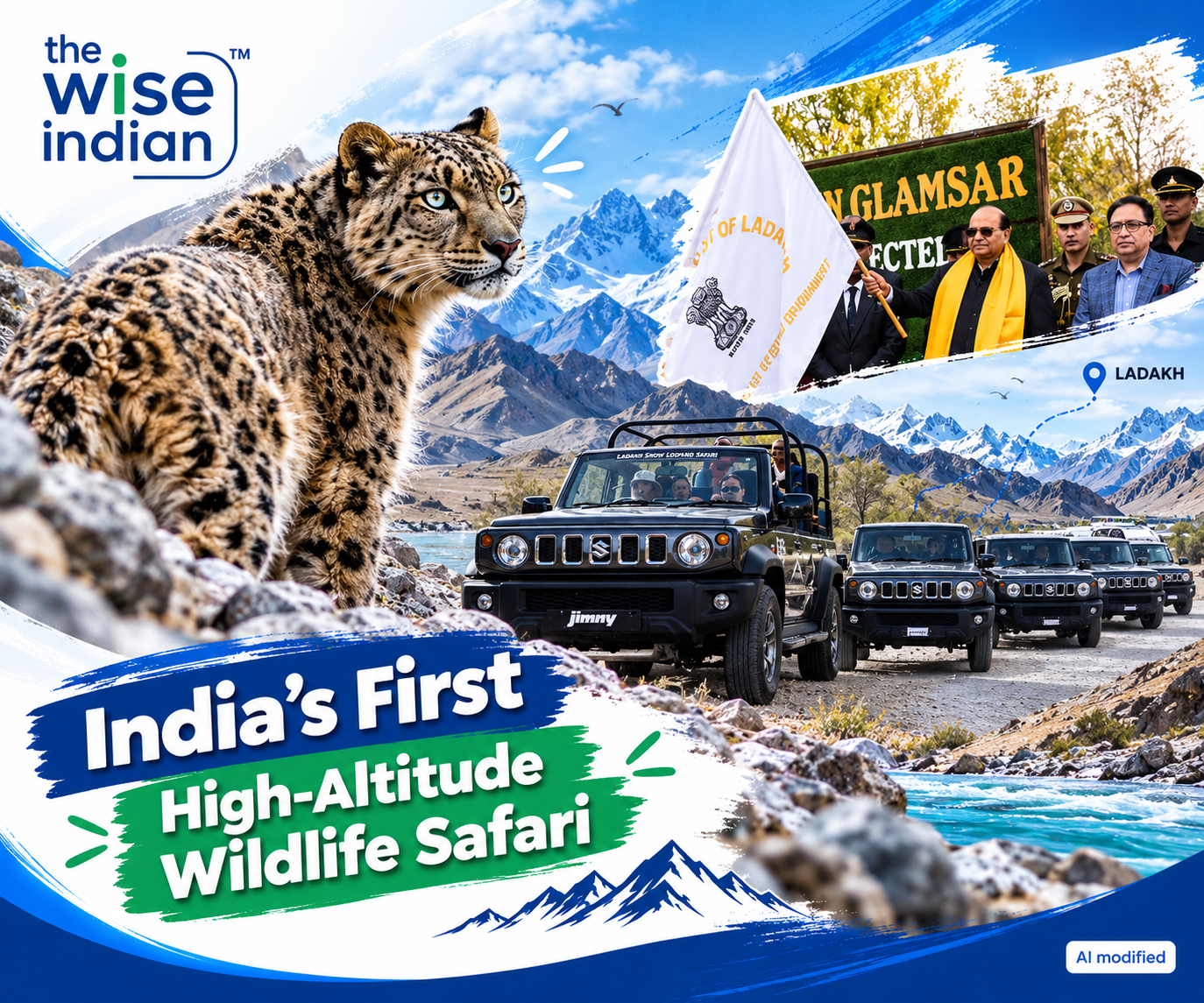
On 7 October 2026, Ladakh launched what officials call India’s first high-altitude wildlife safari. Lieutenant Governor Vinai Kumar Saxena flagged off six vehicles in Leh. The Ladakh snow leopard safari aims to mix regulated tourism with wildlife protection. It also hopes to create jobs for local people.
What Is the Ladakh Snow Leopard Safari?
The Ladakh snow leopard safari is a guided wildlife tour programme in the Union Territory of Ladakh. Six vehicles were flagged off at Choglamsar Protected Forest in Leh. The event was part of Wildlife Week 2026, held under the theme “Connecting Habitats, Thriving Wildlife.” The administration describes the project as India’s first high-altitude wildlife safari. The Tribune reports that the plan was announced on 5 August. It was put into action in about two months. The Snow Leopard and High-Altitude Nature Conservation (SHAN) Society is running it with the Department of Forest, Ecology and Environment.
Specially designed open-back vehicles will carry visitors. Trained local drivers and wildlife guides will lead each trip. Officials say the safari aims to curb illegal off-roading and wildlife disturbance. They call it a major step towards responsible wildlife tourism and community-based conservation. The safari also gives visitors a rare guided chance to see Ladakh’s flora and fauna. Saxena said the project is not only about increasing tourism. He wants wildlife tourism to be responsible, regulated and compatible with conservation. He also called protecting Ladakh’s natural heritage an investment in its ecological security and future economy. The launch also fits a wider aim set out by officials. They want to combine regulated tourism, wildlife conservation and better livelihoods. Saxena stressed that tourism promotion and environmental protection must go hand in hand.
Where Will the Safari Run and What Should Visitors Expect?
The safari will first run in Rumbak, Shang and Uley. ThePrint reports that snow leopards are frequently sighted in these areas. More routes are being identified across Hemis National Park and Changthang. They also include Karakoram Wildlife Sanctuary, Nubra, Zanskar, Sham, Kargil and Drass. The big cat is hard to spot because of its rugged mountain habitat, tour operators say.
Sightings are never guaranteed. Operators say November to March is the best time. Snow pushes prey animals into lower valleys then, they add. Private expeditions in peak season, from January to March, sell out fastest, one operator says. Other wildlife may also appear along the way. Tour operators list blue sheep, Asiatic ibex, red foxes and Tibetan wolves. Golden eagles and bearded vultures are also commonly listed. Winter trips can be tough, as Ladakh is often cut off by road, Higher Himalaya notes. Uley sits at about 13,780 feet, according to Fauna Travel. Visitors should plan time to acclimatise to the altitude. Operators also warn of sub-zero temperatures in winter. Launch reports did not list booking details. Travellers should check official Ladakh channels before planning.
Why Ladakh Matters for India’s Snow Leopards
Ladakh holds India’s largest snow leopard population. The administration cites 477 snow leopards out of about 718 nationwide. That is roughly two-thirds of the national estimate. The Tribune notes that the snow leopard is Ladakh’s state animal. It is listed as vulnerable. The Ladakh snow leopard safari therefore targets the region where most of India’s snow leopards live. Ladakh is also home to more than 38 mammal species. It has over 340 bird species and around 1,800 vascular plant species, per ThePrint. Snow leopards mainly hunt blue sheep and Himalayan ibex, according to tour operator Jehan Numa. Protecting these prey animals therefore matters for the cat’s survival. The species is rare worldwide. Fauna Travel says only 3,500 to 7,000 snow leopards remain in the wild. Locally, the animal is known as shan, according to Jehan Numa.
How Will Local Communities Benefit From the Safari?
The project links tourism with local livelihoods. Twenty local youth are being trained in bird identification and wildlife spotting. They will receive binoculars, and birdwatching hides will be built at major hotspots. Officials say the plan creates openings as wildlife guides, bird guides and nature interpreters. It also supports eco-tourism entrepreneurs. A felting programme involving 50 women links traditional wool work with conservation-based businesses. The administration also handed over funds for conservation education in 50 schools. It launched an AI-based device to reduce human-wildlife conflict as well.
Officials describe the safari as a unique conservation model. In it, the government alone will not protect the environment. Local communities become active partners instead. Saxena said the administration welcomes visitors. However, it will act firmly against activities that damage Ladakh’s fragile ecology.
The Wise Take
The Ladakh snow leopard safari is a promising step for responsible tourism in the Himalayas. It tries to protect a rare cat while giving local people real income. The idea is simple. Wildlife is worth more to a community when it stays alive and undisturbed. Success, however, will depend on strict rules and careful monitoring. Too many vehicles could harm the very animals visitors come to see. Officials have promised regulation, and now they must deliver it. Visitors also have a role, from following guide instructions to respecting wildlife space. Many will watch how Ladakh balances tourism and conservation over the coming seasons. If it works, Ladakh could become a model for other high-altitude regions.
Also read our other article on UP Scholarship 2026-27: Critical Application Deadlines Open for UG, PG, Diploma, and ITI College Students in Uttar Pradesh
Follow The Wise Indian for more inspiring stories.



