

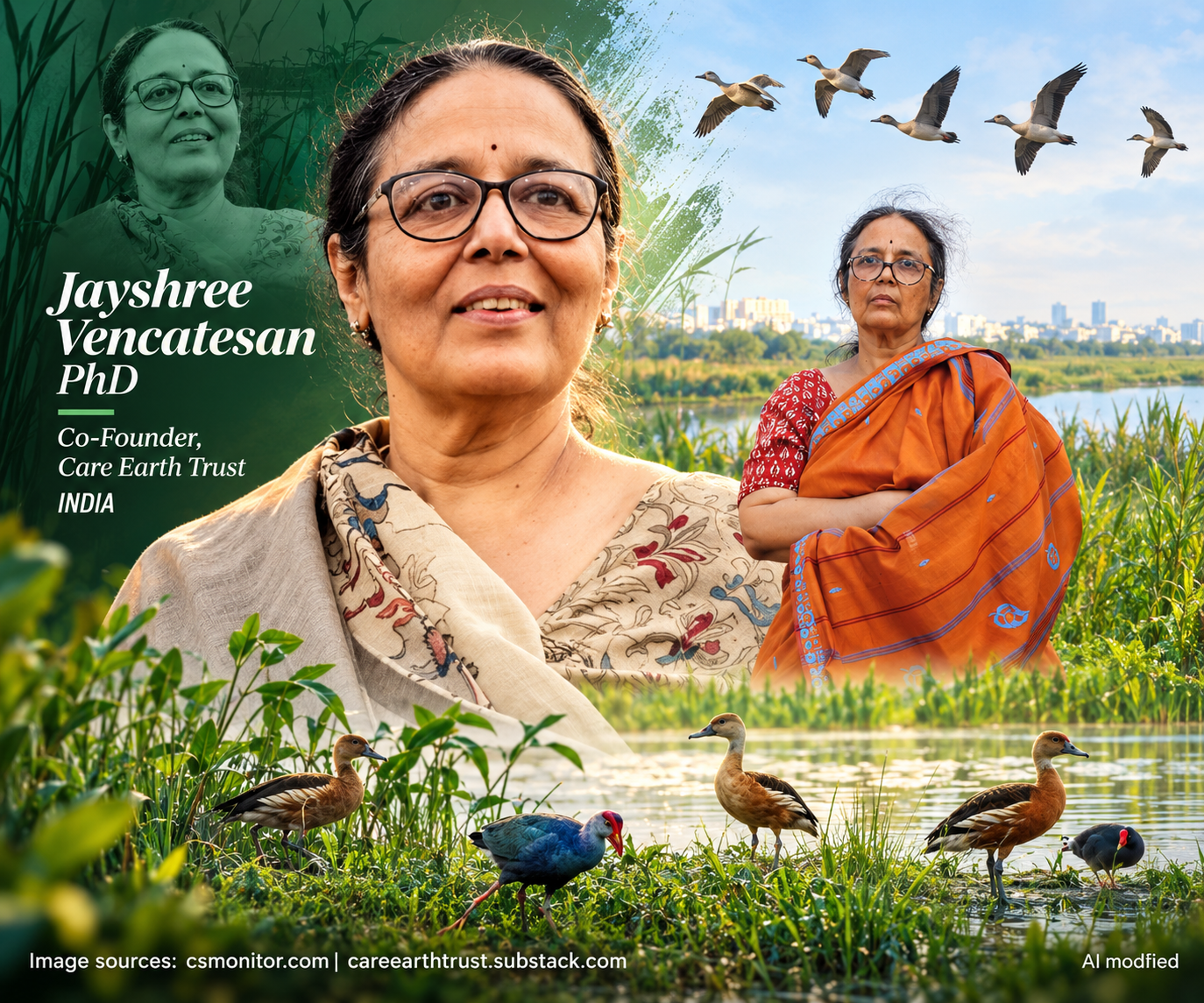
In March 2025, Jayshree Vencatesan became the first Indian to win the Ramsar Award for Wetland Wise Use. The honour is one of the world’s highest recognitions for wetland conservation. She won it for work that began decades earlier, in a Chennai marsh that most people had written off as useless land. Vencatesan is the co-founder and managing trustee of Care Earth Trust, a research and advocacy group based in Chennai. She set it up in 2000 with the ecologist R. J. Ranjit Daniels. Together, they took on a problem few others in the city wanted to touch.
Jayshree Vencatesan, the Ramsar Award and Pallikaranai Marsh
The Ramsar Secretariat announced its 2025 awards in Geneva on 7 March, on the eve of International Women’s Day. The New Indian Express reported that Vencatesan became the first Indian to receive the award for Wetland Wise Use. She was also named one of twelve “Women Changemakers in the World of Wetlands.” The award honours people who use wetlands wisely: drawing value from them without destroying them. For Vencatesan, a wetland is not empty land. It is a working system that a city depends on, whether the city notices or not.
Pallikaranai Marsh shows why that view matters. It stretches across about 1,247 hectares on Chennai’s southern edge. Part fresh water and part salt water, it once soaked up monsoon rain and sheltered a wide range of birds and plants. Over the years, builders and officials treated it as wasteland, a blank space on the map, waiting to be filled. Vencatesan saw flood protection, groundwater recharge and wildlife habitat in the marsh. To make that case in public, she needed evidence. Nobody had measured the marsh or tracked how fast it was shrinking. So she and her colleague set out to find out.
How Jayshree Vencatesan Helped Make the Marsh Visible
The method was simple, and it was anything but easy. Daniels owned a small moped, a TVS Excel Champ. He and Vencatesan rode it around the edges of the marsh, month after month. “We had a rope, a compass and a pair of binoculars,” Vencatesan told The Hindu Centre. “That’s all we used.” With that small kit, they mapped the wetland by hand. They measured its boundaries, counted its birds and recorded what was disappearing.
That slow, patient fieldwork gave the marsh something it had never had before. It gave it a record. Once the data existed, Vencatesan could argue her case with evidence instead of emotion. She has said a scientific approach worked better than sentiment in winning support for public causes. Vencatesan grew up far from Tamil Nadu, in Rajahmundry on the banks of the Godavari in Andhra Pradesh. Her father, Mayur Narasimhan, taught her to love nature early. She later studied at the University of Madras, where her doctoral work looked at the links between biodiversity and gender in the Kolli Hills.
A Ramsar Site, and the Work That Continues
Years of research and advocacy slowly changed how the city saw the marsh. Pallikaranai became a protected forest and, in December 2021, an eco-park. Then, on 8 April 2022, it was declared a Ramsar site under the official name Pallikaranai Marsh Reserve Forest. Ramsar listing is a global stamp of importance. It pulls a wetland into an international network and puts its health on record. For Chennai, the designation was a milestone. It was not the finish line. Vencatesan has kept working for the marsh’s future. She now sits on several state bodies, including the Tamil Nadu State Wetland Authority and the State Wildlife Board. Those roles let her carry field data into the rooms where decisions get made.
Why Wetland Science Matters to Every City
Chennai’s floods in recent years made the value of wetlands plain. A marsh that absorbs rain can spare a neighbourhood from a flood. A marsh filled in with concrete cannot. That is why Vencatesan’s approach travels well beyond one city. She built an all-women research team at Care Earth Trust. She has trained younger scientists to trust their own measurements. Her work shows that protection starts with one honest question. What is actually here, and what do we lose if it goes?
The Wise Take
Jayshree Vencatesan did not save a marsh with a slogan. She saved it with a rope, a compass and years of careful counting. The award she won in 2025 honours that patience. It also carries a lesson for any city facing the same choice. Land that looks empty is rarely empty. It often does quiet, essential work. Protecting it takes evidence, persistence and people willing to look closely when everyone else has already looked away.
Also read our other article on Nine Species Could Cover a Third of India’s Forest Carbon. A New Study Explains How
Follow The Wise Indian for more stories about the scientists and changemakers quietly protecting India’s natural world.



