

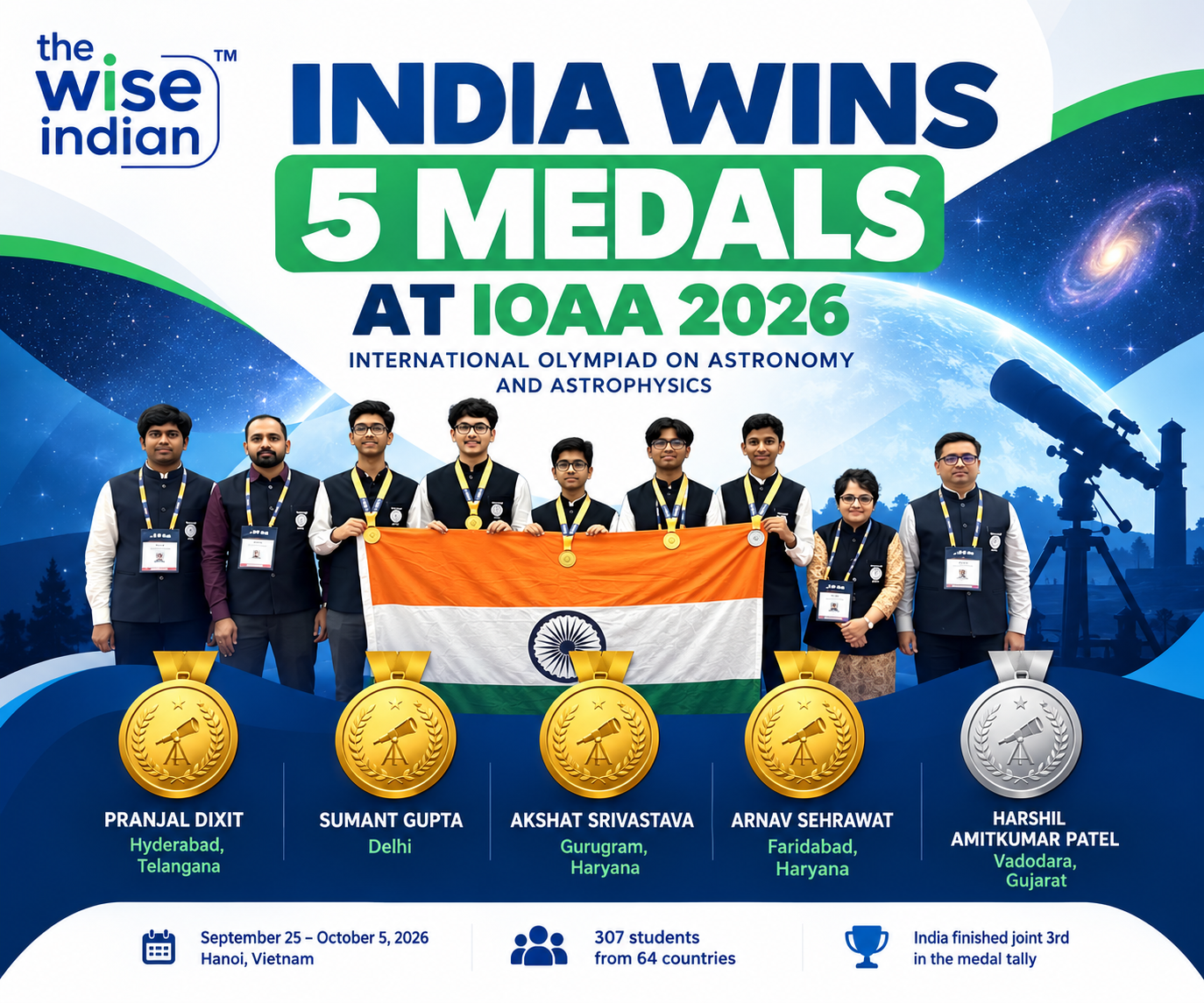
On 5 October 2026, the 19th International Olympiad on Astronomy and Astrophysics (IOAA) concluded in Hanoi, Vietnam. The Department of Atomic Energy announced India’s results the same day. By the next morning, national media had carried the news across the country. India had won four gold medals and one silver. All five Indian students returned home with a medal. Few teams at the contest managed a 100% medal return.
The IOAA 2026 Team That Won Four Golds
India sent a team of five students to IOAA 2026. Every single one of them finished on the podium. That kind of perfect conversion is rare at this level. The competition drew 307 students from 64 countries, all of them the best young astronomers their nations could offer. India’s four golds placed the country third in the overall medal tally, jointly with Vietnam’s guest team. Only Iran and South Korea finished higher, and each of them took five golds. Five students walked in, and five medals walked out. Consistency, rather than one standout performance, made the difference for India.
Who Are India’s Five Medal Winners?
Four Indian students won gold medals. Pranjal Dixit came from Hyderabad. Sumant Gupta travelled from Delhi. Akshat Srivastava is based in Gurugram. Arnav Sehrawat hails from Faridabad. A fifth student, Harshil Amitkumar Patel from Vadodara, won silver. Their backgrounds are ordinary, and their achievement is not. Each of them spent months in training camps before the contest. They studied physics, mathematics and astronomy well beyond their school syllabus. Together, they represented a country that has quietly built one of the strongest astronomy teams in the world. Meanwhile, their success also follows years of steady work by Indian olympiad trainers. Their medals now join a growing list of Indian results at science olympiads.
Inside a Contest Built on Real Astronomy
The IOAA 2026 contest is not a simple quiz. Students sit through theory, data analysis and observation rounds. They solve problems drawn from real astrophysics. They work with data from telescopes and satellites, and they interpret images of distant objects. The syllabus ranges from stellar physics to cosmology and planetary science. Therefore, a medal here reflects deep understanding, not memorised facts.
The IOAA has been held annually since 2007. Each edition tests students across several days. Team India is chosen through a multi-stage process. It begins with a national standard examination, followed by an Indian national olympiad. Only a small group then reaches the orientation camps. From there, a final team of five is selected. The Homi Bhabha Centre for Science Education in Mumbai leads this programme. The Indian Association of Physics Teachers also supports the work. By the time the team reaches Hanoi, each student has solved hundreds of problems under pressure.
Why This Result Matters for Indian Science
Results like this matter beyond the medal table. They show that Indian school students can compete at the very top. Iran and South Korea have long dominated astronomy olympiads. Even so, India has steadily closed the gap in recent years. For India to finish joint third is a genuine step up. Beyond that, the result feeds a larger pipeline. Many olympiad medallists go on to study physics, astronomy and engineering at leading institutions. Some become researchers, and a few later join India’s space science programmes. In turn, the country has invested more in space research in recent years.
ISRO’s missions have raised public interest in astronomy, and that interest now shows up in its youngest students. A gold medal in Hanoi is one small sign of it. Crucially, events like this also shape public imagination. A teenager reading about an olympiad gold may decide to study astronomy. Over time, that kind of inspiration builds a country’s scientific base. India’s space programme already employs thousands of scientists and engineers. A strong school pipeline keeps that talent coming.
The Wise Take
Five students, five medals. No one was left behind. That collective result says more than any single gold. These students trained for years, far from the spotlight. Their teachers and mentors worked without applause. Then, on one day in Hanoi, all of it paid off. The lesson is simple. Big achievements rarely come from luck. They come from quiet preparation, repeated patiently for years. For India, the win is also a reminder that talent exists in every corner of the country. It only needs support to grow. India’s next generation of astronomers may well have been standing on that stage.
Also read our other article on Harmanpreet Kaur Steps Down as Captain: The Record-Breaking Leader Who Helped Indian Women’s Cricket Rise to New Heights
Follow The Wise Indian for more stories about the students, scientists and everyday heroes quietly shaping a better India. From a gold-medal day in Hanoi to a captain passing the baton, we bring you the stories that deserve to be told.



