
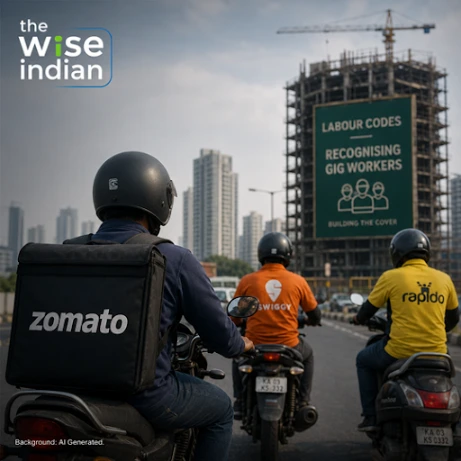
Platform workers gained statutory social security rights in November 2025, but contribution rates and several state rules remain unfinished.
For the delivery rider waiting outside a restaurant, the question has never been whether the law recognises the work. It is whether anything arrives after an accident.
India answered the first question in November 2025. The second is still being worked out.
What the Codes Changed
The four Labour Codes took effect on 21 November 2025, consolidating 29 central labour laws into a single framework covering wages, industrial relations, social security and workplace safety.
For the first time, gig and platform workers were recognised as a distinct category under the Code on Social Security. The Code provides for a Social Security Fund financed through contributions from the aggregator platforms these workers earn from.
Aggregators are required to register gig and platform workers on a designated portal within a prescribed period of 45 days.
For salaried employees, the most consequential change is the wage definition, which requires basic pay to make up at least half of total compensation. That single clause raises provident fund and gratuity liabilities and has forced employers across sectors to restructure salary components.
Where the Rollout Stands
Final central rules under all four Codes have been notified. State implementation is less settled, because labour is a concurrent subject and each state must frame its own rules before local enforcement can begin.
By mid-2026, more than 30 states and union territories had notified rules under at least one Code, though several major industrial states remained at the draft stage. Contribution rates for aggregators, reported to be under consideration in the range of one to two percent of turnover, await central notification.
Two Positions on the Same Reform
The government’s position is that consolidation simplifies compliance while widening coverage, extending social security thresholds and bringing gig workers and fixed-term employees into the formal net.
Trade unions have argued that changes to establishment thresholds, strike-notice requirements and the inspection regime weaken protections in practice. Both positions are being tested in litigation, and the Kerala High Court delivered the first reported judgment under the Codes in April 2026.
The Wise Take
Recognition in statute is the part of a reform that can be announced. Registration portals, contribution rates and state rules are the part that determines whether a rider’s family sees money after a hospital admission, and that work is slower and far less visible. India has done something few countries have attempted by writing platform work into a national social security law rather than leaving it to courts or contracts. The gap now is administrative rather than philosophical. Until the aggregator contribution is notified and states complete their rules, the entitlement exists on paper while the fund it depends on is still being filled.