

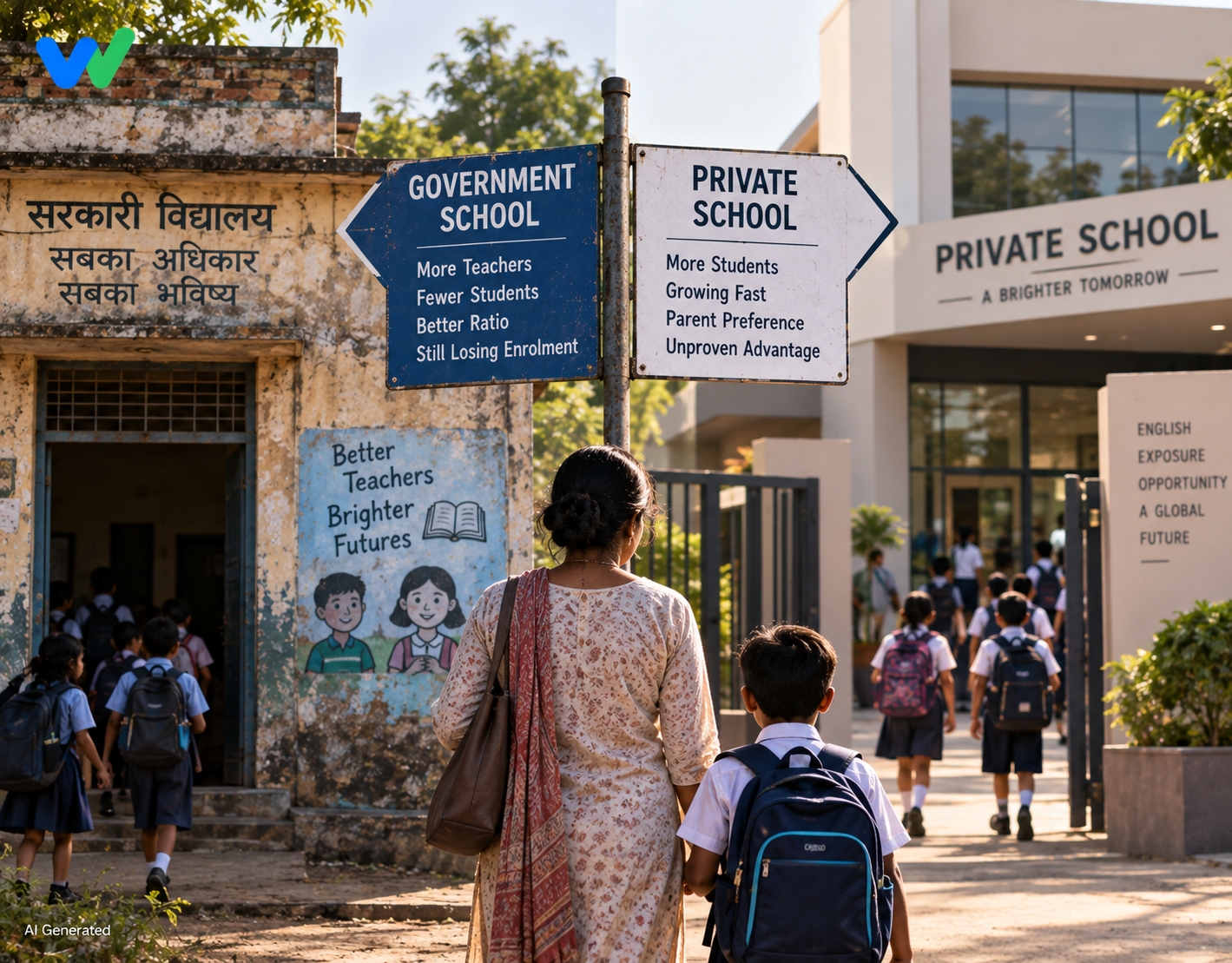
The UDISE+ 2025-26 report shows an almost exact transfer to private schools. The interesting number is what happened to teaching staff while it was happening.
Government school enrolment in India fell by nearly 86 lakh between 2023-24 and 2025-26. Private unaided recognised schools added more than 88 lakh over the same two years. Those government school enrolment figures come from the UDISE+ 2025-26 report, which the Ministry of Education released in July 2026. Read on its own it looks like a clean transfer. It very nearly is one.
The Number That Almost Balances
Government schools went from 12.75 crore students to 11.89 crore. Private unaided recognised schools went from 9 crore to 9.89 crore.
Total enrolment across foundational to secondary levels barely moved. It went from 24.80 crore to 24.72 crore, a fall of about 8.26 lakh.
So 86 lakh left one system and 88 lakh joined the other, and the country ended up with about 8 lakh fewer children in school overall. Most of the movement is children switching, not children disappearing.
Government School Enrolment Fell While Teacher Numbers Rose
Here is the part almost nobody reported. Over the same two years the teaching workforce grew from 98.08 lakh to 1.03 crore. That is roughly five lakh more teachers.
The pupil-teacher ratio improved from 25 to 24. Two things pushed it in the same direction at once. Fewer children, and more teachers.
Other measures moved the same way. Schools with zero enrolment fell from 12,954 to 5,663. Single-teacher schools fell from 1.11 lakh to 1.01 lakh. The total number of schools barely changed, from 14.72 lakh to 14.67 lakh.
Retention improved too. It reached 83.7 percent at middle level and 51.9 percent at secondary level in 2025-26.
What Parents Are Choosing Between
So the government system is losing children while it gets better staffed. That is the puzzle worth sitting with.
For most families the deciding factor is availability rather than proven quality. A school that is close, that opens on time, that teaches in English, that the neighbours use. None of that is irrational and none of it shows up in a ratio.
The premise underneath the switch is that private means better. The evidence for that premise is thinner than the premise. A Central Square Foundation study concluded that private school growth reflects unmet demand from the government system rather than demonstrated superiority, and that both types struggle to deliver age-appropriate learning.
The Wise Take
A parent chooses a school, not a system. That choice rests on things no report captures.
What the government school enrolment data adds is a caution. Paying fees does not by itself buy a better outcome. And the schools losing students are not, on this evidence, the ones getting worse. They are getting more teachers per child at the exact moment families are leaving.
That gap between what a system measures and what a parent sees is the real finding here. Learning outcomes are a separate question and a harder one. The number worth watching next year is not the split between government and private. It is whether five lakh extra teachers change anything a parent notices, and the report itself is where that will show up first.



