
The policy that took effect on 1 July pairs purchase incentives with binding deadlines for the vehicle categories that contribute most to the city’s pollution.
Most electric vehicle policies in India are built on incentives, which people can take or ignore. Delhi’s new one is built on dates, which they cannot.
The Delhi Cabinet approved the Electric Vehicle Policy 2026 on 29 June, and it came into effect on 1 July. It runs until 31 March 2030.
The Deadlines That Do the Work
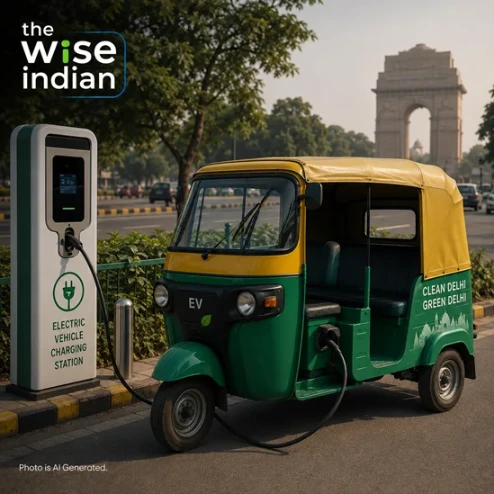
From 1 January 2027, only electric three-wheelers and N1 category goods vehicles may be newly registered in Delhi. From 1 April 2028, the same applies to two-wheelers.
Transport Commissioner Niharika said commercial goods vehicles account for around 33 percent of vehicular pollution in the city, while two-wheelers and three-wheelers together contribute close to 46 percent.
The policy targets at least 30 percent electrification of Delhi’s vehicle fleet by 31 March 2030, building on roughly 14 percent penetration achieved under the 2020 policy.
What Buyers Are Offered
Electric cars priced up to 30 lakh rupees ex-showroom are exempt from road tax and registration fees.
Purchase incentives for electric two-wheelers are set at 30,000 rupees in the first year, 20,000 in the second and 10,000 in the third. Three-wheelers receive 50,000, 40,000 and 30,000 across the same period, and N1 electric trucks up to one lakh rupees.
Owners scrapping older polluting vehicles receive additional support, up to one lakh rupees for four-wheelers, 50,000 rupees for N1 trucks, 25,000 for three-wheelers and 10,000 for two-wheelers.
Hybrid vehicles are not covered by the subsidy, which is restricted to pure electric vehicles. The policy builds on Delhi’s 2020 framework, under which the city reached roughly 14 percent EV penetration by 2025.
The Infrastructure Question
Chief Minister Rekha Gupta said benefits worth around 15,000 crore rupees would be extended over four years, including more than 7,000 crore towards infrastructure.
The government has committed to about 30,000 charging points across the city, with land identified, and a dedicated online portal for incentive applications.
The Wise Take
Registration mandates are the sharpest instrument a state has in transport policy, because they change what is available rather than what is affordable. Delhi has aimed them at the segments where the arithmetic is strongest, since autos and delivery vehicles run high daily distances and recover a higher purchase cost faster than a private car does. The risk sits in sequencing. A mandate that arrives before charging infrastructure does pushes cost onto drivers who have the least room to absorb it, and the 2027 deadline leaves eighteen months to build most of a network. On that timeline, the charging points matter more than the subsidies.