

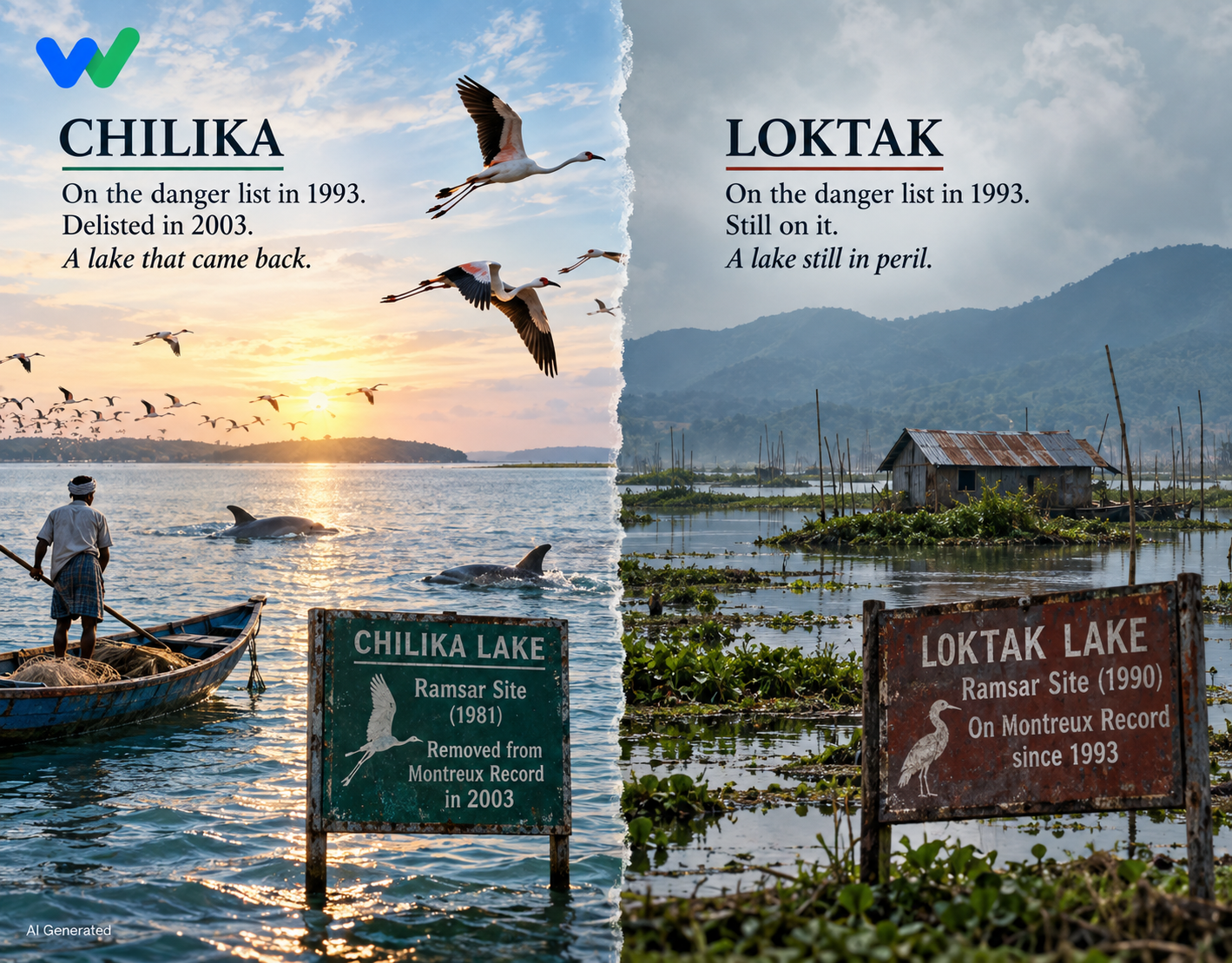
One of them had a problem that engineering could fix. The other has a political one. That is most of the difference between them.
There is a list nobody wants to be on. The Ramsar Convention keeps a register called the Montreux Record, which names wetlands of international importance where the ecology is going wrong. In 1993 two Indian lakes were added to it. Chilika Lake in Odisha came off in 2003. Loktak in Manipur went on the same year and is still on it now, more than three decades later. Chilika is one of the very few sites anywhere to be delisted, and almost nobody in India knows it happened.
What Was Killing Chilika Lake
Chilika Lake is a brackish lagoon, roughly 1,165 square kilometres in the monsoon and about 900 in summer. Brackish means it lives on the mixing of river water and seawater, and that mixing happens at the mouth.
The mouth was closing. Rivers feeding the lagoon brought silt down from bare catchments and dropped it where the lagoon met the sea. Over years the opening migrated, narrowed and choked.
Take away the tidal exchange and the chemistry changes. The water freshens. Weeds move in. The fish that need salt leave, and the fishermen who catch them lose their living.
Chilika Lake was turning into a freshwater swamp, slowly, in front of everyone.
Somebody Cut a Hole in the Beach
The Chilika Development Authority started work in 1992. In 2000 it did the thing that actually mattered, which was to cut a new mouth straight through the barrier beach.
That is a genuinely nervy decision. Open a coastal barrier in the wrong place and you can cause damage that takes decades to reverse, and there is no undo button on a beach.
It worked. Tidal exchange came back. Salinity came back. The fish came back. Three years later the Convention struck the entry off.
Read that sequence again, because the order is the point. The engineering came first. The delisting was paperwork catching up with a physical change in the water.
What Chilika Lake Holds Now
The 2026 bird census counted more than 11.32 lakh birds across 196 species. Over a million birds, in one lagoon, in one winter.
The 2021 count was about 1.21 million, so the number moves year to year. Migratory counts respond to conditions along an entire flyway, not just at the destination, and one season tells you very little on its own.
The lagoon holds more than 200 fish species. A 2021 survey counted 166 Irrawaddy dolphins and 22 Indo-Pacific bottlenose dolphins.
More than two lakh fisherfolk work these waters. That is the number that decided whether the restoration would survive, because a conservation project that costs fishers their catch does not last a decade in any democracy. Here the fish returned with the salt. Ecology and livelihood moved the same way, which is rarer than it sounds.
Why Loktak Is Still on the List
Loktak’s problem is not a blocked mouth.
It is a lake with a hydroelectric barrage, floating villages, contested fishing rights, sedimentation from deforested hills, and a long-running argument about who is allowed to live on it and how. Every one of those is a dispute between people, not a defect in a channel.
You cannot cut a new opening through a political settlement.
That is the honest limit of the Chilika story, and it applies to most of India’s wetlands. They are dying of encroachment, sewage and land conversion. None of those has a single decisive intervention waiting to be funded.
The Wise Take
India has around ninety Ramsar sites and adds more most years. Every addition gets a press release. A Ramsar designation is a listing, and a listing does not by itself move a litre of water.
Chilika Lake suggests two things worth taking seriously. The first is that a dedicated authority with its own budget, running without a break since 1992, did more than any designation could. Thirty four years of one institution is doing as much work in this story as the engineering did.
The second is uncomfortable. What made Chilika fixable was a problem that was physical and singular. We should be careful about treating it as a template, because the reason it is celebrated is partly that it was, by the standards of Indian wetland management, an easy case.
If you want one number to judge any state’s wetland record, do not ask how many sites it has notified. Ask which one has come off a watch list, and in which year. India has exactly one good answer to that question, and it is twenty three years old. Volunteers spent 27 years clearing a Nilgiris forest and most of it is still under weeds, which is what this work looks like without a Chilika-sized mandate behind it.



