
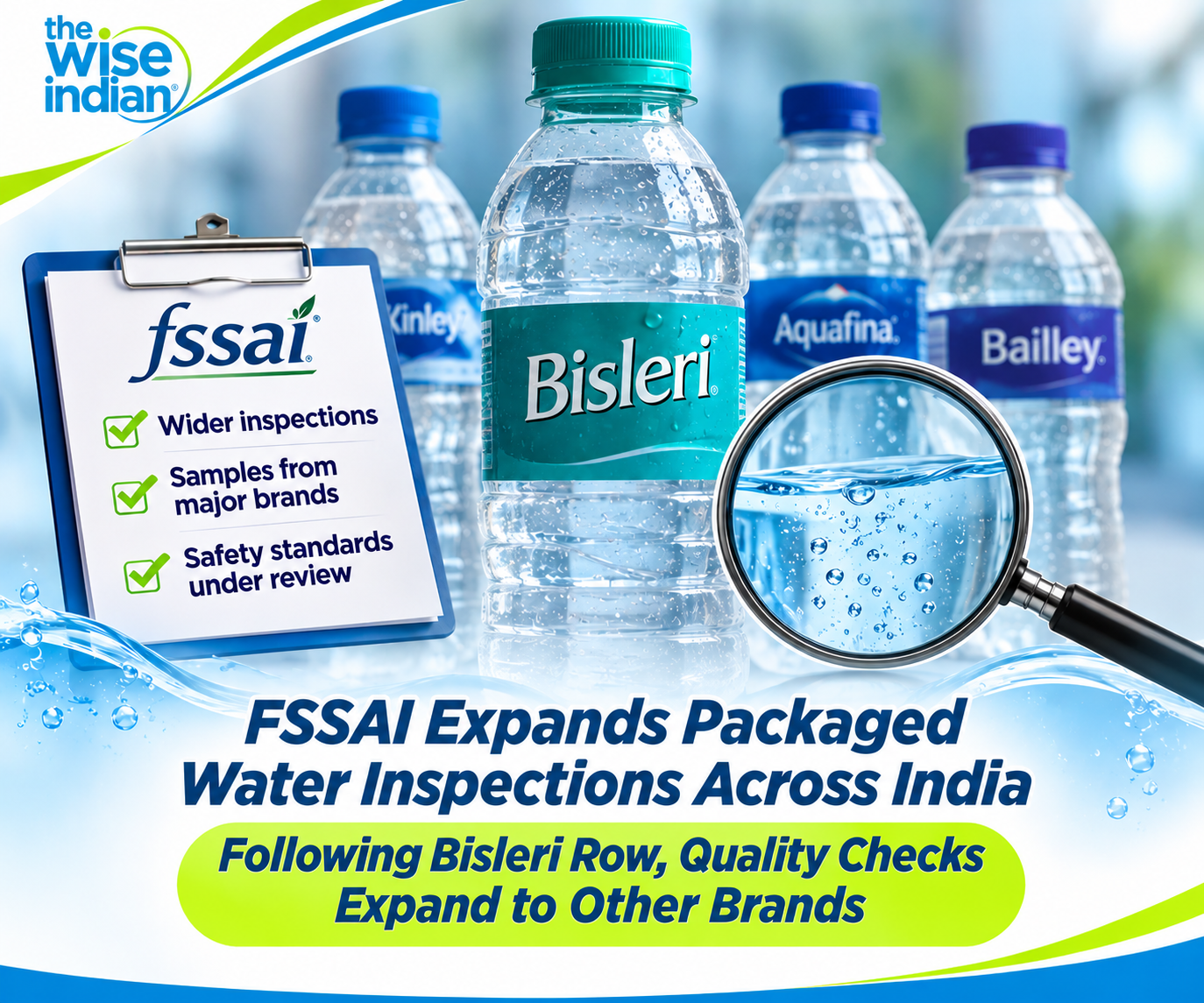
India’s packaged drinking water industry is facing increased regulatory scrutiny after the Food Safety and Standards Authority of India (FSSAI) expanded its inspection drive across major brands. The move follows laboratory findings that declared a sample collected from Bisleri International’s manufacturing facility in Goa unsafe.
The regulator has now collected samples from several manufacturers and is examining their compliance with food safety requirements. The development has brought bottled water quality, manufacturing practices and consumer protection into focus. It also signals stronger enforcement against companies that fail to meet prescribed safety standards.
FSSAI Expands Inspections Across Major Water Brands
The Food Safety and Standards Authority of India has widened its investigation beyond Bisleri to cover the broader packaged drinking water market. According to reports published on November 23, 2026, food safety officials have collected samples from major manufacturers across the country. They have also inspected the premises of food business operators involved in water production and packaging. The collected samples are undergoing laboratory examination to determine whether they meet the applicable safety requirements.
Authorities have indicated that companies found violating regulations could face legal action under the Food Safety and Standards Act, 2006. The expanded FSSAI packaged water inspections aim to identify products that fail quality assessments and strengthen accountability across the industry. The regulator is also examining misleading labels and brand names that resemble established companies. These practices can confuse consumers and make it difficult to identify genuine products. The inspection drive therefore addresses both product safety and market compliance. According to reports, further laboratory findings are expected to clarify whether other manufacturers have violated the prescribed standards. [Source: India Today]
Why Bisleri Came Under Regulatory Scrutiny
The latest enforcement drive follows FSSAI’s decision to sanction prosecution against Bisleri International Pvt. Ltd. over an unsafe water sample. The regulatory sample was collected from the company’s manufacturing facility in Goa on September 30, 2025. During the initial examination, laboratory testing found bromate levels above the prescribed limit. The sample recorded 12 micrograms per litre, compared with the permitted limit of 10 micrograms per litre, according to the company’s account of the testing process. Following an appeal, the sample underwent further examination at a referral food laboratory.
The second assessment also declared it unsafe after detecting polynuclear aromatic hydrocarbons (PAHs). Based on these findings, FSSAI granted approval to initiate prosecution under the Food Safety and Standards Act, 2006. Bisleri, however, has defended its product quality and maintained that its drinking water is safe for consumption. The company stated that it conducts more than 90 quality checks through its 10-step manufacturing process. It also said it had arranged independent laboratory testing and submitted its findings to the regulator. Bisleri has expressed its willingness to cooperate with the authorities and address the matter through appropriate regulatory channels. [Source: Business Standard]
Understanding Bromate and PAH Contamination Concerns
The laboratory findings have drawn attention to two chemical substances that require careful monitoring in drinking water. Bromate can form as a by-product during certain water treatment processes, particularly when ozone reacts with bromide under specific conditions. Excessive bromate levels are a concern because prolonged exposure can pose health risks. Therefore, manufacturers must carefully monitor treatment systems and ensure that their products remain within prescribed limits. The second finding involved polynuclear aromatic hydrocarbons, commonly known as PAHs.
These compounds form a large group of chemicals that can enter the environment through industrial activities, combustion and other pollution sources. Certain PAHs have recognised toxic and carcinogenic properties, making their presence in drinking water a serious quality concern. However, not every compound within this chemical group has identical health effects. Their risks depend on the specific substances, concentrations and exposure levels. The detection of these chemicals highlights why regular laboratory testing is essential throughout water production. It also demonstrates that a product’s appearance, smell and taste cannot establish its chemical safety. The FSSAI packaged water inspections therefore place greater emphasis on laboratory evidence rather than relying solely on routine manufacturing declarations. [Source: Reuters]
Stricter Testing Rules for Packaged Water Manufacturers
India has already introduced several regulatory changes to strengthen quality monitoring in the packaged water sector. In October 2024, FSSAI removed the mandatory Bureau of Indian Standards certification requirement for packaged drinking water and mineral water. However, this change did not remove manufacturers’ responsibility to meet food safety requirements. Subsequently, the regulator classified these products under the high-risk food category. This classification introduced additional inspection and compliance obligations for manufacturers. Facilities must undergo inspections before receiving licences or registrations, followed by regular inspections at least once a year.
Centrally licensed manufacturers in high-risk categories must also undergo annual audits through FSSAI-recognised third-party food safety auditing agencies. Furthermore, FSSAI introduced a dedicated testing scheme for packaged drinking water and mineral water in December 2025. The scheme became effective on January 1, 2026, establishing specific testing requirements for food business operators. These measures strengthen monitoring across manufacturing, processing and quality-control activities. They also encourage companies to identify potential contamination problems before products reach retail outlets. The current enforcement drive builds on this regulatory framework by bringing more manufacturers under active scrutiny. [Source: FSSAI]
The Wise Take
The expanded inspection programme highlights the importance of maintaining consistent drinking water quality across India’s packaged water industry. The Bisleri case has brought attention to the consequences of laboratory findings and the regulatory action that can follow when products fail safety requirements. However, the findings concerning one sample should not automatically be interpreted as proof that every bottle or product from the company is unsafe.
Consumers should continue checking bottle seals, manufacturing details, batch numbers and FSSAI licence information when purchasing drinking water. Manufacturers, meanwhile, must maintain transparent testing procedures and comply with applicable standards throughout production. As authorities examine samples from more brands, the results will provide a clearer understanding of compliance across the sector. Ultimately, stronger inspections, reliable laboratory assessments and responsible manufacturing practices are essential to protecting public health and maintaining consumer confidence.
Also read our other article on NASA’s Voyager 1 Reaches One Light-Day From Earth, Setting a Historic Record After Nearly 50 Years in Space
Follow The Wise Indian for regular updates on stories that shape India’s strategic future and global standing. Stay connected with us for sharp analysis, untold perspectives, and a closer look at the shifting legal landscapes, civic rights, and institutional frameworks defining our democratic fabric.