
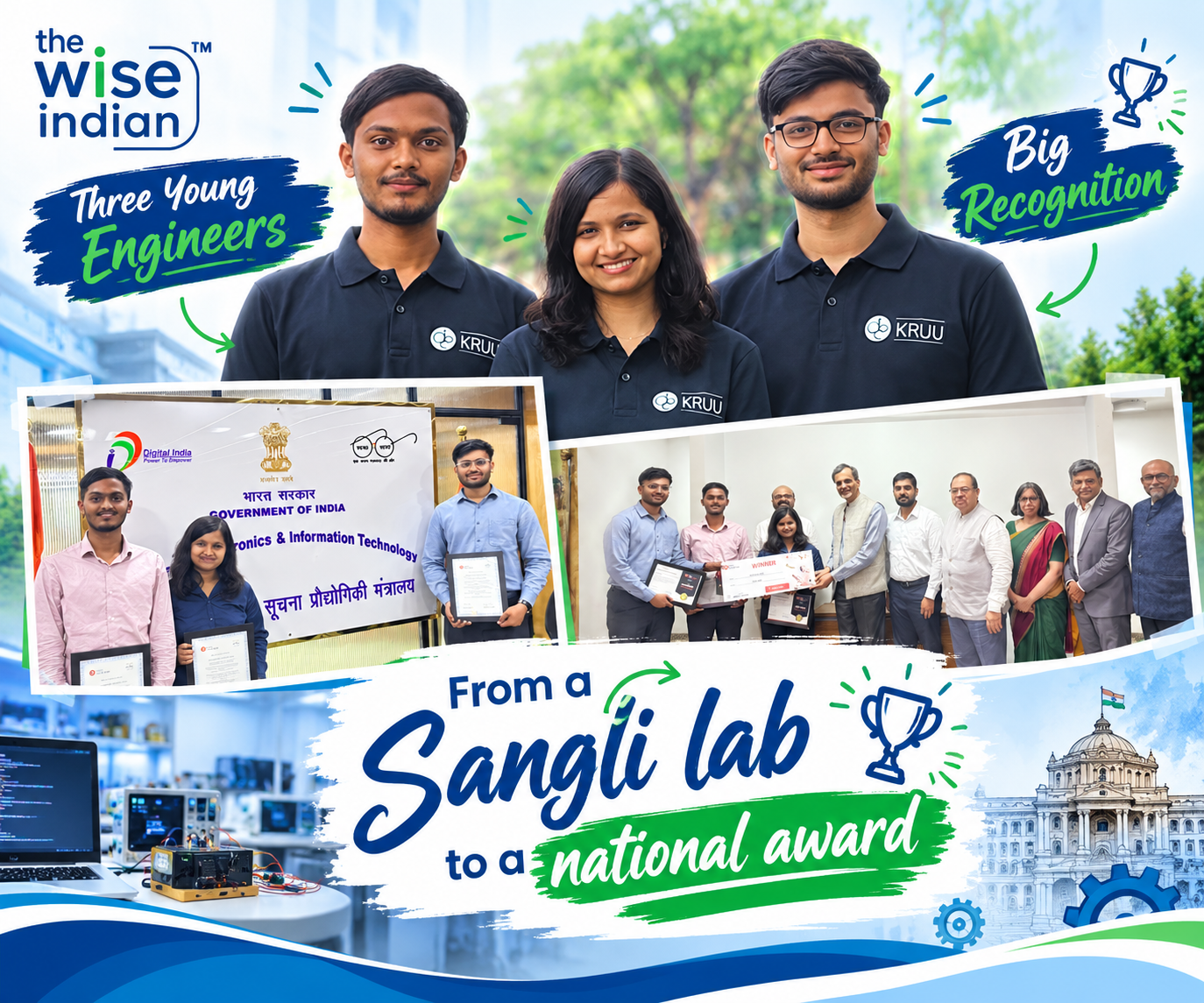
Three Young Engineers in Sangli Build an AI Chatbot for Autism Support and Win National Recognition at GRASP 2026. Three young engineers from Maharashtra have developed an AI chatbot to support parents of children with autism. Their project aims to make practical, evidence-based guidance more accessible between therapy sessions. The team, known as Neurostars, studies at Rajarambapu Institute of Technology in Sangli. Their project, DreamConnect, combines conversational AI with tools for tracking a child’s daily behaviour. The team won the GRASP 2026 national AI hackathon in the “AI for Social Good” category.
AI Chatbot Project Wins National Recognition
The AI chatbot developed by Team Neurostars addresses a challenge many families face: finding reliable guidance when a professional appointment is not immediately available. Parents may have questions about daily routines, behavioural changes and ways to respond to difficult situations. However, access to specialists can depend on location, cost and availability. The team comprises Vaishnavi Rajkumar Patil, Abhishek Shivprasad Patil and Ganesh Ramchandra Mahadik. All three are engineering students at Rajarambapu Institute of Technology in Maharashtra. Their project, DreamConnect, focuses on helping parents organise observations and access guidance during everyday caregiving.
The team earned national recognition through GRASP 2026, a hackathon organised by KRUU in partnership with ASME India. Reports stated that more than 5,000 students participated in the nationwide competition. Neurostars won the “AI for Social Good” category and received a ₹1 lakh prize, along with mentorship, internship opportunities and a chance to collaborate with a European university. The achievement highlights how student engineering projects can respond to real community needs. Instead of focusing only on technical performance, the team explored how digital tools might help families handle practical challenges at home.
How the AI Chatbot Supports Parents
DreamConnect aims to offer parents structured support between therapy sessions. The AI chatbot can respond to questions and provide suggestions based on curated resources. It also includes a daily behavioural tracking feature, helping caregivers record observations about a child’s routines and responses.
According to published reports, the system asks parents five guided questions each day. Their responses help build a record of behavioural patterns over time. The platform can then prepare weekly summaries that highlight changes, progress and areas that may need further attention. These records may also help parents prepare for discussions with therapists. For example, a caregiver could use the summaries to describe recurring situations or changes in a child’s routine. This organised information can support clearer conversations with professionals.
The goal is not to make parents rely on a chatbot for every decision. Instead, the tool aims to provide accessible guidance when questions arise outside appointments. Families still need qualified professionals for assessments, diagnoses and individualised treatment plans. That distinction matters because every autistic child has different strengths, communication preferences and support needs. Advice that helps one child may not suit another. Parents should therefore treat AI-generated suggestions as supplementary information, not as instructions that replace professional judgment.
Technology Behind Dream Connect
The project uses artificial intelligence to connect parents’ questions with information drawn from selected resources. Published coverage describes its use of Retrieval-Augmented Generation, commonly called RAG. This approach retrieves relevant material to help ground an AI model’s response in a reference collection. The team has also reported using expert-reviewed material and frequently asked questions connected with autism support. This approach can help the system provide responses based on a defined information base rather than relying entirely on a general-purpose model’s generated answer.
Reports about the project also identify technologies used in its development, including React.js, Python, Sentence Transformers, FAISS, Gemini 2.5 Flash and Firebase. These tools serve different roles in the application, from building its interface to supporting information retrieval, AI responses and data management.
However, listing technical components does not by itself establish clinical effectiveness. The chatbot’s usefulness depends on the quality of its source material, how accurately it responds, how it handles uncertainty and how carefully the team tests it with intended users. The developers must also consider privacy because behavioural records can contain sensitive information about children and families. Clear explanations about data collection, storage, access and deletion are essential. Parents should understand what information the platform keeps and how the team protects it.
Community Experience Shapes the Project’s Next Steps
The students’ work reflects an effort to understand caregiving challenges before designing a technical solution. Published reports describe their engagement with autism-related community work and families to learn about everyday difficulties. That process helped shape their focus on guidance between appointments and more structured behavioural observations. The project also connects with a wider discussion about using AI responsibly in health-related support. Digital tools can make information easier to access, but they must not present themselves as substitutes for qualified care. They should also make their limits clear, especially when a question requires an individual assessment or urgent professional help.
For DreamConnect, future development will require careful testing, feedback from families and input from qualified professionals. The team will need to check whether parents find the interface understandable, whether the guidance remains appropriate and whether the tracking summaries prove useful in real situations. Accessibility will matter too. Simple language, an easy-to-use design and support for different languages could help more families navigate the platform. The team must balance these goals with privacy safeguards and reliable information.
At this stage, the project should be understood as a support tool rather than a proven replacement for therapy. Its longer-term value will depend on how responsibly the developers test, improve and deploy it.
The Wise Take
The Neurostars team shows how young engineers can use technology to address a meaningful social challenge. Their AI chatbot, DreamConnect, focuses on the practical questions parents may face while supporting children with autism at home. Winning GRASP 2026 gives the project visibility and opportunities for further development. Still, the real measure of success will not be the award alone. It will be whether families can use the platform safely, understand its limitations and find its guidance genuinely helpful. Expert involvement, careful evaluation and strong privacy practices must remain central to that work.
AI can help organise information and support everyday decision-making, but it cannot replace the understanding and care provided by families and qualified professionals. With responsible development, DreamConnect could become a useful additional resource for parents seeking guidance between appointments.
Also read our other article on India AI Readiness Wins a World Bank Top 10 Spot: What the New Report Means for Jobs and Growth
Follow The Wise Indian for more technology-related information, insights, and daily updates on India’s tech landscape