

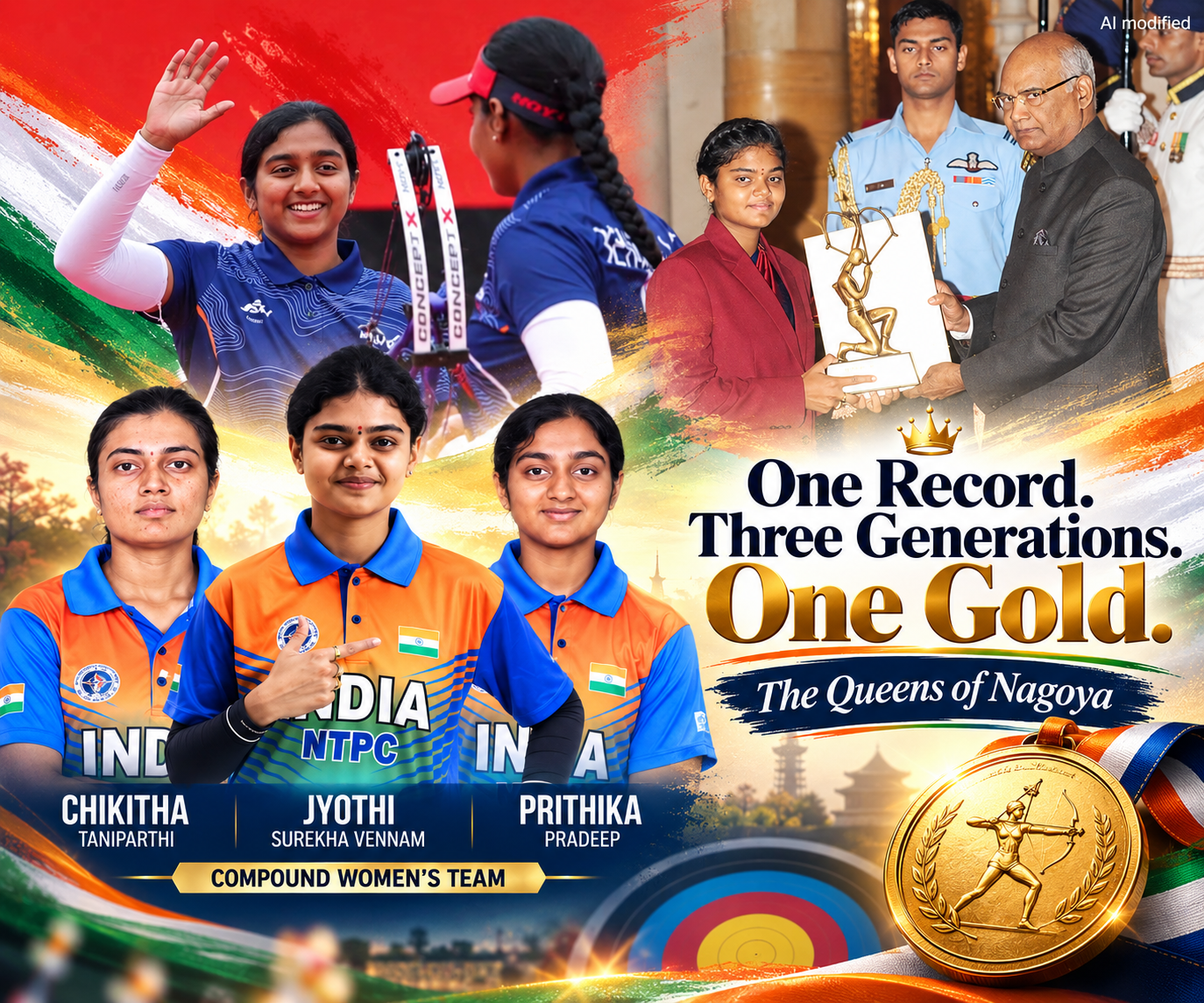
On 30 September 2026, an 18-year-old from Nagercoil stood on the shooting line in Nagoya, Japan, and helped India win an Asian Games gold. Prithika Pradeep was the youngest member of India’s women’s compound archery team. Beside her stood Chikitha Taniparthi, 21, and Jyothi Surekha Vennam, 30. Together, they beat China 238-234 in the final. The score equalled a world record. For Prithika and Chikitha, it was a first Asian Games gold. For Jyothi, it was a fourth. One teenager, one debutant and one veteran, shooting as a single unit.
The Final That Ended 238-234 Against China
The match was part of the Aichi-Nagoya Asian Games. Each of India’s three archers shot eight arrows, 24 in all. A compound team match is scored out of a maximum of 240 points, so the margins are tiny. India’s 238 left China’s 234 behind. World Archery reported that the total equalled the world record for a 24-arrow women’s compound team match. The mark had stood since 2014, when South Korea shot it at the Incheon Asian Games. Reports said India landed 22 of those 24 arrows in the 10-ring. That figure has not been confirmed on an official scorecard, so it is best described as a reported detail.
Compound archery is not the recurve discipline used at the Olympics. A compound bow uses a pulley system, which makes it more stable and more accurate. Scores sit close to the maximum, so a team match often turns on a single arrow. The historic day also paved the way for the country’s first quota places for the Los Angeles 2028 Olympics, secured a few hours later by Chikitha Taniparthi and Sahil Jadhav in the mixed-team event, which India won in a shoot-off against South Korea. India’s men’s compound team defended its title the same day.
Prithika Pradeep and Chikitha Taniparthi: Two First-Time Champions
Two of the three archers were winning their first Asian Games gold. Prithika Pradeep was the younger of them. She was born in Nagercoil, Tamil Nadu, and her family later moved to Pune, where she trained. She turned 18 just five days before the final. Hindustan Times reported that she balanced schoolwork with archery and scored 93 per cent in her Class 12 exams. She began competing internationally in 2024, barely two years before Nagoya. This was her first Asian Games, and she left it with a gold medal.
Chikitha Taniparthi, 21, took a longer road to the same podium. She comes from a farming family in Peddapalli, Telangana. The Hindu reported that she trained first in a backyard. Her family made sacrifices to keep her in the sport. She missed out on the previous Asian Games entirely. That disappointment meant Nagoya was both her debut and her first gold. At 21, she is only at the start of her career. Together, the two represent something Indian archery has not always had: depth. One is still a teenager. The other is barely out of her teens. Both reached an Asian Games final and won it, in a discipline where experience usually decides the biggest matches.
Jyothi Surekha Vennam and a Fourth Asian Games Gold
Jyothi Surekha Vennam is the senior member of the trio, and the most decorated. The 30-year-old from Andhra Pradesh won three golds at the 2023 Asian Games in Hangzhou. Those came in the women’s team, the mixed team and the individual compound. Nagoya added a fourth. She also won a team bronze in 2014 and a team silver in 2018, across more than a decade of Asian Games appearances. Her record gives this win its weight. Four Asian Games golds place her among India’s most successful archers. She received the Arjuna Award in 2017, when she was still in her early twenties. On the line in Nagoya, she was the calmest of the three.
The Wise Take
Three archers, three different stages of a career. One was 18 and had just finished school. Another was 21 and had once missed out entirely. One was 30 and had already won at the highest level. All three shot the same 24 arrows, and all three finished with the same gold. That is the quiet lesson from Nagoya. A team is not built from identical people. It is built from people at different points in their own journeys, who agree to be measured together. Prithika, Chikitha and Jyothi each carried something different to that line. The 238 they produced was something none of them could have reached alone.
Also read our other article on Remya Jose: How a 14-Year-Old From Kerala Built a Washing Machine From a Bicycle and Won a National Innovation Award
Follow The Wise Indian for more stories about the athletes, changemakers and everyday heroes quietly shaping a better India. From a teenager’s first gold in Nagoya to a record-equalling team score, we bring you the stories that deserve to be told.



