

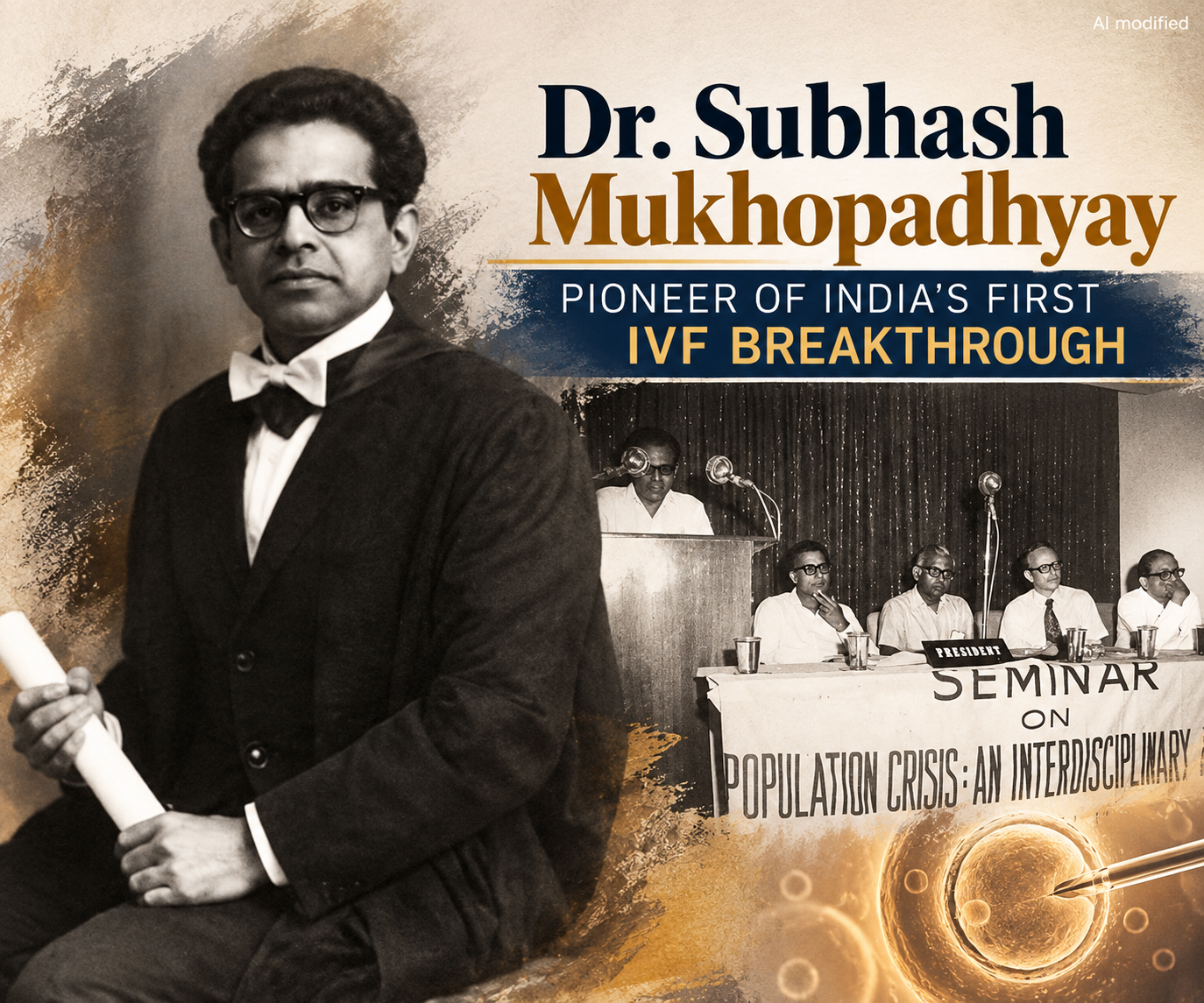
On 3 October 1978, a baby girl was born in Calcutta. Her name was Kanupriya Agarwal, and her family called her Durga. She was India’s first IVF baby, and the second in the world. The doctor who made her birth possible was Subhash Mukhopadhyay, also spelled Subhas Mukherjee. For years, almost nobody believed him. He died without ever hearing his country accept what he had done.
Subhash Mukhopadhyay and a Birth the Country Doubted
The world’s first IVF baby,Louise Brown, was born in Britain on 25 July 1978, and her birth made headlines around the world. Durga arrived in Calcutta in October 1978, less than three months after Louise Brown. Her parents, a Marwari family in Kolkata, had long hoped for a child. According to the Indian Express, her mother Bela had wanted one desperately. The couple met Mukhopadhyay through common friends. He had already spent years working on the problem. The baby was named for the Durga Puja festival underway when she was born. Her birth should have been a national moment. Instead, it became the start of a long fight. Kanupriya grew up and later became an advocate for fertility awareness. In 2022, she spoke to the Indian Express about her mother’s longing for a child.
How Subhash Mukhopadhyay Did It
Mukhopadhyay was a reproductive physiologist, not a celebrity doctor. He earned an MBBS from National Medical College in Calcutta in 1954. He then earned a PhD in reproductive physiology from the University of Calcutta in 1958, at its Rajabazar Science College campus. A decade later, he earned a second PhD from the University of Edinburgh. In 1967, he joined NRS Medical College in Calcutta as a professor. Reproductive science was still young in India then, and funding was scarce.
He did not work alone. He had a team. Sunit Mukherji was a cryobiologist, and Saroj Kanti Bhattacharya was a gynaecologist. Their method set them apart. Mukhopadhyay used cryopreservation to freeze embryos, so a woman could use them in a later cycle. The British team behind Louise Brown had tried something similar. They could not preserve the embryos, so they used a natural cycle instead.
The Committee That Called His Work Bogus
Then came the doubt. The West Bengal government set up an expert committee to examine his method. Mint reports that the committee concluded his claims were bogus. ThePrint reports that the committee refuted the authenticity of his work. No journal had published his findings, which made the claim easier to dismiss. The cost was heavy. Officials denied him permission to travel to Japan to discuss his findings. In June 1981, they transferred him to the Regional Institute of Ophthalmology in Kolkata. He died on 19 June 1981, at the age of 50. The recognition he had earned was still years away.
The Review That Finally Cleared His Name
Meanwhile, India moved on. In August 1986, a baby named Harsha Chawda Shah was born in Mumbai. She was widely reported as India’s first test-tube baby. The doctor credited with her birth was T. C. Anand Kumar. He held that title for more than a decade. Then he looked closer at the older case. Kumar collected Mukhopadhyay’s notes and published them in the journal Current Science in 1997. The records convinced him. He concluded that Mukhopadhyay had reached the milestone first. Mint reports that ICMR recognised Mukhopadhyay’s work in 2002. A memorial research centre in Kolkata now carries his name. In 1991, the National Award-winning film Ek Doctor Ki Maut told his story. Mint has called him a forgotten hero of IVF; the details of his struggle are recorded there.
The Wise Take
Subhash Mukhopadhyay solved a problem that had defeated better-funded teams. Then he spent his final years being told he had not. What he lacked was not skill or evidence. He lacked a system willing to look at what he had actually done. That is the quieter lesson in Durga’s birth. Progress and recognition do not always arrive together. Sometimes the proof sits in a notebook for nearly twenty years, waiting for someone honest enough to read it. Mukhopadhyay did not live to hear his name cleared. The baby he delivered did.
Also read our other article on Panchayati Raj at Nagaur: Nehru’s 1959 Launch and the Village Councils Shaping India Today
Follow The Wise Indian for more stories about the doctors, changemakers and quiet pioneers who shaped a better India. From a village council that changed a state to a birth the country once refused to believe, we bring you the stories that deserve to be told.



