

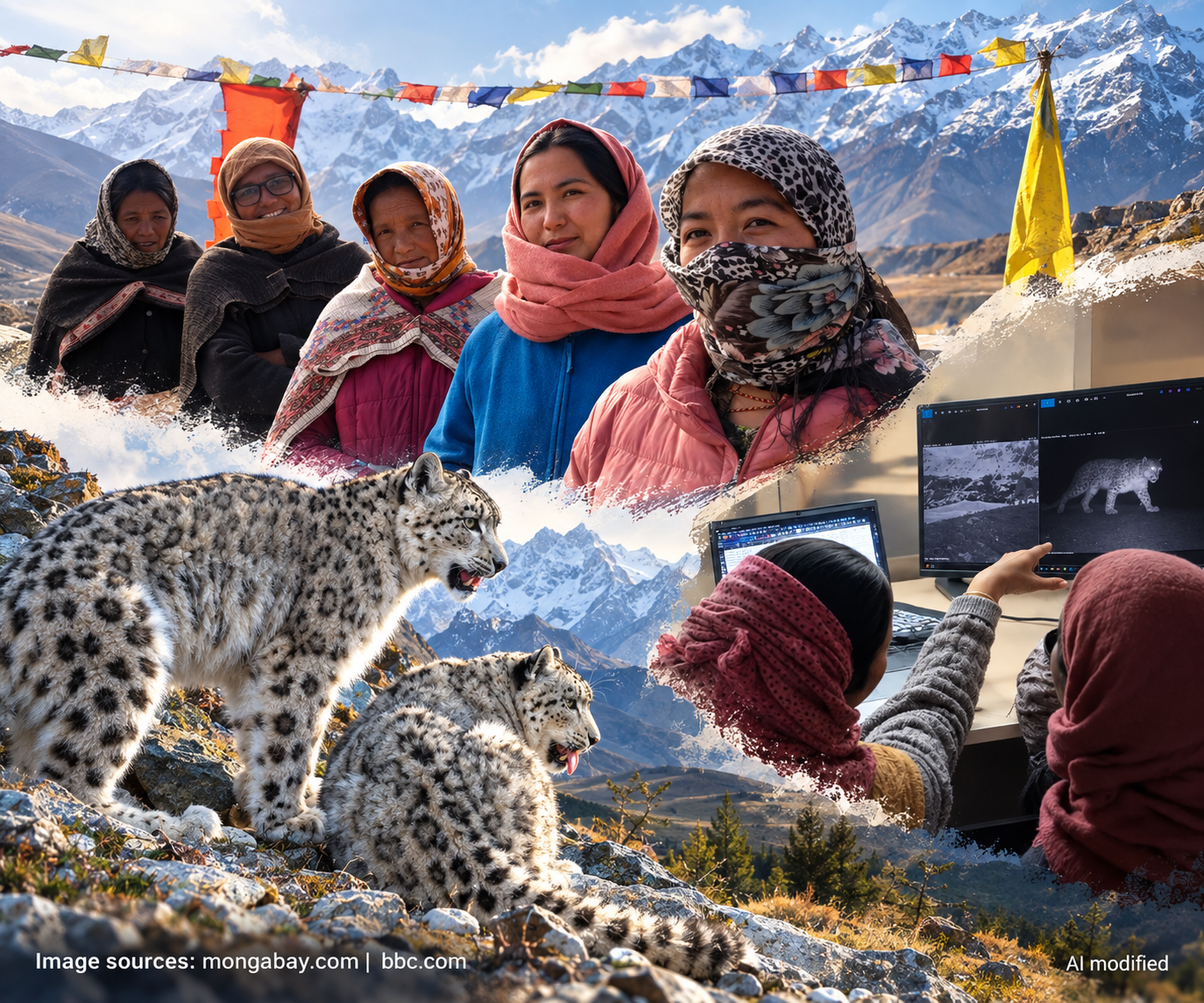
On a high mountain in Himachal Pradesh, a woman who had never touched a computer now helps count snow leopards. Lobzang Yangchen leads an 11-member women’s team from Kibber, a village in Spiti Valley. Together, they sorted camera-trap images for the state’s snow leopard survey. That work helped officials arrive at a number for the first time in years.
Lobzang Yangchen and the Women of Shenmo
Lobzang Yangchen was born in Losar, a village about fifty kilometres from Kibber. As a child, she heard stories about snow leopards taking goats and sheep. “I never saw one,” she told Mongabay India. “We only heard that they came at night, silently, and that herders had to guard their livestock.” Locally, the snow leopard is called “Shen”. So the women named their group “Shenmo”. Yangchen works as a local coordinator for a group supported by the Nature Conservation Foundation, or NCF.
Today, around 50 women from Kibber, Chicham and Demul villages take part. Before this work, they earned mainly from knitting. “Earlier, we depended mainly on knitting. Now we actively participate in snow leopard conservation,” she told Mongabay India. Few of them joined out of love for the animal. “At first, this work on snow leopards didn’t interest us,” she told the BBC. “We joined because we were curious and we could earn a small income.”
How Lobzang Yangchen Learned the Survey Work
She had never touched a computer before she joined the team. “I had seen a computer before but never worked on one,” she told Mongabay India. Training came first. The women began with basic English. Then they learned computer skills. Over time, they learned to tag and process images. They also learned to install and maintain the camera traps themselves. “Now we can tag images, process them and maintain the cameras ourselves,” she said.
Getting there took more than skill. “When we started, I had to take permission from my in-laws to go for the training and to help with fieldwork,” she told Mongabay India. “I am thankful they allowed me.”The work gave them a role that men had usually filled. “Earlier, men used to go and install the cameras and we kept wondering why couldn’t we do it too,” she told the BBC. NCF trained them in camera trapping, monitoring and conservation methods. Programme officer Deep Shikha said this “not only helped protect wildlife but also strengthened them economically.”
Eight Lakh Images and a Statewide Survey
The women’s work fed into a much larger effort. It was Himachal Pradesh’s second state-wide snow leopard survey. The Wildlife Wing of the Forest Department ran it with NCF. Camera traps covered nearly 26,000 square kilometres of habitat. Survey teams identified 44 individual snow leopards from the images. They also documented 43 other species. Volunteers in the villages handled much of the sorting. The team processed more than eight lakh photographs, Mongabay India reported. Counting a snow leopard is not simple.
The cats are shy and live in hard terrain. Camera traps photograph them in passing. Scientists then identify each cat by the rosettes on its coat, which work like fingerprints. The survey estimated 83 snow leopards in the state. The true number likely falls between 67 and 103. That is up from 51 in 2021. The second survey took one year. The first took three. Nationally, India counted 718 snow leopards in its first such assessment, released in January 2024. That is roughly one-sixth of the world’s wild population. Scientists estimate only 3,920 to 6,390 remain. The species has been listed as Vulnerable since 2017.
What Community-Led Conservation Looks Like
Sorting photographs is only part of what the women do. The BBC reports that they install and monitor camera traps on their own. They help villagers apply for government livestock insurance. They also promote predator-proof corrals, stone or mesh pens that protect animals at night. That matters because snow leopards often kill livestock. Herders can lose money and retaliate. Insurance and better pens change that calculation.
Attitudes in the village have shifted too. “People asked why we should protect them if they cause harm,” Yangchen told Mongabay India. “Now they understand that our goats are food for them, and they are also living beings who need food.” She sees the change at home as well. “When I was a child in Losar, we only heard stories about snow leopards,” she said. “Now, because of our efforts, our children can actually see their photographs. This is change.”
The Wise Take
Conservation often asks mountain communities to live with wildlife and little else. Yangchen’s team shows another path. Training gave the women a skill, a role and a small income. In return, the survey gained careful local hands and faster results. The lesson is simple. Protecting a species works better when the people living beside it gain something from the work. Yangchen could not use a computer a few years ago. Now she leads eleven women who help count snow leopards.
Also read our other article on Jayshree Vencatesan: The Chennai Wetland Scientist Who Became the First Indian to Win the Ramsar Award for Wetland Wise Use
Follow The Wise Indian for more stories about the women quietly reshaping conservation in India.



