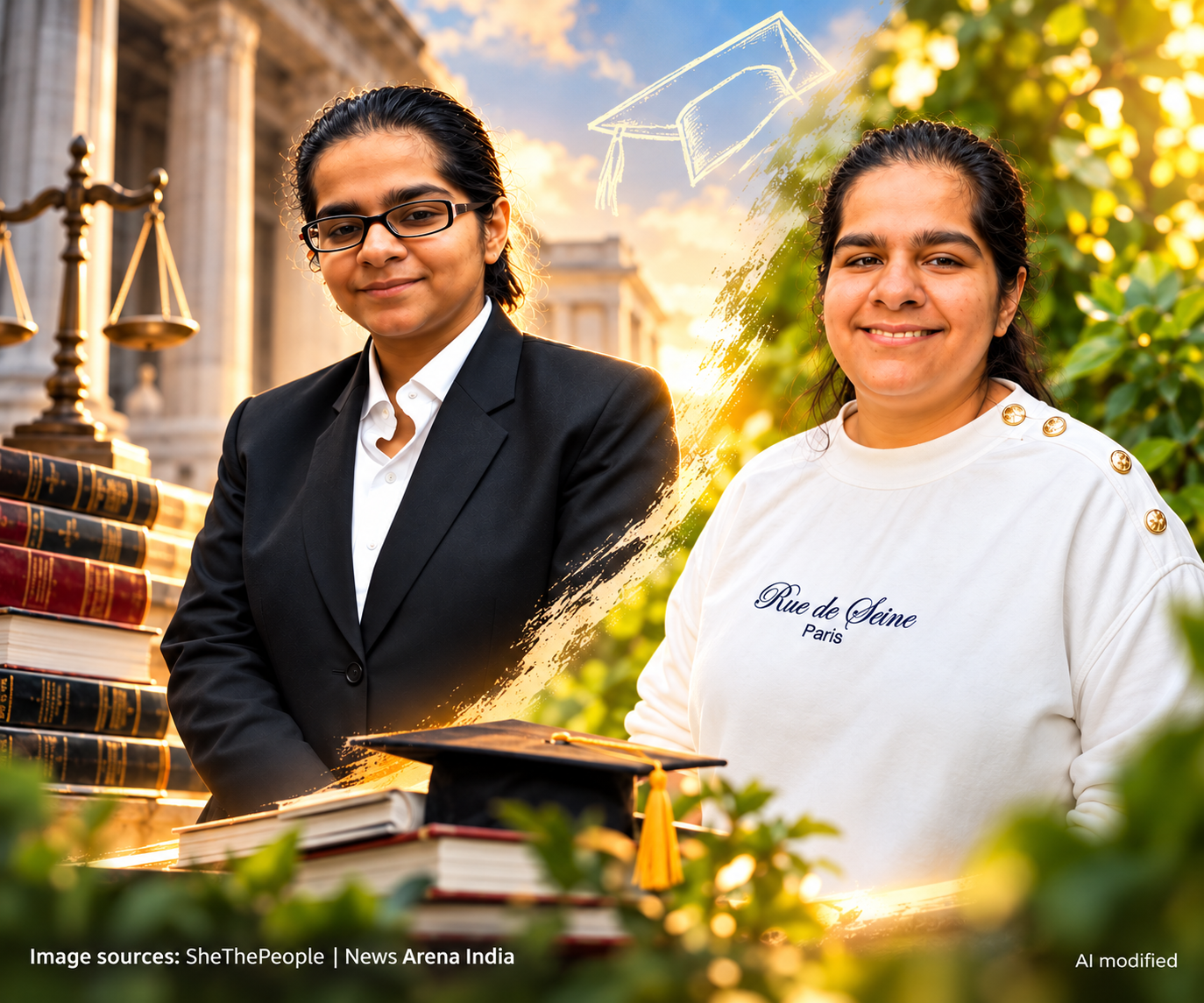
On 6 June 2025, an advocate rose to argue a case before the Supreme Court of India. She appeared before a bench of Justices Sanjay Karol and S. C. Sharma. Her name was Anchal Bhateja. She is blind. According to LiveLaw, she appears to be the first visually impaired woman to argue a matter before India’s highest court.
The case she was arguing made the moment sharper. It was a challenge to the Uttarakhand Judicial Service recruitment rules. Those rules kept candidates with blindness and other benchmark disabilities out of the reserved categories. In plain terms, she stood before the country’s top court to ask why the judiciary kept people like her out.
Anchal Bhateja: The Girl From Bathinda Who Lost Her Sight in School
Anchal Bhateja is from Bathinda, in Punjab. She has low vision from a condition called retinopathy of prematurity. It affects the eyes of some babies born early. Her sight did not stay stable. It worsened over the years, and she lost her eyesight completely before her Class X board examinations. That timing shaped everything that followed.
Class X is when most Indian students begin to plan what they will study and who they might become. Anchal was working all of that out while learning a completely new way of moving through the world. She did not slow down. She finished school, cleared the Common Law Admission Test, and joined the National Law School of India University in Bengaluru. In 2023, she graduated with a B.A. LL.B. (Hons.) degree.
The White Cane She Decided to Carry
For years, Anchal depended on other people to get from one place to another. Then she made a decision that changed her own idea of what her life could look like. She wrote about this in a first-person essay for The Wire’s Livewire. The essay describes 1 November 2018. That was the day she first held a white cane and crossed a campus alone. She called it one of the most inaccessible campuses in India. “The first time that I felt that I could fly in the lifetime up till then, was on November 1, 2018, when I held a white cane and successfully navigated one of the most inaccessible campuses in India,” she wrote.
“My cane did not just enable me to walk, it empowered me to rise and move on. I did not need the elbow, the shoulder or a tie of an escort to walk and fly.” She has also written about the part of disability that is not physical. She quoted a Stoic philosopher on how people suffer more in imagination than in reality. Then she added, “The peculiar characteristic of disability is that a lot of the pain is socially induced.” Her own answer to that is humour. “My journey with my cane made me realise that the best way to live with a disability… was to accept it, to laugh about it and to crack jokes about it.”
What She Says About Access in Indian Courts
Standing up in the Supreme Court was not the end of the road for her. Anchal now works on the system itself. She is a Research Fellow at the Vidhi Centre for Legal Policy. She also consults for Mission Accessibility, which works on disability access. In an interview with Bar & Bench, she argued for building access in from the start. “Accessibility must be seen as a right, not an afterthought,” she said. She has also argued that awareness has to start early, not at the point of hiring.
“Sensitisation cannot happen when someone starts working as a lawyer or a judge; it has to happen at a foundational stage.” She also spoke to the Vidhi Centre for Legal Policy. There, she framed the problem as a circle someone has to break. “Are our courts not accessible because we don’t have lawyers with disabilities, or do we not have lawyers with disabilities because courts are not accessible?” she asked. “We have to start somewhere: we need to integrate universal design in all walks of life, at all courts.”
The Wise Take
Anchal Bhateja did not wait for the system to become accessible before she walked into it. She learned to cross an impossible campus on her own. She finished law school. Then she stood up in the country’s highest court to argue about whose voice counts inside it.
Her story carries a simple lesson. Accessibility is not a favour for a few people. It is the difference between a door being open and a door merely existing. When a courtroom, a website, or a classroom welcomes everyone, more people walk through it. The institution itself grows stronger for it.
Also read our other article on Bhavani Bompelly: The Telangana Teacher Who Turned a Shrinking School Into a Thriving One
Follow The Wise Indian for more stories about the women quietly redrawing the limits around them